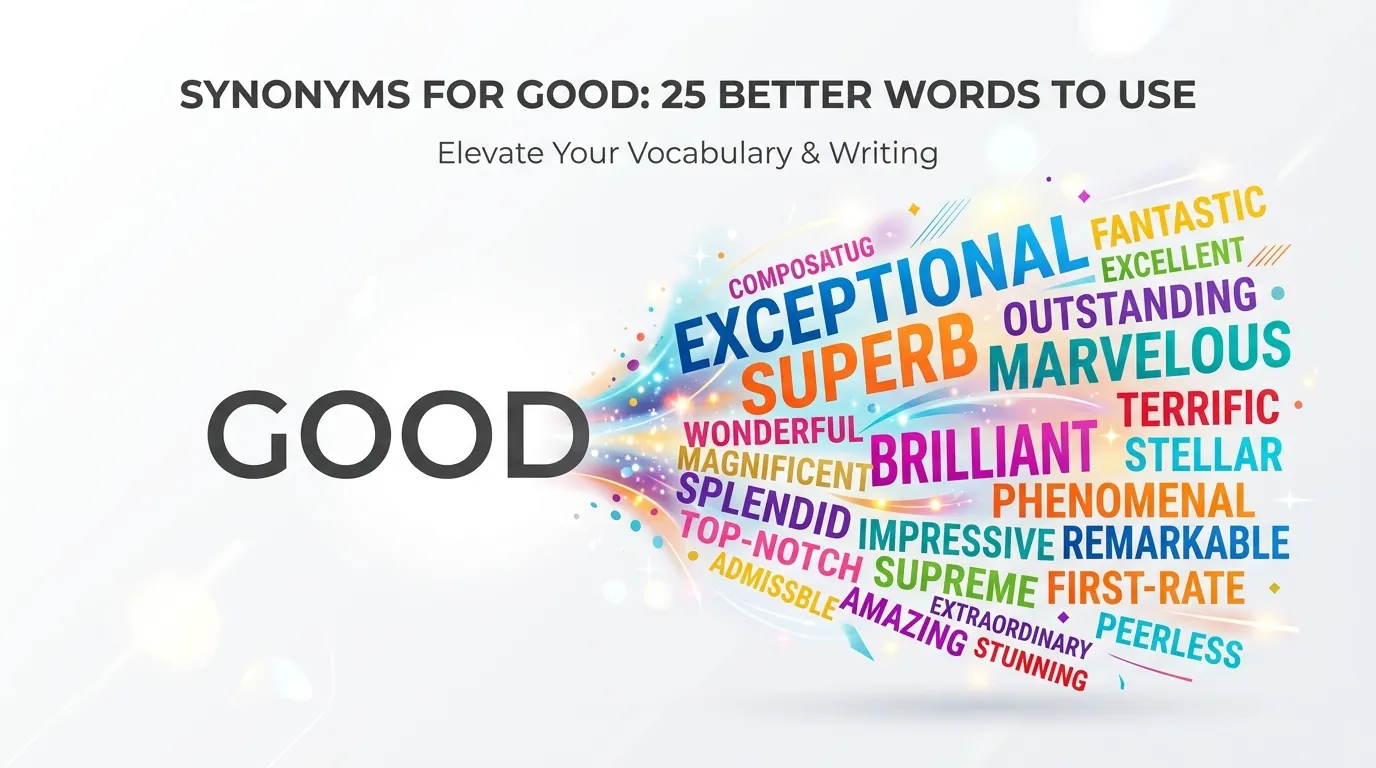
Better words for good include excellent, great, fine, wonderful, positive, useful, kind, decent, admirable, outstanding, superb, effective, pleasant, valuable, worthy, favorable, impressive, remarkable, fantastic, splendid, satisfying, virtuous, respectable, beneficial, and first-rate.
Imagine a student showing a teacher a piece of writing after spending hours working on it. The teacher smiles and says, “This is good.” The student feels happy, but the word does not tell exactly what makes the work good. Perhaps it is excellent, creative, impressive, or simply well-written. This is why learning synonyms for good is useful.
Good is one of the most common words in English, and we use it for people, food, ideas, actions, results, skills, and experiences. However, using the same word again and again can make speech and writing less precise. For English learners and writers, knowing similar words makes it easier to express the exact meaning and tone. This article explains the meaning of good, its history, pronunciation, word formation, 25 useful synonyms, examples, semantic groups, and antonyms.
Meaning of Good
Definition
Good (Adjective):
Good means having a positive quality, being satisfactory, useful, suitable, or morally right.
Examples
- She is a good student who works hard.
- This restaurant serves good food.
Connotative Meaning
Connotation: the feelings or ideas that a word suggests beyond its basic meaning.
- Positive tone: Good usually suggests quality, approval, kindness, success, or value.
- Negative tone: The word itself is not normally negative, although “good” can sound weak when something is actually excellent.
- Neutral tone: It can simply describe something that meets an expected standard.
Etymology
The word good is one of the oldest and most widely used words in English.
- Old English (450–1100): Good came from Old English gōd, meaning good, valuable, suitable, virtuous, or favorable.
- Middle English (1100–1500): It appeared in forms such as good and kept many of its earlier meanings.
- Modern English (1500–Present): The word developed into a very broad term used for quality, morality, usefulness, health, skill, and general approval.
The word is related to similar forms in other Germanic languages, including German gut and Dutch goed.
Pronunciation (IPA)
- IPA: /ɡʊd/
- Syllables: good
Affixation Pattern of Good
- Root: good
- Prefix: None
- Suffix: None
- Word formations:
- good — adjective
- goodness — noun
- goodly — adverb/adjective, mainly literary
- goodhearted — adjective
- goodheartedness — noun
- goodwill — noun
- good-natured — adjective
- goodness — noun
25 Synonyms of Good With Meaning & Examples
1. Excellent (Adjective)
Meaning: Extremely good and of very high quality.
Examples:
- She did an excellent job.
- The hotel provides excellent service.
2. Great (Adjective)
Meaning: Very good, enjoyable, or impressive.
Examples:
- We had a great time at the party.
- He is a great teacher.
3. Fine (Adjective)
Meaning: Good enough or of satisfactory quality.
Examples:
- The food was fine.
- Everything is fine now.
4. Wonderful (Adjective)
Meaning: Very good, pleasant, or enjoyable.
Examples:
- We had a wonderful evening.
- She gave me some wonderful advice.
5. Positive (Adjective)
Meaning: Good, useful, or showing approval and hope.
Examples:
- She has a positive attitude.
- The meeting produced positive results.
6. Useful (Adjective)
Meaning: Helpful or practical for a particular purpose.
Examples:
- This book contains useful information.
- Your advice was very useful.
7. Kind (Adjective)
Meaning: Caring, friendly, and willing to help others.
Examples:
- She is a kind person.
- It was kind of you to help me.
8. Decent (Adjective)
Meaning: Acceptable, respectable, or reasonably good.
Examples:
- He found a decent job.
- The restaurant serves decent food.
9. Admirable (Adjective)
Meaning: Deserving respect or approval.
Examples:
- Her courage is admirable.
- He showed admirable patience.
10. Outstanding (Adjective)
Meaning: Exceptionally good or better than others.
Examples:
- She is an outstanding student.
- The team gave an outstanding performance.
11. Superb (Adjective)
Meaning: Extremely good or excellent.
Examples:
- The chef prepared a superb meal.
- His performance was superb.
12. Effective (Adjective)
Meaning: Successful in producing the desired result.
Examples:
- This method is very effective.
- The teacher used an effective strategy.
13. Pleasant (Adjective)
Meaning: Enjoyable, comfortable, or agreeable.
Examples:
- We had a pleasant conversation.
- The weather was pleasant today.
14. Valuable (Adjective)
Meaning: Useful, important, or worth a lot.
Examples:
- She gave me valuable advice.
- Experience is valuable in this field.
15. Worthy (Adjective)
Meaning: Deserving respect, attention, or approval.
Examples:
- This cause is worthy of support.
- He is a worthy candidate.
16. Favorable (Adjective)
Meaning: Positive, helpful, or likely to produce a good result.
Examples:
- The company received favorable reviews.
- We are waiting for favorable weather.
17. Impressive (Adjective)
Meaning: Causing admiration because of quality or ability.
Examples:
- She gave an impressive speech.
- His progress has been impressive.
18. Remarkable (Adjective)
Meaning: Unusually good, interesting, or noticeable.
Examples:
- She made remarkable progress.
- The scientist achieved a remarkable result.
19. Fantastic (Adjective)
Meaning: Extremely good, exciting, or enjoyable.
Examples:
- We had a fantastic holiday.
- That was a fantastic idea.
20. Splendid (Adjective)
Meaning: Excellent or very impressive.
Examples:
- The garden looks splendid.
- They enjoyed a splendid meal.
21. Satisfying (Adjective)
Meaning: Giving pleasure because a need or expectation has been met.
Examples:
- It was a satisfying meal.
- Finishing the project was satisfying.
22. Virtuous (Adjective)
Meaning: Morally good and guided by strong principles.
Examples:
- She is known as a virtuous person.
- The story teaches children to be virtuous.
23. Respectable (Adjective)
Meaning: Considered good, proper, or worthy of respect.
Examples:
- He earns a respectable salary.
- She has a respectable reputation.
24. Beneficial (Adjective)
Meaning: Producing a useful or positive result.
Examples:
- Exercise is beneficial to the body.
- The change was beneficial for the business.
25. First-rate (Adjective)
Meaning: Of the highest quality.
Examples:
- The school provides first-rate education.
- We received first-rate service.
Prototype Meaning
The most typical meaning of good is having a positive quality or being better than something that is poor, bad, or unacceptable. When people hear good, they often think of something that meets expectations or gives a positive result. A good meal tastes pleasant, a good student performs well, and a good person behaves with kindness and honesty. The exact meaning changes with context, which is why good is such a flexible word in English.
Prototype Categorization
The 25 synonyms of good can be grouped according to the specific meaning they express. This helps writers select a more precise word instead of using good for every situation.
- High quality: excellent, outstanding, superb, fantastic, splendid, first-rate , use these for something that is much better than average.
- General approval: great, fine, wonderful, decent , useful in everyday speech and casual writing.
- Helpfulness and usefulness: useful, effective, valuable, beneficial , best for advice, methods, tools, actions, and results.
- Positive experiences: pleasant, satisfying, wonderful , useful for food, conversations, events, weather, and experiences.
- Moral goodness: kind, admirable, virtuous, worthy, respectable , describe people, behavior, values, or actions.
- Positive results or conditions: positive, favorable, effective, beneficial , suitable for results, situations, decisions, and outcomes.
- Strong impression: impressive, remarkable, outstanding , use these when something deserves special attention or admiration.
Understanding these categories makes your vocabulary more precise and helps you match each synonym to the right situation.
Antonyms of Good
Bad (Adjective)
Meaning: Not good or of poor quality.
Poor (Adjective)
Meaning: Low in quality, ability, or standard.
Evil (Adjective)
Meaning: Morally very wrong or harmful.
Harmful (Adjective)
Meaning: Causing damage or negative effects.
Unpleasant (Adjective)
Meaning: Not enjoyable, comfortable, or agreeable.
Inferior (Adjective)
Meaning: Lower in quality or value than something else.
Useless (Adjective)
Meaning: Having no practical value or purpose.
Unfavorable (Adjective)
Meaning: Negative or unlikely to produce a good result.
Short Questions and Answers
What does good mean?
Good describes something positive, useful, satisfactory, valuable, enjoyable, or morally right.
When should good be used?
Use good when you want to describe a positive quality in a person, thing, action, experience, result, or situation.
Is good positive or negative?
Good is normally a positive word. It shows approval or describes something as satisfactory or desirable.
How is it different from similar words?
Good is a broad and flexible word. Excellent means extremely good, kind focuses on behavior toward others, useful focuses on practical value, and effective focuses on producing a desired result.
Conclusion
Learning synonyms for good gives you more choices when speaking and writing in English. Instead of repeating good in every sentence, you can use excellent for very high quality, kind for caring behavior, effective for successful methods, beneficial for positive effects, or outstanding for something that is better than most.
Each synonym adds a slightly different meaning to your sentence. A strong vocabulary helps you communicate your ideas with greater accuracy and confidence. You do not need to memorize all 25 words in one day. Start with a few common alternatives and practice using them in your own sentences. With regular reading, writing, and speaking practice, choosing the right word will become easier and more natural.

Author Bio
I am Sajjad Ali, an English language writer specializing in synonyms, word meanings, and practical English usage.
I use my expertise in English vocabulary and word choice to create simple, accurate, and helpful content for learners and readers.