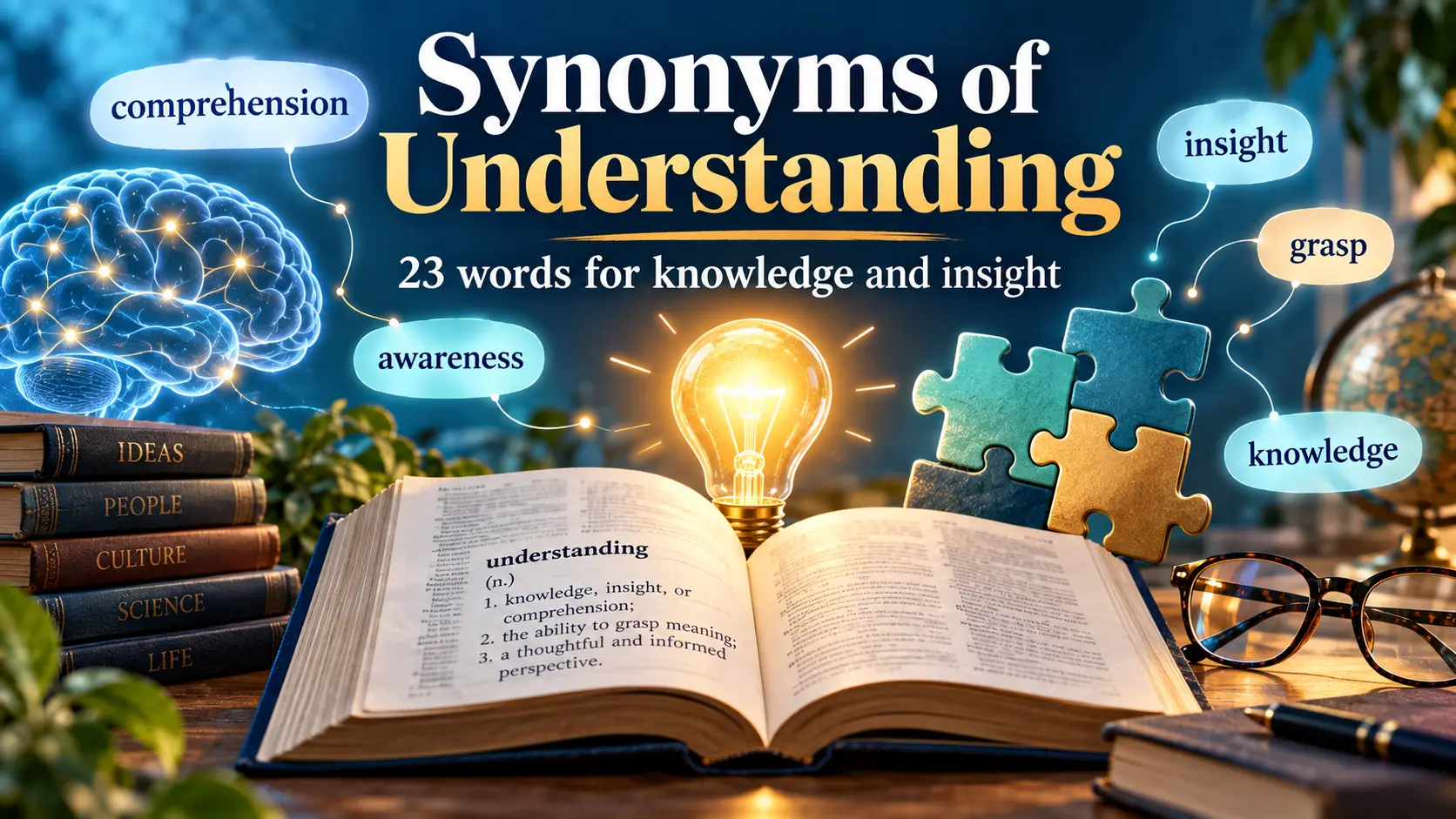
Maya is new at school and does not speak much English yet. Her classmate Leo sits with her, speaks slowly, and points at pictures. Maya smiles. Leo is understanding, and slowly, Maya gains an understanding of her new class. That is the word in action. It means knowing how something works, or being kind and patient with others. People use it at school, at work, in families, and in agreements.
✓ Synonyms help English learners grow their vocabulary.
✓ Synonyms help content writers stay clear and avoid repetition.
✓ This article covers meaning, grammar, history, pronunciation, and word groups.
✓ You will also learn 32 synonyms, each with examples.
Let us begin.
Meaning of Understanding
Definition
Understanding (Noun / Adjective): As a noun: knowing what something means or how it works; also, an agreement. As an adjective: kind, patient, and willing to accept others’ feelings.
Examples
- She has a strong understanding of math.
- My boss was very understanding when my son was sick.
Connotative Meaning
The feeling of understanding changes with context.
- Positive tone: Warm and caring when describing people. “He is an understanding friend.”
- Negative tone: It can point out a gap. “There is a lack of understanding between them.”
- Neutral tone: Plain when describing knowledge or deals. “We reached an understanding on the price.”
(Connotation: the feeling or emotion a word carries beyond its dictionary meaning.)
Etymology
Understanding is a native English word. It joins under and stand. Experts think under once meant “among” or “between,” so to understand was to “stand among” an idea and see it clearly.
- Old English (450–1100): Understandan meant “to grasp the meaning of,” and the noun understandung meant “comprehension.”
- Middle English (1100–1500): Understonding meant “intelligence” and “the power to think.” It was common in religious and learned writing.
- Modern English (1500–Present): Understanding kept its meaning of “knowledge” and added “sympathy” and “agreement.” The adjective sense, “kind and patient,” became common in the 1800s.
Pronunciation (IPA)
- IPA: /ˌʌndərˈstændɪŋ/ (US), /ˌʌndəˈstændɪŋ/ (UK)
- Syllables: un·der·stand·ing (four syllables, main stress on the third)
Affixation Pattern of Understanding
- Root: stand
- Prefix: under- (among, between)
- Suffix: -ing (forms a noun or adjective)
- Word formations:
- understand (verb)
- understood (verb, past tense and participle)
- understandable (adjective)
- understandably (adverb)
- understandingly (adverb)
- misunderstand (verb)
- misunderstanding (noun)
32 Synonyms of Understanding With Meaning & Examples
1. Comprehension (Noun)
Meaning: The ability to understand something.
Examples:
- The test checks reading comprehension.
- His comprehension of French is good.
2. Grasp (Noun)
Meaning: A firm understanding of something.
Examples:
- She has a good grasp of history.
- His grasp of the rules is weak.
3. Knowledge (Noun)
Meaning: Facts and information a person knows.
Examples:
- He has knowledge of plants.
- Knowledge grows with reading.
4. Awareness (Noun)
Meaning: Knowing that something exists or is true.
Examples:
- We need more awareness of safety.
- Her awareness of the problem helped.
5. Insight (Noun)
Meaning: A deep and clear understanding.
Examples:
- The book gives insight into space.
- She has great insight into people.
6. Perception (Noun)
Meaning: The way someone sees or understands something.
Examples:
- His perception of the event was different.
- Good perception helps artists.
7. Apprehension (Noun)
Meaning: Understanding or grasp (formal; also means worry).
Examples:
- He had little apprehension of the danger.
- Her apprehension of the facts was clear.
8. Cognition (Noun)
Meaning: The mental process of knowing and thinking.
Examples:
- Sleep helps cognition.
- The study looks at cognition in kids.
9. Intelligence (Noun)
Meaning: The ability to learn and understand.
Examples:
- The puzzle tests your intelligence.
- Dolphins show high intelligence.
10. Intellect (Noun)
Meaning: The power of the mind to think and reason.
Examples:
- She has a sharp intellect.
- Books feed the intellect.
11. Wisdom (Noun)
Meaning: Good judgment from knowledge and experience.
Examples:
- Grandpa shared his wisdom.
- It takes wisdom to stay calm.
12. Discernment (Noun)
Meaning: The ability to judge well.
Examples:
- Choose friends with discernment.
- He shows discernment in art.
13. Judgment (Noun)
Meaning: The ability to decide wisely.
Examples:
- Trust your judgment.
- She showed good judgment.
14. Know-how (Noun)
Meaning: Practical skill and knowledge.
Examples:
- He has the know-how to fix cars.
- Baking takes know-how.
15. Expertise (Noun)
Meaning: Expert skill or knowledge.
Examples:
- We need her tech expertise.
- His expertise is in law.
16. Mastery (Noun)
Meaning: Complete skill in something.
Examples:
- She has mastery of the piano.
- Mastery takes practice.
17. Familiarity (Noun)
Meaning: Good knowledge from experience.
Examples:
- His familiarity with the city helped.
- She has familiarity with the software.
18. Realization (Noun)
Meaning: The moment you understand something.
Examples:
- The realization hit him at once.
- Her realization came too late.
19. Interpretation (Noun)
Meaning: A way of explaining a meaning.
Examples:
- Each student had an interpretation of the poem.
- His interpretation was clever.
20. Empathy (Noun)
Meaning: Feeling and sharing another person’s feelings.
Examples:
- The nurse showed empathy.
- Empathy makes us kinder.
21. Sympathy (Noun)
Meaning: Care and sorrow for someone’s trouble.
Examples:
- We sent our sympathy to the family.
- She felt sympathy for the lost dog.
22. Compassion (Noun)
Meaning: Deep care and wish to help others.
Examples:
- He treats patients with compassion.
- Compassion can change lives.
23. Tolerance (Noun)
Meaning: Accepting views or ways different from yours.
Examples:
- Tolerance helps teams work well.
- Schools teach tolerance.
24. Patience (Noun)
Meaning: Staying calm and waiting without anger.
Examples:
- Teachers need patience.
- Thank you for your patience.
25. Agreement (Noun)
Meaning: A shared decision between people.
Examples:
- They reached an agreement.
- The agreement is in writing.
26. Arrangement (Noun)
Meaning: A plan agreed on by people.
Examples:
- We have an arrangement to share rides.
- The arrangement suits us both.
27. Accord (Noun)
Meaning: Formal agreement or harmony.
Examples:
- The two nations signed an accord.
- They acted in accord.
28. Consensus (Noun)
Meaning: General agreement among a group.
Examples:
- The team reached a consensus.
- There is no consensus yet.
29. Rapport (Noun)
Meaning: A friendly, understanding relationship.
Examples:
- She built rapport with her students.
- Good rapport makes work easier.
30. Compassionate (Adjective)
Meaning: Showing care for others’ pain.
Examples:
- She is a compassionate doctor.
- He gave a compassionate reply.
31. Considerate (Adjective)
Meaning: Thinking of others’ needs.
Examples:
- It was considerate to call first.
- He is a considerate neighbor.
32. Sympathetic (Adjective)
Meaning: Showing care and understanding.
Examples:
- My teacher was sympathetic.
- They were sympathetic to our needs.
Prototype Meaning
When people hear understanding, they usually picture a light bulb moment, when an idea finally makes sense. A second strong image is a kind person who listens without judging. The core idea is connection: between a mind and an idea, or between two people.
Prototype Categorization
The 32 synonyms fall into five groups:
- Mental grasp (comprehension, grasp, knowledge, awareness, perception, apprehension, cognition, realization, interpretation): Use these for how the mind takes in ideas.
- Deep thinking and judgment (insight, intelligence, intellect, wisdom, discernment, judgment): Use these for smart, careful thinking.
- Skill and experience (know-how, expertise, mastery, familiarity): Use these for practical, hands-on knowledge.
- Kindness toward others (empathy, sympathy, compassion, tolerance, patience, rapport, compassionate, considerate, sympathetic): Use these for warm, caring understanding.
- Agreements (agreement, arrangement, accord, consensus): Use these when understanding means a shared deal.
This grouping helps writers avoid mix-ups. A résumé needs expertise. A sympathy card needs compassion. A business report needs consensus. Pick the group that matches your meaning, then choose the best word.
Antonyms of Understanding
Ignorance (Noun)
- A lack of knowledge.
Confusion (Noun)
- Not being able to think clearly.
Misunderstanding (Noun)
- A failure to understand correctly.
Intolerance (Noun)
- Unwillingness to accept differences.
Disagreement (Noun)
- A lack of agreement.
Unsympathetic (Adjective)
- Not showing care for others.
Harsh (Adjective)
- Unkind and severe.
Short Questions and Answers
What does understanding mean?
As a noun, it means knowing how something works, or an agreement. As an adjective, it means kind and patient.
When should understanding be used?
Use it for knowledge (“an understanding of science”), kindness (“an understanding teacher”), or deals (“we have an understanding”).
Is understanding positive or negative?
It is usually positive. It becomes negative only with words like “lack of” or “no.”
How is it different from similar words?
Knowledge is about facts. Empathy is about feelings. Agreement is about deals. Understanding can mean all three, so context matters.
Conclusion
True understanding joins the mind and the heart. Learning this word and its 32 synonyms grows your vocabulary in both areas: knowledge and kindness.
You can say expertise in a job letter, empathy in a kind note, and consensus in a meeting. This strengthens your writing and speaking. It also helps you avoid repeating the same word again and again. Every good choice builds your confidence in English.
Keep learning with synonyms for explained, because clear explanations build understanding. You can also read synonyms for beliefs to understand what people hold true, and categories synonyms to organize what you know.
Make vocabulary a daily habit. Each day, choose one synonym and use it in a real sentence, spoken or written. Understanding grows one word at a time.

Dshaikh
Founder & Editorial Director
I’m the founder and editorial director of this vocabulary series. I’ve spent over 35 years in pharmaceutical and healthcare marketing across Pakistan, the UAE, and the USA, where I launched 200+ brands and earned two Guinness World Records. That work taught me one lesson again and again: the right word builds trust, and the wrong one loses it. I set the plain-English standard for every guide here, so you can use new words the same day you learn them.