Mover: “What is in this box, ma’am?”
Lena: “My grandmother’s glass vase. Please be careful. It is very fragile.”
Mover: “Got it. I’ll put a big red sticker on it.”
Fragile means easy to break or hurt. We see it on boxes, but we also use it for people, feelings, peace, and health. That is why it is such a common word.
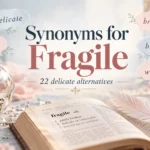
Still, one word cannot show every shade of weakness. Is the thing thin? Weak? Sensitive? Learning synonyms helps English learners and content writers be exact and avoid repetition. This article explains the meaning of fragile and shares 24 synonyms with examples. You will also learn its grammar, history, pronunciation, and meaning groups.
Meaning of Fragile
Definition
Fragile (Adjective): Easily broken, damaged, or hurt; not strong.
Examples
- Handle the fragile plates with care.
- After the long illness, his health was fragile.
Connotative Meaning
The feeling of fragile changes with context.
- Positive tone: It can sound tender and precious. “A fragile flower bloomed in the snow.”
- Negative tone: It can suggest weakness or risk. “The team’s confidence is fragile.”
- Neutral tone: On labels and in science, it just gives a fact. “Fragile: handle with care.”
(Connotation: the feeling or emotion a word carries beyond its dictionary meaning.)
Etymology
Fragile comes from the Latin fragilis, meaning “easily broken.” It grows from frangere, “to break.” The same root gives us fracture and fragment.
- Old English (450–1100): The word did not exist yet. Speakers used native Germanic words for “weak” and “breakable” instead.
- Middle English (1100–1500): The word frail came first, around 1300, through Old French fraile. It shares the same Latin root.
- Modern English (1500–Present): In the early 1500s, fragile came in from French. At first it meant “morally weak.” By the 1560s, it meant “easily broken,” the main sense today.
Pronunciation (IPA)
- IPA: /ˈfrædʒaɪl/ (UK), /ˈfrædʒəl/ (US)
- Syllables: frag·ile (two syllables, stress on the first)
Affixation Pattern of Fragile
- Root: frag, from Latin frangere (to break)
- Prefix: None
- Suffix: -ile (able to be; tending to)
- Word formations:
- fragility (noun)
- fragileness (noun)
- fragilely (adverb, rare)
- fragment (noun and verb, same root)
- fracture (noun and verb, same root)
- fraction (noun, same root)
24 Synonyms for Fragile With Meaning & Examples
1. Breakable (Adjective)
Meaning: Able to be broken easily.
Examples:
- Keep breakable toys away from the baby.
- The box holds breakable dishes.
2. Delicate (Adjective)
Meaning: Fine, soft, and easily damaged.
Examples:
- She wore a delicate silk scarf.
- The bird has delicate wings.
3. Brittle (Adjective)
Meaning: Hard but easy to snap.
Examples:
- Old leaves become brittle.
- The candy is thin and brittle.
4. Frail (Adjective)
Meaning: Weak, especially in body.
Examples:
- The frail old man used a cane.
- Her voice was frail.
5. Flimsy (Adjective)
Meaning: Thin and poorly made.
Examples:
- The flimsy tent blew away.
- That is a flimsy excuse.
6. Weak (Adjective)
Meaning: Lacking strength.
Examples:
- The bridge is too weak for trucks.
- He felt weak after the flu.
7. Feeble (Adjective)
Meaning: Very weak and without energy.
Examples:
- The kitten gave a feeble cry.
- He made a feeble attempt.
8. Dainty (Adjective)
Meaning: Small, pretty, and delicate.
Examples:
- She has dainty hands.
- They served dainty cakes.
9. Fine (Adjective)
Meaning: Very thin or light.
Examples:
- Her hair is fine and soft.
- The spider spun a fine thread.
10. Thin (Adjective)
Meaning: Narrow or not thick.
Examples:
- Be careful on the thin ice.
- The walls are thin.
11. Crumbly (Adjective)
Meaning: Breaking easily into small bits.
Examples:
- The cookie was crumbly.
- The old wall was crumbly.
12. Shatterable (Adjective)
Meaning: Able to break into many pieces.
Examples:
- Use plastic, not shatterable glass.
- The screen is shatterable.
13. Rickety (Adjective)
Meaning: Shaky and likely to fall apart.
Examples:
- We sat on a rickety chair.
- The rickety bridge swayed.
14. Shaky (Adjective)
Meaning: Unsteady and not firm.
Examples:
- The table is shaky.
- Their plan looks shaky.
15. Unstable (Adjective)
Meaning: Likely to change or fall.
Examples:
- The ladder is unstable.
- The weather is unstable.
16. Precarious (Adjective)
Meaning: Not secure; in danger of falling.
Examples:
- The vase sat in a precarious spot.
- He is in a precarious job.
17. Tenuous (Adjective)
Meaning: Very weak or slight.
Examples:
- They have a tenuous link.
- The peace is tenuous.
18. Vulnerable (Adjective)
Meaning: Easily hurt or attacked.
Examples:
- Young kids are vulnerable to colds.
- She felt vulnerable at night.
19. Sensitive (Adjective)
Meaning: Easily affected or upset.
Examples:
- He has sensitive skin.
- She is sensitive about her grades.
20. Tender (Adjective)
Meaning: Soft, gentle, or easily hurt.
Examples:
- My knee is still tender.
- It was a tender moment.
21. Susceptible (Adjective)
Meaning: Easily affected by something.
Examples:
- Plants are susceptible to frost.
- He is susceptible to flu.
22. Infirm (Adjective)
Meaning: Weak from age or illness.
Examples:
- They care for the infirm.
- Her infirm aunt stays inside.
23. Sickly (Adjective)
Meaning: Often ill; not healthy.
Examples:
- He was a sickly child.
- The plant looked sickly.
24. Insubstantial (Adjective)
Meaning: Lacking strength or solid form.
Examples:
- The report had insubstantial proof.
- The fog felt insubstantial.
Prototype Meaning
When people hear fragile, they usually picture glass or china wrapped in paper with a “Handle With Care” label. The typical image is an object that could break with one small drop. From there, the idea spreads to weak bodies, soft feelings, and shaky situations.
Prototype Categorization
The 24 synonyms fall into four groups:
- Easy to break (objects) (breakable, brittle, flimsy, crumbly, shatterable, thin, fine): Use these for glass, paper, food, and poorly made things.
- Soft and pretty (delicate, dainty, tender): Use these for gentle beauty, like lace or flowers.
- Weak in body or health (frail, weak, feeble, infirm, sickly): Use these for people or animals with low strength.
- Unsteady or at risk (rickety, shaky, unstable, precarious, tenuous, insubstantial, vulnerable, sensitive, susceptible): Use these for situations, feelings, links, and risks.
These groups help writers pick the right image. A brittle cookie snaps; a delicate flower is lovely; a precarious job is risky. Choosing by group keeps meaning clear and tone correct.
Antonyms of Fragile
Sturdy (Adjective)
- Strong and well built.
Strong (Adjective)
- Having great power or strength.
Durable (Adjective)
- Able to last a long time.
Robust (Adjective)
- Strong and healthy.
Tough (Adjective)
- Hard to break or damage.
Unbreakable (Adjective)
- Not able to be broken.
Resilient (Adjective)
- Able to recover quickly.
Short Questions and Answers
What does fragile mean?
It means easy to break, damage, or hurt.
When should fragile be used?
Use it for breakable objects, weak health, hurt feelings, or unsteady situations like a fragile peace.
Is fragile positive or negative?
It depends. It can feel tender and precious, or it can warn about weakness and risk.
How is it different from similar words?
Brittle means hard but snappy. Frail is mostly about the body. Delicate adds beauty. Vulnerable is about being open to harm. Fragile covers all of these.
Conclusion
Some things need gentle hands, and some ideas need gentle words. Learning fragile and its 24 synonyms helps you describe weakness with care and clarity. Your vocabulary becomes richer and more exact.
Now you can choose brittle for a cracker, frail for a patient, or tenuous for a weak link. This strengthens your writing and speaking. It also helps you avoid repeating the same word. Every precise choice adds to your English confidence.
Keep growing your vocabulary with synonyms for cheap for low-quality goods, synonyms for messed up for things that got broken, and synonyms for beliefs to talk about ideas people hold close, even when they feel fragile.
Practice a little every day. Look around your home, find three things that could break, and describe each with a different synonym.

Dshaikh
Founder & Editorial Director
I’m the founder and editorial director of this vocabulary series. I’ve spent over 35 years in pharmaceutical and healthcare marketing across Pakistan, the UAE, and the USA, where I launched 200+ brands and earned two Guinness World Records. That work taught me one lesson again and again: the right word builds trust, and the wrong one loses it. I set the plain-English standard for every guide here, so you can use new words the same day you learn them.