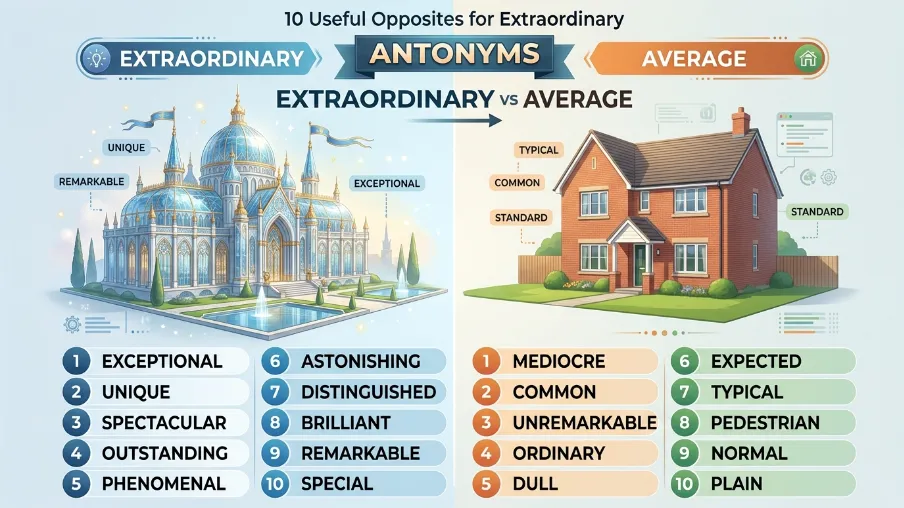
The most common opposite of extraordinary is ordinary. It describes something normal, usual, or not special. Depending on context, other antonyms include commonplace, typical, average, unremarkable, mundane, and mediocre when extraordinary refers specifically to exceptional quality or performance.
Quick Answer
Ordinary is the strongest and most natural antonym of extraordinary.
- Extraordinary = unusually impressive, remarkable, or beyond what is normal.
- Ordinary = normal, usual, or not especially remarkable.
However, the best opposite depends on what extraordinary means in a particular sentence. For example, typical works when the contrast is about what is normal, while unremarkable works when the contrast is about something not attracting attention.
Quick Comparison
| Word | Meaning | Example |
| Extraordinary | Very unusual or impressive | She showed extraordinary talent. |
| Ordinary | Normal or not unusual | It was an ordinary day. |
| Typical | Normal for a particular person, group, or situation | This is a typical school day. |
| Commonplace | Very common and not unusual | Smartphones are commonplace today. |
| Unremarkable | Not unusual or worthy of special attention | He had an unremarkable career. |
| Mundane | Ordinary and often lacking excitement | He was tired of his mundane routine. |
| Average | Around the usual or expected level | His performance was average. |
One-Line Definition
Extraordinary: Very unusual, remarkable, or far beyond what is normally expected.
Main antonym — Ordinary: Normal, usual, or not particularly special.
What Are the Main Antonyms of Extraordinary?
The most useful opposites are:
- Ordinary — normal and not unusual.
- Typical — representative of what is normally expected.
- Commonplace — common and therefore not unusual.
- Unremarkable — not especially noticeable or impressive.
- Mundane — ordinary and often lacking excitement.
- Average — typical in quality, ability, size, or performance.
- Routine — usual and repeated in a regular way.
- Normal — within the usual range or standard.
- Conventional — following ordinary or established patterns.
- Mediocre — only average in quality; useful when extraordinary means exceptionally good.
Not all of these are interchangeable. The correct choice depends on the meaning and context.
1. Ordinary
Ordinary is the clearest and most direct antonym of extraordinary.
It describes something that is normal, usual, or not especially different.
Example:
It looked like an ordinary house from the outside.
Extraordinary: She has extraordinary musical ability.
Ordinary: She has ordinary musical ability.
Use ordinary when you simply want to contrast something exceptional with something normal.
2. Typical
Typical means characteristic of what normally happens or what is expected.
It is especially useful when extraordinary contrasts with something that follows a normal pattern.
Example:
The weather was typical for this time of year.
Compare:
- Extraordinary: The team achieved an extraordinary result.
- Typical: The team achieved a typical result.
Unlike ordinary, typical often suggests that something represents the usual pattern.
3. Commonplace
Commonplace means common, familiar, or not unusual.
It works particularly well when extraordinary means rare or unusual.
Example:
Once considered extraordinary, smartphones are now commonplace.
This word is stronger than simply saying something is ordinary because it emphasizes that the thing is widely seen or experienced.
4. Unremarkable
Unremarkable means not unusual, impressive, or worthy of special attention.
It is a useful opposite when extraordinary means remarkable or noteworthy.
Example:
The building looked unremarkable from the outside.
This word does not necessarily mean bad. Something can be perfectly acceptable while still being unremarkable.
5. Mundane
Mundane describes something ordinary, routine, and often lacking excitement or interest.
Example:
After years of exciting travel, he found office work rather mundane.
The important distinction is that mundane can carry a mildly negative feeling. Ordinary is usually more neutral.
6. Average
Average means typical or around the middle level of quality, ability, size, or performance.
It is a good antonym when extraordinary refers to unusually high ability or performance.
Example:
Her test score was average rather than extraordinary.
However, average is not always a direct antonym. If extraordinary means simply “unusual,” then average may not be the best choice.
7. Routine
Routine refers to something regularly done or happening in the usual way.
Example:
The inspection was a routine procedure, not an extraordinary event.
This is particularly useful when the contrast concerns an event, activity, or procedure.
8. Normal
Normal means usual, expected, or within the ordinary range.
Example:
His recovery was normal and did not require special treatment.
Normal is a broad everyday opposite, but ordinary is often more natural when describing something as not special or remarkable.
9. Conventional
Conventional means following established, traditional, or commonly accepted ways of doing things.
Example:
She chose a conventional approach instead of an extraordinary one.
This word is most appropriate when extraordinary describes an unusual or unconventional method, idea, or approach.
10. Mediocre
Mediocre means only average or of moderate quality, especially when something could have been much better.
Example:
The restaurant received mediocre reviews despite its extraordinary reputation.
Be careful with this antonym. Mediocre is not a general opposite of extraordinary. It works mainly when extraordinary means exceptionally good or excellent.
Context Matters: Which Antonym Should You Use?
There is no single replacement for extraordinary in every sentence.
When extraordinary means “very unusual”
Use:
- ordinary
- normal
- typical
- commonplace
- routine
Example:
The event was extraordinary.
Possible contrast:
The event was ordinary.
When extraordinary means “remarkably impressive”
Use:
- ordinary
- unremarkable
- average
- mediocre
Example:
She gave an extraordinary performance.
A suitable contrast might be:
She gave an average performance.
Or, if the performance was specifically disappointing:
She gave a mediocre performance.
When extraordinary means “exciting or unusual”
Use:
- mundane
- routine
- ordinary
- unremarkable
Example:
He wanted an extraordinary life.
Contrast:
He was tired of his mundane routine.
Extraordinary vs. Ordinary
The simplest way to understand the relationship is:
Extraordinary → beyond what is usual
Ordinary → within what is usual
Consider these examples:
- She has an extraordinary talent. → She has a normal level of talent.
- It was an extraordinary experience. → It was an ordinary experience.
- He made an extraordinary effort. → He made an ordinary effort.
- The discovery was extraordinary. → The discovery was unremarkable.
The correct antonym changes slightly according to the intended contrast.
Example Sentences
Here are natural examples showing how different antonyms work:
- Ordinary: It started as an ordinary Monday morning.
- Typical: His reaction was typical of someone in that situation.
- Commonplace: Online shopping has become commonplace.
- Unremarkable: The hotel was clean but otherwise unremarkable.
- Mundane: She wanted to escape her mundane daily routine.
- Average: His performance was average compared with the other students.
- Routine: The doctor described the procedure as routine.
- Normal: Everything returned to normal after the storm.
- Conventional: They rejected the conventional solution.
- Mediocre: The film received mediocre reviews.
Grammar and Word Class
Extraordinary is an adjective.
Most of its common antonyms are also adjectives:
- extraordinary → ordinary
- extraordinary → typical
- extraordinary → commonplace
- extraordinary → unremarkable
- extraordinary → mundane
- extraordinary → average
- extraordinary → normal
- extraordinary → conventional
- extraordinary → mediocre
This makes them grammatically easy to compare in sentences.
For example:
She had an extraordinary experience.
can become:
She had an ordinary experience.
However, context determines which adjective sounds most natural.
Common Mistakes
Mistake 1: Treating “mediocre” as the universal antonym
❌ The opposite of extraordinary is always mediocre.
✅ Ordinary is the general opposite; mediocre is appropriate when extraordinary means exceptionally high in quality.
Mistake 2: Assuming “average” always means ordinary
Average specifically suggests a middle or typical level.
For example:
His height is average.
This does not necessarily mean his height is unremarkable in every sense.
Mistake 3: Using “mundane” when you only mean normal
Mundane can suggest boredom or lack of excitement.
It was an ordinary day.
is neutral, while:
It was a mundane day.
can suggest that the day was dull.
Expert Tip
Choose the antonym according to the specific quality that makes something extraordinary. If it is extraordinary because it is unusual, choose ordinary, typical, or commonplace. If it is extraordinary because it is impressive, average, unremarkable, or mediocre may be more appropriate.
Mini Practice
Choose the best antonym:
1. The scientist made an extraordinary discovery.
A. Routine
B. Ordinary
C. Both A and B may work depending on the intended meaning
Answer: C.
Ordinary contrasts with something unusual or remarkable, while routine would work better if the intended contrast is with a normal, expected procedure.
2. She gave an extraordinary performance.
A. Mediocre
B. Typical
C. Commonplace
Answer: A.
Mediocre is appropriate when extraordinary means exceptionally impressive or excellent.
Short Questions & Answers
What is the opposite of extraordinary?
The most common opposite of extraordinary is ordinary, meaning normal, usual, or not especially remarkable. Depending on context, typical, commonplace, unremarkable, mundane, average, or normal may also work.
What is a stronger opposite of extraordinary?
There is no single stronger antonym in every context. Unremarkable strongly contrasts with extraordinary when the meaning is “not worthy of special attention,” while mediocre can provide a stronger negative contrast when extraordinary means exceptionally good.
Can ordinary always replace extraordinary?
No. Ordinary is the general opposite, but another word may be more precise. For example, mundane emphasizes dullness, typical emphasizes what is expected, and mediocre emphasizes average quality.
What is the difference between extraordinary and ordinary?
Extraordinary describes something unusually remarkable, impressive, or outside the normal range. Ordinary describes something normal, usual, or not particularly special.
Is mediocre a true antonym of extraordinary?
Mediocre can be an antonym when extraordinary means exceptionally good or impressive, but it is not a universal antonym. Ordinary is the safer general opposite.
Key Takeaways
The best general antonym for extraordinary is ordinary. Other choices become more useful when you want to express a specific contrast:
- Ordinary → normal or not special
- Typical → what is normally expected
- Commonplace → common and not unusual
- Unremarkable → not noteworthy
- Mundane → ordinary and often dull
- Average → around the normal or middle level
- Routine → regularly occurring or expected
- Mediocre → only average in quality
The key is to match the antonym to the meaning of extraordinary in the sentence, rather than treating every opposite as interchangeable.

Author Bio
I am Sajjad Ali, an English language writer specializing in synonyms, word meanings, and practical English usage.
I use my expertise in English vocabulary and word choice to create simple, accurate, and helpful content for learners and readers.