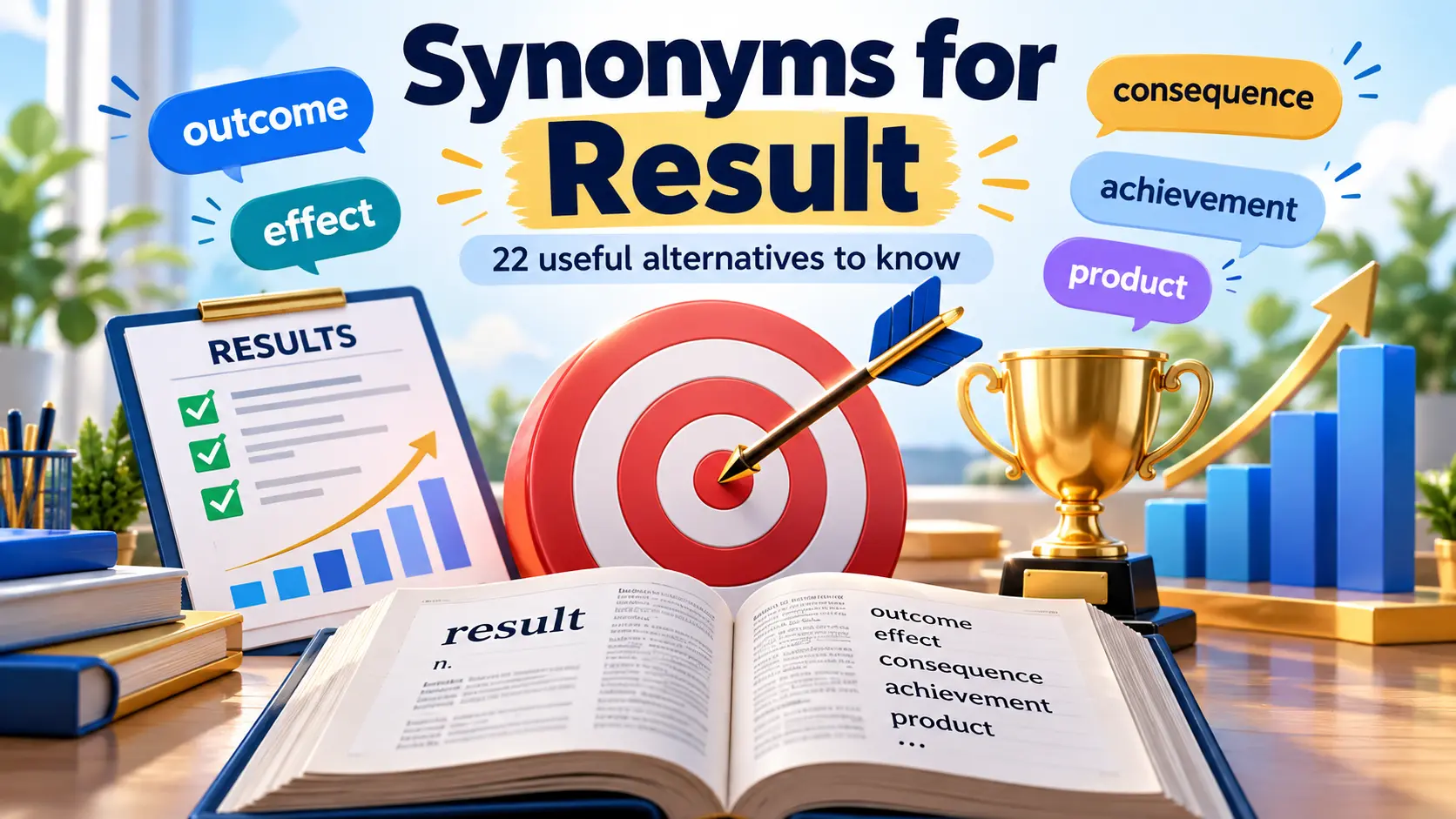
A result is what happens because of something else. Think of these everyday moments:
- At school: You study hard. The result is an A on your test.
- In the kitchen: You forget the cake in the oven. The result is smoke!
- At the doctor: You take a blood test. You wait for the results.
We use result all the time because life is full of causes and effects. Still, saying “result” again and again sounds dull. Synonyms help English learners and content writers sound clear and fresh. In this article, you will learn what result means and discover 25 synonyms with examples. You will also see its grammar, history, pronunciation, and meaning groups.
Meaning of Result
Definition
Result (Noun / Verb): Something that happens or is caused by an action or event. As a verb, it means “to happen because of something.”
Examples
- The result of the game was a tie.
- Heavy rain resulted in floods on Main Street.
Connotative Meaning
The feeling of result changes with context.
- Positive tone: Good outcomes. “Her hard work got great results.”
- Negative tone: Bad outcomes. “The crash was the result of speeding.”
- Neutral tone: Facts and data. “The survey results are on page two.”
(Connotation: the feeling or emotion a word carries beyond its dictionary meaning.)
Etymology
Result comes from the Latin resultare, meaning “to spring back” or “to bounce back.” It joins re- (back) and saltare (to leap).
- Old English (450–1100): The word did not exist yet. Old English speakers used other words for outcomes.
- Middle English (1100–1500): In the early 1400s, the verb resulten arrived from Medieval Latin. It meant “to follow as a consequence.”
- Modern English (1500–Present): By the 1620s, result was also a noun meaning “outcome.” Today we use it for scores, tests, and the effects of actions.
Pronunciation (IPA)
- IPA: /rɪˈzʌlt/
- Syllables: re·sult (two syllables, stress on the second)
Affixation Pattern of Result
- Root: sult, from Latin saltare (to leap)
- Prefix: re- (back, again)
- Suffix: None in the base word; -s, -ed, -ing, -ant are added to form new words
- Word formations:
- results (plural noun; verb, third person)
- resulted (verb, past tense)
- resulting (adjective; verb, present participle)
- resultant (adjective and noun)
- resultantly (adverb)
25 Synonyms for Result With Meaning & Examples
1. Outcome (Noun)
Meaning: The way something ends.
Examples:
- The outcome of the vote surprised us.
- We waited for the outcome of the trial.
2. Consequence (Noun)
Meaning: A result, often a bad one.
Examples:
- Being late has consequences.
- Pollution is a consequence of waste.
3. Effect (Noun)
Meaning: A change caused by something.
Examples:
- The medicine had a quick effect.
- Music has a calming effect on me.
4. Upshot (Noun)
Meaning: The final result of a long story or process.
Examples:
- The upshot is that we must move.
- The upshot of the talk was a new plan.
5. End result (Noun)
Meaning: The final thing that comes out of a process.
Examples:
- The end result was a lovely garden.
- Hard work made the end result great.
6. Product (Noun)
Meaning: Something made or caused by a process.
Examples:
- The book is a product of ten years of work.
- Stress is a product of busy days.
7. Fruit (Noun)
Meaning: A good result of effort.
Examples:
- The prize was the fruit of her practice.
- They enjoy the fruits of their labor.
8. Aftermath (Noun)
Meaning: The time or effects after something bad.
Examples:
- The town cleaned up in the aftermath of the storm.
- Many people felt sad in the aftermath.
9. Repercussion (Noun)
Meaning: An unexpected, usually bad, later effect.
Examples:
- The choice had big repercussions.
- The rule change had repercussions for all.
10. Ramification (Noun)
Meaning: A complex effect that follows an action.
Examples:
- Think about the ramifications first.
- The law has many ramifications.
11. Fallout (Noun)
Meaning: Bad side effects that follow an event.
Examples:
- The fallout from the scandal was huge.
- He dealt with the fallout at work.
12. Conclusion (Noun)
Meaning: The end or the final decision.
Examples:
- The story has a happy conclusion.
- We reached a conclusion after a long talk.
13. Culmination (Noun)
Meaning: The highest point or final result of something.
Examples:
- The show was the culmination of a year of work.
- Graduation is the culmination of school.
14. Payoff (Noun)
Meaning: A reward or result that makes effort worth it.
Examples:
- The payoff for training was a medal.
- Saving money has a big payoff.
15. Score (Noun)
Meaning: The number that shows a result in a game or test.
Examples:
- The final score was 3 to 1.
- She got a high score on the quiz.
16. Verdict (Noun)
Meaning: A decision or final judgment.
Examples:
- The jury gave its verdict.
- The verdict on the new menu is good.
17. Finding (Noun)
Meaning: A result of a study or search.
Examples:
- The main finding surprised the team.
- The findings were shared online.
18. Answer (Noun)
Meaning: The result of solving a problem.
Examples:
- The answer to the sum is ten.
- Did you get the right answer?
19. Yield (Noun)
Meaning: The amount produced as a result.
Examples:
- The farm had a big yield of corn.
- The investment’s yield was small.
20. Harvest (Noun)
Meaning: The result of work over time.
Examples:
- The harvest of her effort was success.
- This year’s harvest was large.
21. Issue (Noun)
Meaning: An outcome (formal or old use).
Examples:
- We waited for the issue of the battle.
- The issue of the plan was unclear.
22. Follow from (Verb)
Meaning: To happen as a result of something.
Examples:
- Good grades follow from good habits.
- Many jobs followed from the new factory.
23. Stem from (Verb)
Meaning: To come from or be caused by.
Examples:
- His fear stems from a bad dream.
- The problem stems from poor planning.
24. Arise (Verb)
Meaning: To happen as a result of something.
Examples:
- Problems may arise from rushing.
- New ideas arose from the meeting.
25. Ensue (Verb)
Meaning: To happen after and because of something.
Examples:
- Laughter ensued when the dog ran in.
- Chaos ensued after the lights went out.
Prototype Meaning
When people hear result, they usually picture the end of a cause-and-effect chain. You do something, and then something happens. A test score, a game score, or a doctor’s report are the most typical images. The core idea is simple: an ending that comes from an action.
Prototype Categorization
The 25 synonyms fit into five groups:
- General outcome (outcome, effect, end result, conclusion, upshot, issue): Neutral words for how something ends.
- Negative results (consequence, aftermath, repercussion, ramification, fallout): Words for bad or serious effects.
- Positive rewards (fruit, payoff, harvest, culmination, product, yield): Words for good results earned by effort.
- Measured or judged results (score, verdict, finding, answer): Words for results in tests, courts, studies, and math.
- Verbs of resulting (follow from, stem from, arise, ensue): Action words that show one thing causing another.
Grouping helps writers match word to mood. Use payoff for a win and fallout for a mess. Use finding in reports and score in sports. The right group saves you from a wrong tone.
Antonyms of Result
Cause (Noun)
- The thing that makes something happen.
Origin (Noun)
- The point where something starts.
Source (Noun)
- The place or thing something comes from.
Beginning (Noun)
- The first part or start of something.
Reason (Noun)
- Why something happens.
Cause (verb) (Verb)
- To make something happen.
Short Questions and Answers
What does result mean?
It means the outcome of an action or event. As a verb, it means to happen because of something.
When should result be used?
Use it for scores, tests, studies, and any cause-and-effect situation. It fits both casual and formal writing.
Is result positive or negative?
It is neutral. The words around it show if the result is good or bad, like “great results” or “sad results.”
How is it different from similar words?
Consequence often sounds negative. Payoff sounds positive. Outcome is neutral like result but often used for events, while result is common for numbers and data.
Conclusion
Every action leads to a result. Learning this word and its synonyms gives you more ways to talk about causes and effects. Your vocabulary grows. Your writing becomes sharper, and your speaking becomes more exact.
Using outcome, payoff, or fallout also helps you avoid repeating the same word. Each choice adds the right mood to your sentence. Over time, this builds real confidence in English.
To keep going, read synonyms for explained to share how a result happened. You can also explore synonyms of understanding and categories synonyms to sort and discuss your findings clearly.
Make it a habit. Each day, describe one thing that happened and its result using a new synonym. Small steps lead to big results.

Dshaikh
Founder & Editorial Director
I’m the founder and editorial director of this vocabulary series. I’ve spent over 35 years in pharmaceutical and healthcare marketing across Pakistan, the UAE, and the USA, where I launched 200+ brands and earned two Guinness World Records. That work taught me one lesson again and again: the right word builds trust, and the wrong one loses it. I set the plain-English standard for every guide here, so you can use new words the same day you learn them.