“I believe every person can learn something new every day.”
That is what Mr. Ali tells his students each morning. It is one of his beliefs, an idea he holds to be true. Beliefs are the ideas we accept as true, even when we cannot prove them. They can be about faith, family, money, health, or the world. That is why the word appears so often in talks, essays, and news.
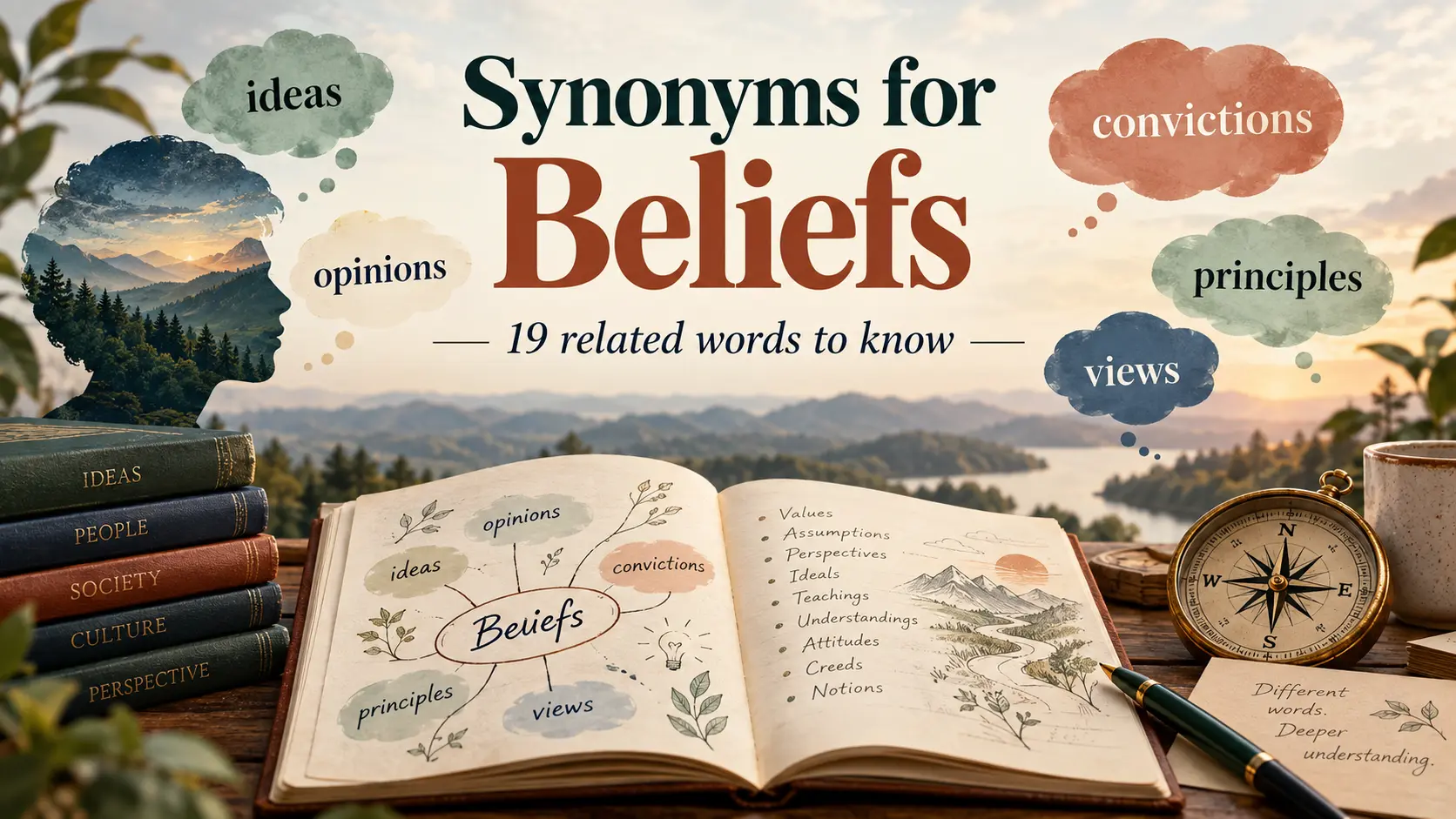
Yet writing beliefs over and over can sound flat. English learners and content writers need synonyms to show the exact kind of belief: a value, an opinion, or a conviction. This article explains the meaning of beliefs and shares 21 synonyms with examples. It also covers grammar, history, pronunciation, and meaning groups.
Meaning of Beliefs
Definition
Beliefs (Noun, plural): Ideas or feelings that a person accepts as true or right.
Examples
- People have different beliefs about how to raise children.
- Her beliefs guide how she treats others.
Connotative Meaning
The feeling of beliefs changes with context.
- Positive tone: Strong and inspiring. “Her beliefs gave her courage.”
- Negative tone: Rigid or false. “His old beliefs stopped him from changing.”
- Neutral tone: Simple description. “The survey asked about people’s beliefs.”
(Connotation: the feeling or emotion a word carries beyond its dictionary meaning.)
Etymology
Belief is a native English word. It is linked to the old word lēof, meaning “dear” or “loved.” So a belief was first an idea held dear.
- Old English (450–1100): Gelēafa meant “belief” or “faith.” It was used mostly for religious faith.
- Middle English (1100–1500): Around the 1100s, the prefix ge- was replaced by be-, giving bileave and bileve.
- Modern English (1500–Present): In the 1500s, the spelling changed to belief, perhaps to match words like grief. The plural beliefs now covers faith, values, and personal opinions.
Pronunciation (IPA)
- IPA: /bɪˈliːfs/
- Syllables: be·liefs (two syllables, stress on the second)
Affixation Pattern of Beliefs
- Root: lief, from Old English lēof (dear)
- Prefix: be- (a native English prefix)
- Suffix: -s (plural)
- Word formations:
- belief (noun, singular)
- believe (verb)
- believer (noun)
- believable (adjective)
- unbelievable (adjective)
- disbelief (noun)
- make-believe (noun and adjective)
21 Synonyms for Beliefs With Meaning & Examples
1. Convictions (Noun)
Meaning: Strong, firm beliefs.
Examples:
- She speaks with deep convictions.
- His convictions never changed.
2. Principles (Noun)
Meaning: Basic rules of right and wrong a person follows.
Examples:
- He is a man of principles.
- Honesty is one of her principles.
3. Values (Noun)
Meaning: Ideas about what matters most in life.
Examples:
- Family is one of our core values.
- The school teaches good values.
4. Views (Noun)
Meaning: Personal ways of thinking about a topic.
Examples:
- They share similar views.
- What are your views on homework?
5. Opinions (Noun)
Meaning: Personal thoughts or judgments.
Examples:
- Everyone has opinions about food.
- She keeps her opinions to herself.
6. Ideas (Noun)
Meaning: Thoughts or notions about something.
Examples:
- He has old-fashioned ideas.
- Their ideas about work differ.
7. Notions (Noun)
Meaning: Ideas or beliefs, sometimes vague.
Examples:
- Kids have funny notions about space.
- Drop the notion that you can’t learn.
8. Thoughts (Noun)
Meaning: Opinions or ideas someone has.
Examples:
- Share your thoughts on the plan.
- Her thoughts on the topic were wise.
9. Attitudes (Noun)
Meaning: Ways of thinking and feeling about something.
Examples:
- Attitudes about health are changing.
- His attitude toward work is great.
10. Perspectives (Noun)
Meaning: Points of view shaped by experience.
Examples:
- Travel gave me new perspectives.
- Students shared their perspectives.
11. Faith (Noun)
Meaning: Strong trust, often in God or a religion.
Examples:
- Her faith keeps her hopeful.
- He has faith in his team.
12. Creed (Noun)
Meaning: A set of beliefs, often religious.
Examples:
- They follow an ancient creed.
- Kindness is his creed.
13. Doctrines (Noun)
Meaning: Beliefs taught by a group or church.
Examples:
- The church explained its doctrines.
- The party has strict doctrines.
14. Dogma (Noun)
Meaning: Beliefs accepted without question.
Examples:
- Science should not become dogma.
- He rejects old dogma.
15. Tenets (Noun)
Meaning: Main beliefs of a system or group.
Examples:
- Respect is a key tenet of the club.
- Learn the tenets of the faith.
16. Ideology (Noun)
Meaning: A system of ideas, often political.
Examples:
- The two parties have different ideologies.
- Her ideology shaped her vote.
17. Philosophy (Noun)
Meaning: A personal set of guiding ideas.
Examples:
- His philosophy is to enjoy each day.
- The company has a simple philosophy.
18. Credo (Noun)
Meaning: A short statement of beliefs.
Examples:
- “Work hard, be kind” is her credo.
- The team lives by a credo.
19. Assumptions (Noun)
Meaning: Things accepted as true without proof.
Examples:
- Check your assumptions first.
- His assumptions were wrong.
20. Theories (Noun)
Meaning: Ideas meant to explain something.
Examples:
- She has theories about the missing key.
- Scientists test their theories.
21. Trust (Noun)
Meaning: A firm belief that someone or something is reliable.
Examples:
- Trust takes time to build.
- I have trust in my doctor.
Prototype Meaning
When people hear beliefs, they usually picture deep ideas someone holds close to the heart, such as faith, family values, or a personal code. The typical image is a strong inner idea that shapes how a person lives. The core meaning is acceptance of something as true.
Prototype Categorization
The 21 synonyms fall into five groups:
- Firm moral beliefs (convictions, principles, values, credo, philosophy): Use these for deep personal rules that guide behavior.
- Personal opinions (views, opinions, ideas, notions, thoughts, attitudes, perspectives): Use these for everyday thoughts and points of view.
- Religious and group beliefs (faith, creed, doctrines, dogma, tenets): Use these for shared beliefs in faiths and organizations.
- Systems of thought (ideology, theories): Use these for organized sets of ideas in politics or science.
- Unproven or trusting beliefs (assumptions, trust): Use these when belief rests on trust rather than proof.
These groups help writers pick a word with the right weight. Opinions are light, while convictions are heavy. Dogma sounds critical, while values sounds warm. Choosing the group first protects your tone.
Antonyms of Beliefs
Doubts (Noun)
- Feelings of being unsure.
Disbelief (Noun)
- Refusal to accept something as true.
Skepticism (Noun)
- A questioning attitude toward claims.
Distrust (Noun)
- A lack of trust.
Uncertainty (Noun)
- Not being sure.
Facts (Noun)
- Things proven to be true.
Short Questions and Answers
What does beliefs mean?
It means ideas or feelings a person accepts as true or right.
When should beliefs be used?
Use it for faith, values, opinions, or deep personal ideas. It fits essays, speeches, and everyday talk.
Is beliefs positive or negative?
It is usually neutral. It sounds positive when beliefs inspire good acts and negative when they are rigid or false.
How is it different from similar words?
Opinions are lighter and change easily. Convictions are stronger. Faith is often religious. Beliefs is the general word for all of them.
Conclusion
Our beliefs shape who we are, and our words show them to the world. Learning beliefs and its 21 synonyms helps you grow your vocabulary and express ideas with care.
You can write values in a mission statement, opinions in a review, and convictions in a speech. This makes your writing and speaking stronger. It also helps you avoid saying the same word again and again. Step by step, your confidence in English will grow.
Want to explore related words? Read synonyms of understanding to learn how people make sense of ideas, great synonyms for good to describe values you admire, and synonyms for fragile for beliefs that are easily shaken.
Practice every day. Write one sentence about something you believe, and use a new synonym each time.

Dshaikh
Founder & Editorial Director
I’m the founder and editorial director of this vocabulary series. I’ve spent over 35 years in pharmaceutical and healthcare marketing across Pakistan, the UAE, and the USA, where I launched 200+ brands and earned two Guinness World Records. That work taught me one lesson again and again: the right word builds trust, and the wrong one loses it. I set the plain-English standard for every guide here, so you can use new words the same day you learn them.