| Sara wanted new shoes. She found a pair for five dollars. “So cheap!” she said with a smile. A week later, the soles fell off. “Well,” she sighed, “they really were cheap.” |
The word cheap means low in price. It can also mean poor in quality. People use it every day when they shop, talk about money, or judge how well something is made.
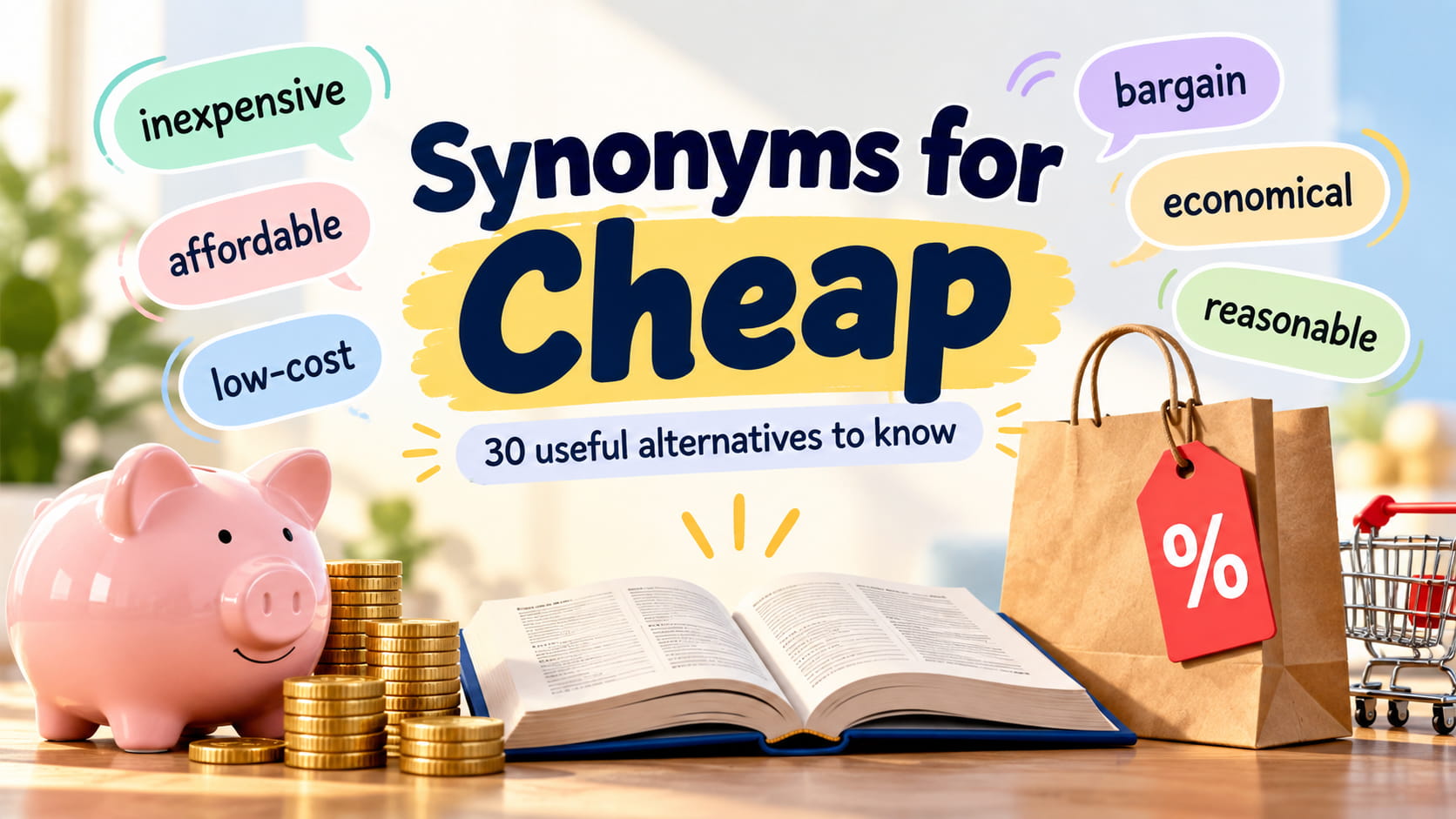
But one word is not enough. Learning synonyms helps English learners and content writers say things more clearly. It also keeps writing fresh. This article looks at the meaning of cheap and 30 synonyms with examples. You will also learn its grammar, history, pronunciation, and word groups.
Meaning of Cheap
Definition
Cheap (Adjective): Costing little money, or made with low quality.
Examples
- The bus is a cheap way to get to school.
- This cheap toy broke on the first day.
Connotative Meaning
The feeling of cheap changes with context.
- Positive tone: It sounds good when it means a smart deal. “I found a cheap flight!”
- Negative tone: It sounds bad when it means poor quality or a stingy person. “He is too cheap to pay.”
- Neutral tone: It is plain when it only states the price. “Apples are cheap this week.”
(Connotation: the feeling or emotion a word carries beyond its dictionary meaning.)
Etymology
The word cheap comes from an old word for trade. It traces back through Germanic languages to the Latin caupo, meaning “small trader.”
- Old English (450–1100): Cēap meant “trade,” “bargain,” or “market.” It was a noun, not an adjective.
- Middle English (1100–1500): Chep still meant “price” or “bargain.” People said good chep to mean “a good deal.”
- Modern English (1500–Present): In the 1500s, good cheap was shortened to cheap, an adjective meaning “low in price.” Later it also came to mean “poor quality” and “stingy.”
Pronunciation (IPA)
- IPA: /tʃiːp/
- Syllables: cheap (one syllable)
Affixation Pattern of Cheap
- Root: cheap (low in price)
- Prefix: None
- Suffix: None in the base word; -ly, -ness, -en, and -er/-est are added to form new words
- Word formations:
- cheaply (adverb)
- cheapness (noun)
- cheapen (verb)
- cheaper / cheapest (comparative and superlative adjectives)
- cheapskate (noun, informal)
- cheapo (noun or adjective, slang)
- dirt-cheap (adjective)
30 Synonyms for Cheap With Meaning & Examples
1. Inexpensive (Adjective)
Meaning: Not costing much money.
Examples:
- We ate at an inexpensive café.
- Pencils are inexpensive school supplies.
2. Affordable (Adjective)
Meaning: Priced so most people can pay for it.
Examples:
- They found an affordable apartment.
- The new phone is affordable for students.
3. Low-cost (Adjective)
Meaning: Having a small price.
Examples:
- We took a low-cost airline to Miami.
- The clinic offers low-cost checkups.
4. Budget (Adjective)
Meaning: Made for people who want to spend less.
Examples:
- They stayed in a budget hotel.
- This is a budget laptop for simple tasks.
5. Economical (Adjective)
Meaning: Saving money by not wasting it.
Examples:
- A small car is more economical.
- Buying in bulk is economical.
6. Reasonable (Adjective)
Meaning: Fair in price, not too high.
Examples:
- The rent is reasonable for this area.
- They charge reasonable fees.
7. Bargain (Adjective)
Meaning: Sold at a much lower price than usual.
Examples:
- She bought a bargain coat at the sale.
- The store has a bargain bin.
8. Cut-price (Adjective)
Meaning: Sold at a reduced price.
Examples:
- He found cut-price tickets online.
- The shop sells cut-price snacks.
9. Discounted (Adjective)
Meaning: Offered for less than the normal price.
Examples:
- Seniors get discounted tickets.
- I bought a discounted jacket.
10. Reduced (Adjective)
Meaning: Lowered in price.
Examples:
- All winter boots are reduced.
- We paid a reduced rate at night.
11. Knockdown (Adjective)
Meaning: Very low in price, often surprising.
Examples:
- They sold the sofa at a knockdown price.
- He got a knockdown deal on a bike.
12. Cut-rate (Adjective)
Meaning: Cheaper than normal, sometimes lower quality.
Examples:
- The cut-rate repair did not last.
- She used a cut-rate phone plan.
13. Dirt-cheap (Adjective)
Meaning: Extremely cheap.
Examples:
- Bananas were dirt-cheap at the market.
- The old books were dirt-cheap.
14. Cheapo (Adjective)
Meaning: Cheap and of low quality (slang).
Examples:
- My cheapo headphones stopped working.
- He drives a cheapo car.
15. Shoddy (Adjective)
Meaning: Badly made and poor in quality.
Examples:
- The shoddy shelf fell down.
- They did shoddy work on the roof.
16. Tacky (Adjective)
Meaning: Cheap-looking and in poor taste.
Examples:
- The party had tacky decorations.
- She wore a tacky gold hat.
17. Tawdry (Adjective)
Meaning: Showy but cheap and poor in quality.
Examples:
- The shop was full of tawdry jewelry.
- The hotel room felt tawdry.
18. Flimsy (Adjective)
Meaning: Thin and weak, easy to break.
Examples:
- The flimsy bag ripped at once.
- That table looks flimsy.
19. Second-rate (Adjective)
Meaning: Not very good; below the best.
Examples:
- It was a second-rate movie.
- He hired a second-rate plumber.
20. Inferior (Adjective)
Meaning: Lower in quality than others.
Examples:
- The copy is inferior to the real one.
- They used inferior paint.
21. Trashy (Adjective)
Meaning: Cheap, low quality, and in bad taste.
Examples:
- She reads trashy magazines.
- The show was loud and trashy.
22. Chintzy (Adjective)
Meaning: Cheap and showy, or stingy (informal).
Examples:
- The gift was a bit chintzy.
- Do not be chintzy with the tip.
23. Gimcrack (Adjective)
Meaning: Showy but badly made.
Examples:
- The fair sold gimcrack toys.
- He bought a gimcrack clock.
24. Stingy (Adjective)
Meaning: Not willing to spend or share money.
Examples:
- The stingy man never buys lunch.
- Don’t be stingy with snacks.
25. Miserly (Adjective)
Meaning: Very unwilling to spend money.
Examples:
- The miserly king hid his gold.
- His miserly ways upset his family.
26. Tight-fisted (Adjective)
Meaning: Holding on to money too tightly.
Examples:
- My tight-fisted uncle split the bill to the cent.
- She is tight-fisted with her pay.
27. Penny-pinching (Adjective)
Meaning: Too careful about spending tiny amounts.
Examples:
- The penny-pinching boss cut coffee breaks.
- He stopped penny-pinching on vacation.
28. Frugal (Adjective)
Meaning: Careful with money in a smart way.
Examples:
- My frugal grandma saves every coupon.
- They live a frugal life.
29. Thrifty (Adjective)
Meaning: Using money wisely and not wasting it.
Examples:
- A thrifty shopper compares prices.
- She is thrifty with her allowance.
30. Mean (Adjective)
Meaning: Unkind or ungenerous, especially about money (British).
Examples:
- It was mean of him to charge his friend.
- Don’t be mean with the sweets.
Prototype Meaning
When most people hear cheap, they picture a price tag with a small number. They imagine a good deal at a store, like a one-dollar snack or a sale shirt. This money sense is the core. The ideas of poor quality and stingy people grow out of it.
Prototype Categorization
The 30 synonyms fall into four clear groups:
- Low price, positive (inexpensive, affordable, low-cost, budget, economical, reasonable): Use these when a low price is a good thing.
- Sale and discount words (bargain, cut-price, discounted, reduced, knockdown, cut-rate, dirt-cheap): Use these for deals and lowered prices.
- Poor quality (cheapo, shoddy, tacky, tawdry, flimsy, second-rate, inferior, trashy, chintzy, gimcrack): Use these when something looks or works badly.
- Spending habits (stingy, miserly, tight-fisted, penny-pinching, frugal, thrifty, mean): Use these to describe people. Frugal and thrifty are kind; the others are critical.
These groups help writers pick the right tone. Praise a deal with affordable. Criticize a product with shoddy. Describe a careful saver with thrifty, not stingy.
Antonyms of Cheap
Expensive (Adjective)
- Costing a lot of money.
Costly (Adjective)
- High in price or causing loss.
Pricey (Adjective)
- A bit too expensive (informal).
Luxurious (Adjective)
- Rich, comfortable, and high in cost.
High-quality (Adjective)
- Made very well with good materials.
Generous (Adjective)
- Happy to give or share money.
Lavish (Adjective)
- Spending or given in large, rich amounts.
Short Questions and Answers
What does cheap mean?
It means low in price. It can also mean low in quality or unwilling to spend money.
When should cheap be used?
Use it for prices, weak products, or stingy people. In polite or formal writing, try affordable or inexpensive.
Is cheap positive or negative?
Both. A cheap ticket is good news. A cheap chair that breaks is bad news. Calling a person cheap is always negative.
How is it different from similar words?
Affordable is always positive. Shoddy is always about bad quality. Frugal is a kind way to describe a saver. Cheap can do all three jobs.
Conclusion
Now you know that cheap can mean a smart deal, a weak product, or a stingy person. Learning its synonyms grows your vocabulary fast. You can pick affordable to sound kind, shoddy to sound critical, or thrifty to praise a saver.
This makes your writing and speaking stronger. It also helps you avoid saying the same word again and again. Each new word builds your English confidence.
Want to keep building your word power? Learn synonyms for additional to talk about extra fees, try great synonyms for good to praise a real bargain, and read synonyms for fragile to describe flimsy things that break too soon.
Try this: pick three new synonyms today. Use each one in a sentence about something you bought. Small daily practice turns new words into words you own.

Dshaikh
Founder & Editorial Director
I’m the founder and editorial director of this vocabulary series. I’ve spent over 35 years in pharmaceutical and healthcare marketing across Pakistan, the UAE, and the USA, where I launched 200+ brands and earned two Guinness World Records. That work taught me one lesson again and again: the right word builds trust, and the wrong one loses it. I set the plain-English standard for every guide here, so you can use new words the same day you learn them.