
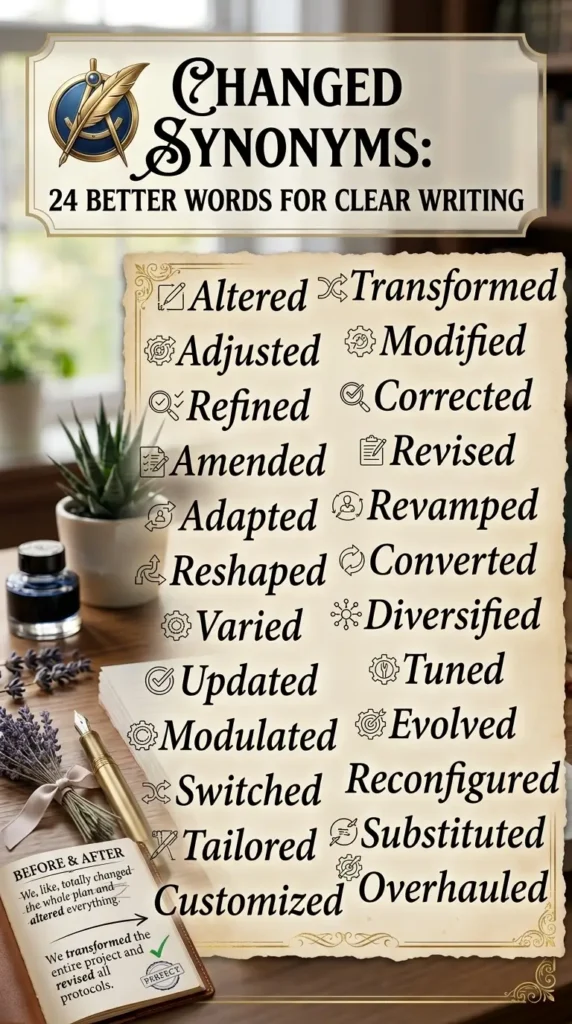

Altered, modified, transformed, revised, adjusted, replaced, converted, updated, and adapted are useful synonyms for changed, depending on the context.
Introduction
Changed is a common English word that means something became different from its previous state. Imagine opening your favorite shop one morning and noticing that the owner has moved the shelves, changed the lighting, and added new products. You might say, “The shop has changed a lot.” We use this word in everyday speech because it can describe changes in people, places, plans, opinions, habits, and things. However, changed is a broad word, so it does not always show exactly what happened.
A writer may use modified for a small adjustment, transformed for a major difference, or revised for an improved piece of writing. Learning these alternatives helps English learners choose more precise words and avoid repetition. This article explains the meaning, history, pronunciation, word formation, 24 synonyms, examples, semantic categories, antonyms, and practical uses of changed.
Meaning of Changed
Definition
Changed (Verb/Adjective):
Changed means made or became different from an earlier state, condition, form, or situation.
Examples
- She changed her hairstyle last week.
- The weather has changed since morning.
Connotative Meaning
Connotation: The feeling or idea that a word suggests beyond its basic meaning.
- Positive tone: Changed can suggest improvement, growth, progress, or renewal.
- Negative tone: It can suggest loss, disruption, or an unwanted difference.
- Neutral tone: It can simply describe a difference without suggesting whether it is good or bad.
Etymology
The word changed comes from the verb change, which entered English through French.
- Old English (450–1100): The modern verb change was not commonly used in Old English; native words such as wendan were used for ideas related to turning or altering.
- Middle English (1100–1500): Change entered English from Old French changier, meaning “to alter, exchange, or substitute.”
- Modern English (1500–Present): Change developed many meanings related to alteration, exchange, transformation, money, habits, and circumstances. Changed is its regular past-tense and past-participle form.
Pronunciation (IPA)
- IPA: /tʃeɪndʒd/
- Syllables: changed — 1 syllable
Affixation Pattern of Changed
- Root: change
- Prefix: None
- Suffix: -ed — marks the past tense/past participle
- Word formations:
- change — noun/verb
- changed — verb/adjective
- changing — verb/adjective/noun
- changeable — adjective
- unchanged — adjective
- changer — noun
- changeability — noun
24 Synonyms of Changed With Meaning & Examples
1. Altered (Verb)
Meaning: Made something different, usually in some specific way.
Examples:
- The designer altered the dress.
- They altered the original plan.
2. Modified (Verb)
Meaning: Changed something slightly to improve or adjust it.
Examples:
- She modified the recipe.
- The engineer modified the design.
3. Transformed (Verb)
Meaning: Changed something greatly into a new or different form.
Examples:
- Technology has transformed our lives.
- The renovation transformed the old house.
4. Revised (Verb)
Meaning: Changed something after reviewing it to improve or correct it.
Examples:
- She revised her essay.
- The company revised its policy.
5. Adjusted (Verb)
Meaning: Changed something slightly to make it work better.
Examples:
- He adjusted the chair.
- We adjusted the schedule.
6. Replaced (Verb)
Meaning: Removed one thing and put another in its place.
Examples:
- They replaced the old computer.
- She replaced the broken window.
7. Converted (Verb)
Meaning: Changed something from one form, use, or system into another.
Examples:
- They converted the garage into an office.
- The file was converted to PDF format.
8. Updated (Verb)
Meaning: Changed something to make it more current or modern.
Examples:
- She updated her profile.
- The website was updated yesterday.
9. Adapted (Verb)
Meaning: Changed something so it works better in a new situation.
Examples:
- They adapted the plan to fit the new conditions.
- The book was adapted for television.
10. Amended (Verb)
Meaning: Changed a document, rule, or statement to correct or improve it.
Examples:
- The law was amended last year.
- She amended the contract.
11. Altered (Verb)
Meaning: Changed the form, appearance, or nature of something.
Examples:
- The tailor altered the jacket.
- The experience altered his opinion.
12. Reshaped (Verb)
Meaning: Changed the form, structure, or character of something.
Examples:
- The project reshaped the local economy.
- The experience reshaped her thinking.
13. Remodeled (Verb)
Meaning: Changed the structure or appearance of a building or space.
Examples:
- They remodeled their kitchen.
- The hotel was completely remodeled.
14. Reorganized (Verb)
Meaning: Changed the arrangement or structure of something.
Examples:
- The company reorganized its departments.
- She reorganized the files.
15. Reformed (Verb)
Meaning: Changed something in order to improve or correct it.
Examples:
- The government reformed the system.
- The organization reformed its policies.
16. Renewed (Verb)
Meaning: Made something fresh, active, or effective again.
Examples:
- They renewed their efforts.
- The experience renewed his confidence.
17. Converted (Verb)
Meaning: Changed something from one purpose, form, or condition into another.
Examples:
- The factory was converted into apartments.
- She converted the document into another format.
18. Shifted (Verb)
Meaning: Moved or changed from one position, condition, or idea to another.
Examples:
- Public opinion shifted quickly.
- The wind shifted during the night.
19. Evolved (Verb)
Meaning: Developed gradually into a different or more advanced form.
Examples:
- Her writing style evolved over time.
- The business has evolved since its launch.
20. Developed (Verb)
Meaning: Changed or grew gradually into a more advanced state.
Examples:
- His ideas developed over several years.
- The town developed rapidly.
21. Revamped (Verb)
Meaning: Improved something by making major changes to it.
Examples:
- The company revamped its website.
- They revamped the old marketing strategy.
22. Renewed (Verb)
Meaning: Restored something by giving it new energy, life, or purpose.
Examples:
- She renewed her interest in painting.
- The team renewed its commitment to the project.
23. Substituted (Verb)
Meaning: Changed one thing for another that takes its place.
Examples:
- They substituted fresh ingredients for canned ones.
- The coach substituted a new player.
24. Replaced (Verb)
Meaning: Put something new or different in the position of something else.
Examples:
- The old system was replaced.
- They replaced the damaged equipment.
Note: Some synonyms have specific uses. Modified usually suggests a small change, transformed suggests a major change, revised is common for writing or plans, replaced means one thing takes the place of another, and evolved usually suggests gradual development.
Prototype Meaning
The most typical meaning of changed is became different or made something different. When people hear this word, they usually imagine a person, object, plan, or situation that is no longer the same as before. The change may be small or dramatic, positive or negative, depending on the context.
Prototype Categorization
The 24 synonyms can be grouped into meaningful semantic categories:
- General alteration: altered, modified, adjusted — useful for changes that affect an existing thing without completely replacing it.
- Major transformation: transformed, reshaped, revamped, remodeled — useful when a substantial change takes place.
- Improvement and correction: revised, amended, reformed, renewed — useful for improving documents, systems, policies, plans, or efforts.
- Replacement: replaced, substituted — used when one thing takes the place of another.
- Modernization: updated, revamped — useful when something is made newer or more current.
- Gradual development: evolved, developed — useful when change happens over time.
- Movement or transition: shifted, converted, adapted — useful when something moves toward a different position, purpose, form, or situation.
- Organization and structure: reorganized, remodeled, reshaped — useful when the arrangement or structure changes.
This grouping helps writers choose a synonym that describes how much something changed and what kind of change occurred.
Antonyms of Changed
1. Unchanged (Adjective)
Meaning: Remaining the same as before.
2. Constant (Adjective)
Meaning: Staying the same without significant change.
3. Stable (Adjective)
Meaning: Remaining steady and unlikely to change suddenly.
4. Preserved (Adjective/Verb)
Meaning: Kept in its original or existing condition.
5. Maintained (Verb)
Meaning: Kept something at the same level, condition, or state.
6. Unaltered (Adjective)
Meaning: Not changed or modified.
Short Questions and Answers
What does changed mean?
Changed means that something became different from its previous state, or that someone made it different.
When should changed be used?
Use changed when you want to describe a difference in a person, object, plan, opinion, situation, habit, or condition.
Is changed positive or negative?
It can be either. A change may be an improvement, a problem, or simply a difference.
How is it different from similar words?
Changed is a broad term. Modified usually means a smaller adjustment, transformed suggests a major change, revised often refers to writing or plans, and evolved suggests gradual development.
Conclusion
Learning synonyms for changed can make your English more precise and your writing more interesting. The word changed is useful because it covers many types of differences, but more specific alternatives can tell readers exactly what happened. For example, modified suggests a small adjustment, transformed suggests a major change, revised is useful for documents and plans, and evolved describes gradual development. Other words such as updated, adapted, reorganized, replaced, converted, and revamped can describe specific situations more clearly.
This vocabulary is valuable for English learners, students, bloggers, journalists, and content writers. Instead of replacing changed with a difficult word just to sound advanced, choose an alternative that matches the real meaning of your sentence. Practice new synonyms in complete sentences and read them in real English. With regular practice, you can expand your vocabulary, avoid repetition, and communicate your ideas with greater accuracy and confidence.
Synonyms for Yearn: 25 Words With Examples.