- Illusion: Something that appears real but is not.
- Delusion: A false belief that someone accepts as true.
- Phantom: Something that seems to exist but may not be real.
- Vision: A mental or imagined picture of something.
- Dream: A desired idea or hope that may not happen.
- Fata morgana: A complex optical illusion, often seen near the horizon.
- False hope: An expectation that may never become reality.
- Fantasy: An imagined idea or situation.
- Deception: Something that gives a false impression.
Introduction
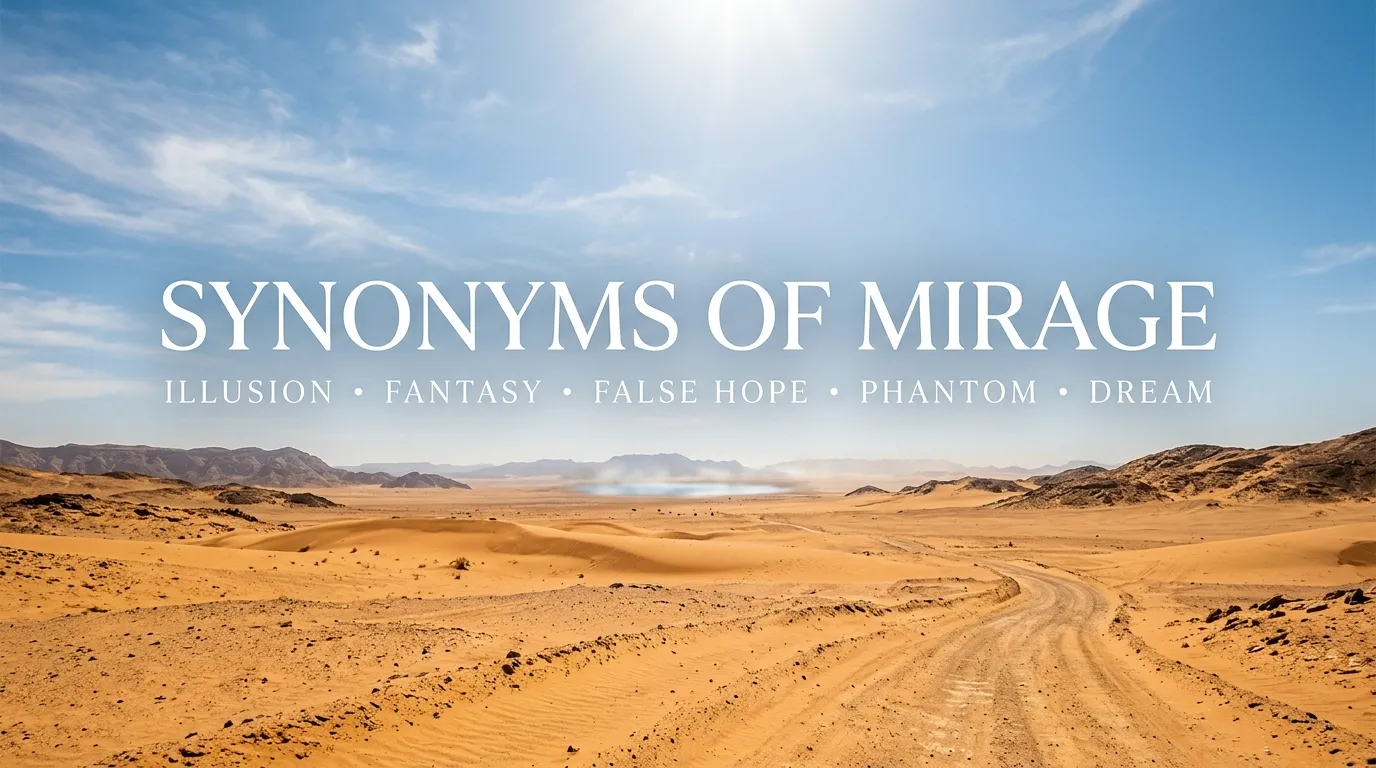
Imagine traveling through a hot desert under the bright afternoon sun. In the distance, you suddenly see what looks like a pool of water. You walk toward it, but the water seems to move farther away. When you reach the spot, there is no water at all. What you saw was a mirage.
A mirage is an optical phenomenon caused by the bending of light through layers of air with different temperatures. The word is also used in everyday English for something that looks real or achievable but turns out to be an illusion. For example, a person may call an unrealistic promise a “mirage of success.”
Several words are related to mirage, but they do not all have exactly the same meaning. Illusion is a broad term for something that appears different from reality. Phantom can describe something seemingly present but not real. False hope focuses on an expectation that is unlikely to come true. Learning these differences helps you choose the right word for each context.
Meaning of Mirage
Definition
Mirage (Noun):
An optical effect in which light bends because of differences in air temperature, making distant objects or areas appear distorted, displaced, or reflected.
In figurative English, a mirage can also mean something that seems real, possible, or desirable but is actually unattainable or deceptive.
Examples
- The travelers thought they saw water, but it was only a mirage.
- The distant trees appeared to float above the road like a mirage.
- His dream of instant success proved to be a mirage.
Connotative Meaning
Connotation means the feeling or idea connected with a word beyond its basic meaning.
- Positive tone: A mirage can suggest hope, beauty, mystery, or wonder when used creatively.
- Negative tone: It often suggests deception, disappointment, or something unattainable.
- Neutral tone: In science, it simply describes a natural optical phenomenon.
Etymology of Mirage
The word mirage has a relatively recent history in English.
French Origin
Mirage came into English from French mirage, which is related to mirer, meaning “to look at” or “to reflect.”
18th Century English
The English word became associated with optical phenomena in which distant objects appeared distorted or displaced because of atmospheric conditions.
Modern English
Today, mirage has both a scientific and figurative meaning. It can describe an actual atmospheric optical effect or something that appears attractive or possible but does not exist as expected.
Pronunciation
IPA: /mɪˈrɑːʒ/
Syllables: mi-rage
The stress falls on the second syllable.
The final sound is similar to the sound in the word beige.
Word Formation of Mirage
- Root: mirage
- Prefix: None
- Suffix: None
- Mirage: noun
- Mirages: plural noun
The word does not have a common English verb form directly derived from mirage. Instead, related ideas are expressed with words such as illusion, distort, reflect, and deceive.
23 Synonyms of Mirage With Meanings and Examples
1. Illusion
Part of speech: Noun
Meaning: Something that appears real but is actually different from reality.
Examples:
- The reflection created an illusion of water.
- His confidence was only an illusion.
2. Delusion
Part of speech: Noun
Meaning: A false belief that a person strongly accepts as true.
Examples:
- Believing that success would come without effort was a delusion.
- He lived under the delusion that everyone admired him.
3. Phantom
Part of speech: Noun
Meaning: Something that seems to exist but has no real physical presence.
Examples:
- The distant shape looked like a phantom.
- His promise of easy wealth became a phantom of his imagination.
4. Apparition
Part of speech: Noun
Meaning: A strange or unusual appearance, often imagined or ghost-like.
Examples:
- A strange apparition appeared in the mist.
- The distant figure seemed like an apparition.
5. Fata Morgana
Part of speech: Noun
Meaning: A complex atmospheric optical illusion that can make distant objects appear elevated, stretched, or distorted.
Examples:
- The sailors reported seeing a fata morgana near the horizon.
- The unusual image was identified as a fata morgana.
6. Fantasy
Part of speech: Noun
Meaning: An imagined situation or idea that is not based on reality.
Examples:
- His plan for instant wealth was a fantasy.
- She knew that living without responsibilities was only a fantasy.
7. Dream
Part of speech: Noun
Meaning: A desired hope or imagined possibility.
Examples:
- His dream of becoming famous seemed impossible.
- The promise of an easy life turned out to be a dream.
8. Vision
Part of speech: Noun
Meaning: An imagined picture or idea of something that may or may not become real.
Examples:
- Her vision of a perfect future remained distant.
- The beautiful scene seemed like a vision.
9. False Hope
Part of speech: Noun phrase
Meaning: A belief that something good will happen when there is little reason to expect it.
Examples:
- The advertisement gave customers false hope.
- The promise of quick success created false hope.
10. False Promise
Part of speech: Noun phrase
Meaning: A promise that is misleading or unlikely to be fulfilled.
Examples:
- The offer turned out to be a false promise.
- He became tired of hearing false promises.
11. Misconception
Part of speech: Noun
Meaning: An idea or belief that is incorrect.
Examples:
- The belief that money guarantees happiness is a misconception.
- That expectation was based on a misconception.
12. Deception
Part of speech: Noun
Meaning: Something intended to make someone believe something that is not true.
Examples:
- The attractive advertisement was a form of deception.
- The apparent opportunity was based on deception.
13. Pretense
Part of speech: Noun
Meaning: An attempt to make something appear true when it is not.
Examples:
- His confidence was merely a pretense.
- The peaceful appearance was only a pretense.
14. Make-Believe
Part of speech: Noun
Meaning: An imagined situation that is treated as though it were real.
Examples:
- The children created a world of make-believe.
- His plan sounded more like make-believe than reality.
15. Chimera
Part of speech: Noun
Meaning: An unrealistic idea, hope, or imagined possibility.
Examples:
- His plan for effortless success was a chimera.
- The perfect life she imagined became a distant chimera.
16. Pipe Dream
Part of speech: Noun phrase
Meaning: A hope or plan that is unlikely to happen.
Examples:
- Becoming rich without working was only a pipe dream.
- Their plan to finish the huge project in one day was a pipe dream.
17. Fantasy World
Part of speech: Noun phrase
Meaning: An imagined world or situation that is separated from ordinary reality.
Examples:
- The novel takes readers into a fantasy world.
- He seemed to live in a fantasy world.
18. Unreality
Part of speech: Noun
Meaning: The quality of seeming unreal or disconnected from reality.
Examples:
- The strange landscape created a sense of unreality.
- She could not escape the feeling of unreality.
19. Specter
Part of speech: Noun
Meaning: Something imagined, feared, or difficult to grasp as a real presence.
Examples:
- The promise of failure became a constant specter.
- The distant shape looked like a specter.
20. Phantasm
Part of speech: Noun
Meaning: An image, idea, or appearance that exists mainly in the imagination.
Examples:
- The creature was nothing more than a phantasm.
- His perfect future was a phantasm of his imagination.
21. Illusory Hope
Part of speech: Noun phrase
Meaning: A hope that appears possible but is unlikely to become real.
Examples:
- The promise of instant success was an illusory hope.
- They eventually realized that their expectation was an illusory hope.
22. Unattainable Dream
Part of speech: Noun phrase
Meaning: A desired goal that is extremely difficult or impossible to achieve.
Examples:
- For him, unlimited wealth became an unattainable dream.
- The perfect future remained an unattainable dream.
23. Phantom Hope
Part of speech: Noun phrase
Meaning: A hope that appears possible but has little chance of becoming reality.
Examples:
- The promise of an immediate solution was a phantom hope.
- They eventually abandoned their phantom hope of easy success.
Prototype Meaning of Mirage
The most typical meaning of mirage is an image that appears real but is actually an optical effect. The classic example is a traveler in a hot desert who sees what looks like water in the distance.
The figurative meaning comes from this physical idea. When someone calls an opportunity, dream, or promise a mirage, they mean it appears attractive or possible but cannot actually be reached or achieved.
For example:
The promise of instant wealth was a mirage.
Here, the speaker is not talking about a physical optical phenomenon. The word suggests that the promise looked real but disappeared when examined closely.
Prototype Categorization
The related words for mirage can be grouped according to their specific meaning.
Optical and Visual Illusions
- Illusion
- Fata morgana
- Apparition
- Phantom
- Phantasm
These are useful when describing something that appears visually real but is not what it seems.
False Beliefs
- Delusion
- Misconception
- Pretense
- Unreality
These focus more on mistaken beliefs or appearances.
Unrealistic Hopes
- False hope
- Illusory hope
- Phantom hope
- Unattainable dream
- Pipe dream
- Chimera
These are especially useful when mirage is being used figuratively.
Imagination and Fantasy
- Fantasy
- Dream
- Vision
- Make-believe
- Fantasy world
These words describe imagined ideas or situations rather than actual physical phenomena.
Deceptive Appearances
- Deception
- False promise
- Specter
These focus on something that gives a misleading impression.
Mirage Synonyms for Different Situations
| Situation | Useful Alternative |
| Optical phenomenon | Illusion, fata morgana |
| Something imaginary | Fantasy, phantasm |
| Unrealistic goal | Pipe dream, chimera |
| Unrealistic hope | False hope, illusory hope |
| Wrong belief | Delusion, misconception |
| False appearance | Illusion, deception |
| Imagined future | Dream, vision |
| Literary description | Phantom, apparition, specter |
| False promise | False promise, deception |
Antonyms of Mirage
A true opposite of mirage depends on whether you mean the physical or figurative sense.
1. Reality
Part of speech: Noun
Meaning: The actual state of things rather than an appearance or illusion.
2. Truth
Part of speech: Noun
Meaning: Something that agrees with facts or reality.
3. Certainty
Part of speech: Noun
Meaning: A state in which something is known or accepted as definite.
4. Fact
Part of speech: Noun
Meaning: Something that is known to be true.
5. Actuality
Part of speech: Noun
Meaning: The state of being real or existing in fact.
6. Reality-Based Idea
Part of speech: Noun phrase
Meaning: An idea supported by actual facts and circumstances.
Bad Synonyms: 21 Better Words for Clear Writing
Short Questions and Answers
What does mirage mean?
A mirage is an optical phenomenon that makes something appear different from its actual location or form. Figuratively, it can mean an unrealistic hope, dream, or appearance.
What is the closest synonym for mirage?
Illusion is one of the closest general synonyms. In a figurative context, false hope, chimera, or pipe dream may be more precise.
Is illusion the same as mirage?
Not exactly. Mirage is a specific type of optical phenomenon, while illusion is a broader term for something that appears different from reality.
What is a synonym for mirage in a figurative sense?
Depending on the sentence, you can use illusion, fantasy, chimera, pipe dream, false hope, or unattainable dream.
What is a mirage in literature?
In literature, a mirage often represents something that looks attractive or achievable but remains out of reach. It can symbolize false hope, impossible dreams, or deceptive appearances.
What is the opposite of mirage?
Reality, truth, fact, actuality, and certainty can serve as opposites depending on the context.
Can mirage describe a person?
Usually, mirage describes an appearance, idea, hope, or phenomenon rather than a person. In creative writing, however, a person may metaphorically be described as a mirage if they seem unreachable or unreal.
Conclusion
The word mirage has both a scientific and a figurative meaning. In its literal sense, it describes an optical phenomenon caused by the bending of light through layers of air. In everyday and literary language, it can describe something that looks real or achievable but is actually an illusion.
Useful alternatives include illusion, phantom, apparition, fantasy, dream, chimera, false hope, pipe dream, misconception, and deception. The right choice depends on the idea you want to express. Use illusion for a broad false appearance, fata morgana for a specific atmospheric effect, pipe dream for an unrealistic plan, and false hope for an expectation that is unlikely to come true.
Understanding these distinctions makes your writing more precise and expressive.

Author Bio
I am Sajjad Ali, an English language writer specializing in synonyms, word meanings, and practical English usage.
I use my expertise in English vocabulary and word choice to create simple, accurate, and helpful content for learners and readers.