Ever burned the toast or sent a text to the wrong person?
Then you know what messed up means. It describes something that went wrong, got ruined, or became untidy. It can also describe a situation that feels unfair or upsetting.
Why do people say it so much?
It is short, casual, and fits many problems. Kids say it about games. Adults say it about work, plans, and even feelings.
Why learn its synonyms?
Messed up is informal. English learners and content writers need other words for school, work, and polite talk. Synonyms also make writing more exact.
What will this article cover?
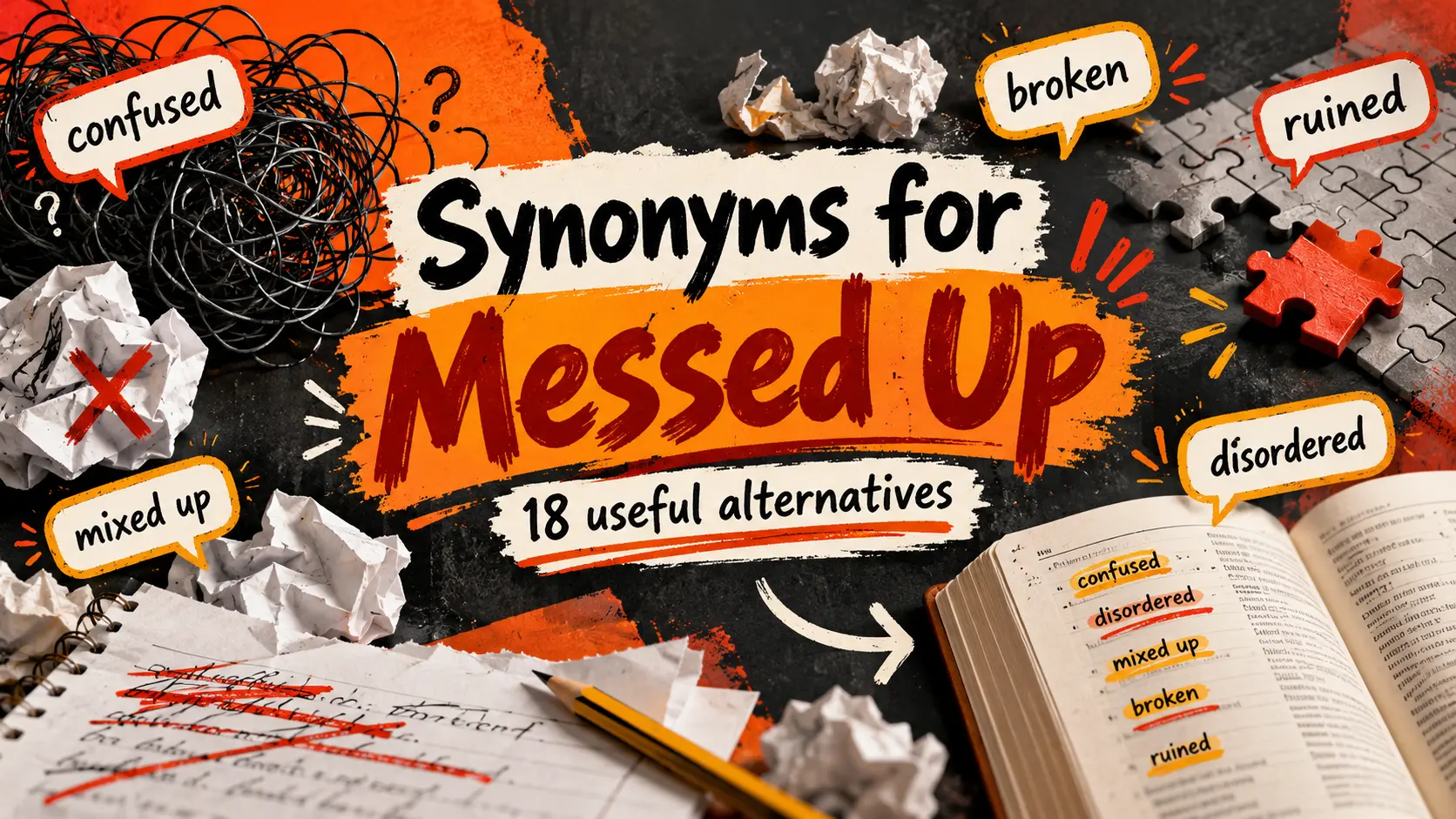
You will learn the meaning of messed up and 20 synonyms with examples. You will also explore its grammar, history, pronunciation, and meaning groups.
Meaning of Messed Up
Definition
Messed Up (Adjective / Phrasal Verb): Ruined, broken, untidy, or wrong. As a phrasal verb (mess up), it means to make a mistake or spoil something.
Examples
- I messed up the recipe and added salt instead of sugar.
- His room was so messed up that he could not find his shoes.
Connotative Meaning
The feeling of messed up changes with context.
- Positive tone: Rarely positive. It can sound friendly and honest when owning a mistake. “Sorry, I messed up. I will fix it.”
- Negative tone: Usually negative. It shows damage, chaos, or unfairness. “That is a messed up thing to do.”
- Neutral tone: It can simply describe an untidy state. “The wind messed up my hair.”
(Connotation: the feeling or emotion a word carries beyond its dictionary meaning.)
Etymology
Mess comes from the Old French mes, meaning “a portion of food.” That word came from Late Latin missum, “something put on the table,” from mittere, “to send.”
- Old English (450–1100): The word did not exist yet in English.
- Middle English (1100–1500): Around 1300, mes meant “a serving of food.” Soldiers still eat in a “mess hall” today.
- Modern English (1500–Present): By the 1800s, mess meant “a jumble” or “a dirty state,” from the idea of mixed-up food. The phrase mess up appeared in the early 1900s, and messed up became common slang later in the 20th century.
Pronunciation (IPA)
- IPA: /mɛst ʌp/
- Syllables: messed · up (two syllables, two words)
Affixation Pattern of Messed Up
- Root: mess
- Prefix: None
- Suffix: -ed (past tense or adjective); up is an adverb particle, not a suffix
- Word formations:
- mess (noun and verb)
- mess up (phrasal verb)
- messed up / messed-up (adjective)
- mess-up (noun, informal)
- messing (verb, present participle)
- messy (adjective)
- messily (adverb)
- messiness (noun)
20 Synonyms for Messed Up With Meaning & Examples
1. Ruined (Adjective)
Meaning: Completely spoiled or destroyed.
Examples:
- The rain left our picnic ruined.
- My shirt is ruined by paint.
2. Botched (Adjective)
Meaning: Done badly or clumsily.
Examples:
- The botched repair made things worse.
- It was a botched plan from the start.
3. Bungled (Adjective)
Meaning: Handled in a clumsy, careless way.
Examples:
- The bungled robbery ended fast.
- He bungled the job interview.
4. Spoiled (Adjective)
Meaning: Damaged so it is no longer good.
Examples:
- The milk is spoiled.
- The noise spoiled the movie.
5. Damaged (Adjective)
Meaning: Harmed or broken in some way.
Examples:
- The box arrived damaged.
- The storm left damaged trees.
6. Broken (Adjective)
Meaning: Not working or split into parts.
Examples:
- My phone screen is broken.
- The broken toy sat in the corner.
7. Wrecked (Adjective)
Meaning: Badly damaged or destroyed.
Examples:
- The car was wrecked in the crash.
- Our plans were wrecked by the storm.
8. Faulty (Adjective)
Meaning: Having a defect or mistake.
Examples:
- The faulty wire caused a fire.
- He gave faulty directions.
9. Untidy (Adjective)
Meaning: Not neat or in order.
Examples:
- Her desk is always untidy.
- The yard looked untidy.
10. Messy (Adjective)
Meaning: Dirty or disordered.
Examples:
- The kids made a messy kitchen.
- She has messy handwriting.
11. Disorganized (Adjective)
Meaning: Lacking order or planning.
Examples:
- The event was disorganized.
- He is a disorganized student.
12. Chaotic (Adjective)
Meaning: In total confusion and disorder.
Examples:
- The airport was chaotic.
- Mornings at home are chaotic.
13. Jumbled (Adjective)
Meaning: Mixed up in a confused way.
Examples:
- The letters were all jumbled.
- His notes were jumbled.
14. Muddled (Adjective)
Meaning: Confused and unclear.
Examples:
- Her story was muddled.
- I felt muddled after the long day.
15. Screwed up (Adjective)
Meaning: Ruined or wrong (very informal).
Examples:
- The printer screwed up my pages.
- The whole schedule is screwed up.
16. Troubled (Adjective)
Meaning: Having problems or worries.
Examples:
- He is a troubled young man.
- The company is in troubled times.
17. Distressed (Adjective)
Meaning: Very upset or worried.
Examples:
- The lost child was distressed.
- She felt distressed after the news.
18. Unfair (Adjective)
Meaning: Not just or right.
Examples:
- The rule feels unfair.
- It is unfair to blame her.
19. Wrong (Adjective)
Meaning: Not correct or not right.
Examples:
- He took the wrong bus.
- Cheating is wrong.
20. Blundered (Verb)
Meaning: Made a careless, silly mistake.
Examples:
- He blundered and missed the goal.
- The clerk blundered with my order.
Prototype Meaning
When people hear messed up, they usually picture a plan or object that went wrong. A burnt meal, a torn page, or a failed test are typical images. The core idea is that something was fine before and now it is not.
Prototype Categorization
The 20 synonyms fit into four groups:
- Mistakes and poor handling (botched, bungled, blundered, screwed up): Use these when a person made an error.
- Damage and ruin (ruined, spoiled, damaged, broken, wrecked, faulty): Use these when something no longer works or looks right.
- Disorder and confusion (untidy, messy, disorganized, chaotic, jumbled, muddled): Use these for places, plans, or thoughts that lack order.
- Emotional or moral trouble (troubled, distressed, unfair, wrong): Use these for people who are hurting or for situations that feel unjust.
This grouping helps writers stay exact. A broken toy is not the same as a bungled plan. A chaotic room is not the same as an unfair rule. Pick the group, then pick the word that fits the tone.
Antonyms of Messed Up
Fixed (Adjective)
- Repaired and working again.
Organized (Adjective)
- Neat and well planned.
Tidy (Adjective)
- Clean and in order.
Perfect (Adjective)
- Without any mistakes.
Correct (Adjective)
- Right and free from error.
Stable (Adjective)
- Calm, steady, and not likely to change.
Short Questions and Answers
What does messed up mean?
It means ruined, broken, untidy, or wrong. It can also mean unfair or emotionally troubled.
When should messed up be used?
Use it in casual speech with friends and family. In formal writing, choose damaged, disorganized, or mistaken instead.
Is messed up positive or negative?
It is almost always negative. It can sound honest and humble when someone admits their own mistake.
How is it different from similar words?
Botched focuses on poor skill. Messy focuses on dirt or disorder. Unfair focuses on justice. Messed up can cover all of these in casual talk.
Conclusion
Everyone messes up sometimes. Now you have 20 words to describe it well. Learning synonyms for messed up grows your vocabulary and gives you formal and casual choices.
This makes your writing stronger and your speaking clearer. You can say botched for a bad job or chaotic for a busy morning. You will also avoid repeating the same slang again and again. Step by step, your English confidence will grow.
Ready to turn a mistake into a win? Read great synonyms for good for when things go right, synonyms for result to describe what happened next, and synonyms for fragile for things that break easily.
Practice daily. Each evening, write one sentence about something that went wrong and use a new synonym. Mistakes are how we learn words too!

Dshaikh
Founder & Editorial Director
I’m the founder and editorial director of this vocabulary series. I’ve spent over 35 years in pharmaceutical and healthcare marketing across Pakistan, the UAE, and the USA, where I launched 200+ brands and earned two Guinness World Records. That work taught me one lesson again and again: the right word builds trust, and the wrong one loses it. I set the plain-English standard for every guide here, so you can use new words the same day you learn them.