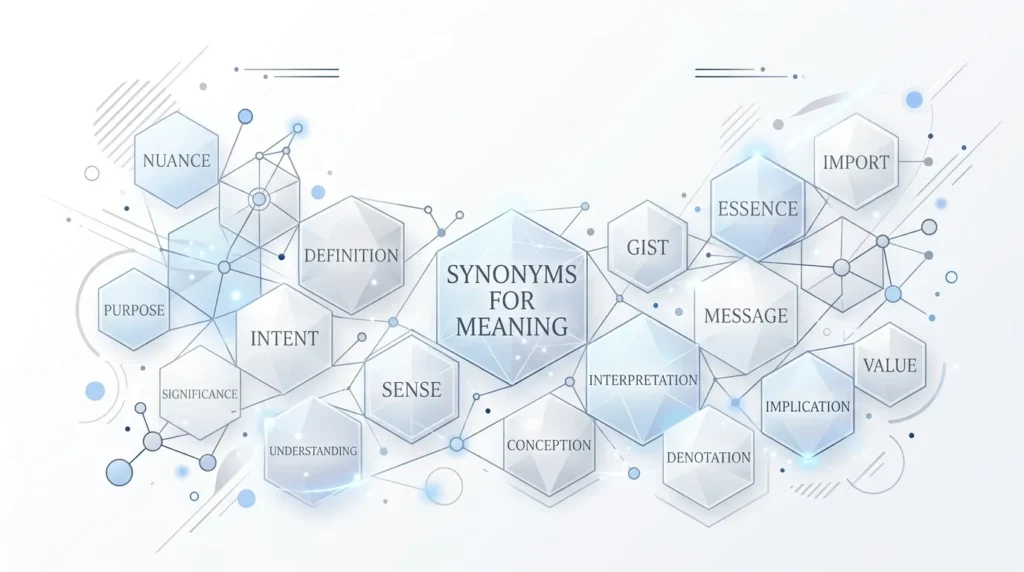
Meaning can also be expressed as sense, definition, significance, purpose, message, interpretation, intention, implication, idea, concept, explanation, and importance.
Imagine reading a short message from a friend that says, “I need some space.” You understand the words, but you may wonder what the person really means. Does the message ask for privacy, time alone, or a break from a difficult situation? This simple example shows why the word meaning is important.
We use it when talking about the definition of a word, the purpose of an action, the message in a story, or the importance of an event. Because meaning has several uses, its best synonym depends on the context.
Learning synonyms for meaning helps English learners understand language more clearly and gives writers better ways to express ideas without repeating the same word. In this article, we will explore its definition, history, pronunciation, word formation, 22 useful synonyms, semantic categories, antonyms, and examples.
Meaning of Meaning
Definition
Meaning (Noun):
Meaning is the idea, message, purpose, or sense that something expresses or represents.
Examples
- What is the meaning of this word?
- Her smile had a special meaning for him.
Connotative Meaning
Connotation: the feeling or idea that a word suggests beyond its direct definition.
- Positive tone: Meaning can suggest importance, value, purpose, or understanding.
- Negative tone: In some contexts, it can suggest hidden implications or a message that causes concern.
- Neutral tone: It can simply refer to the definition or sense of a word, phrase, sign, or statement.
Etymology
The word meaning comes from the Old English verb mænan, which meant “to intend,” “to signify,” or “to have in mind.”
- Old English (450 to 1100): Forms related to mænan were used for intending, remembering, or expressing an idea.
- Middle English (1100 to 1500): The forms developed into words such as menen and mening, referring to intention, sense, or significance.
- Modern English (1500 to Present): Meaning became a common noun for the sense, idea, purpose, or significance expressed by something.
The word is closely related to mean, which developed from the same Germanic linguistic family.
Pronunciation (IPA)
- IPA: /ˈmiː.nɪŋ/
- Syllables: mean-ing
Affixation Pattern of Meaning
- Root: mean
- Prefix: None
- Suffix: -ing
- Word formations:
- mean: verb, adjective
- meaning: noun
- meaningful: adjective
- meaningfully: adverb
- meaningfulness: noun
- meaningless: adjective
- meaninglessness: noun
The suffix -ing helps form the noun meaning from the verb mean.
22 Synonyms of Meaning With Meaning & Examples
1. Sense (Noun)
Meaning: The idea or interpretation expressed by a word, sentence, or action.
Examples:
- I understand the sense of the sentence.
- What sense does this word have here?
2. Definition (Noun)
Meaning: A clear explanation of what a word, phrase, or concept means.
Examples:
- Check the dictionary for the definition.
- The teacher explained the definition of the term.
3. Significance (Noun)
Meaning: The importance or special value of something.
Examples:
- The event has great significance for the community.
- She explained the significance of the discovery.
4. Purpose (Noun)
Meaning: The reason why something exists or is done.
Examples:
- What is the purpose of this meeting?
- The purpose of the tool is to save time.
5. Interpretation (Noun)
Meaning: An explanation of the meaning of something.
Examples:
- Her interpretation of the poem was interesting.
- Different readers may have different interpretations.
6. Intention (Noun)
Meaning: What someone plans or wants to do.
Examples:
- I understood his intention.
- Her intention was to help the team.
7. Implication (Noun)
Meaning: An idea or result that is suggested without being directly stated.
Examples:
- His words had a serious implication.
- We discussed the implications of the decision.
8. Message (Noun)
Meaning: An idea or lesson that someone wants to communicate.
Examples:
- The story has a powerful message.
- What is the main message of the speech?
9. Idea (Noun)
Meaning: A thought, concept, or understanding about something.
Examples:
- I understand the main idea of the article.
- What idea does this symbol represent?
10. Concept (Noun)
Meaning: A general idea or principle about something.
Examples:
- The concept is difficult for beginners.
- The book explains the concept clearly.
11. Import (Noun)
Meaning: Importance or significance, especially in formal language.
Examples:
- The decision was of great import.
- The discovery was of considerable import.
12. Substance (Noun)
Meaning: The main or important idea contained in something.
Examples:
- I understood the substance of his argument.
- The speech had little substance.
13. Content (Noun)
Meaning: The ideas or information contained in something.
Examples:
- The content of the letter was surprising.
- We discussed the content of the report.
14. Purport (Noun)
Meaning: The main meaning or intended message of something.
Examples:
- I understood the purport of his statement.
- The purport of the letter was clear.
15. Denotation (Noun)
Meaning: The direct or literal meaning of a word.
Examples:
- The denotation of the word is easy to find.
- Students should learn both denotation and connotation.
16. Connotation (Noun)
Meaning: An additional feeling or idea associated with a word.
Examples:
- The word has a positive connotation.
- Its connotation changes in different cultures.
17. Reference (Noun)
Meaning: The person, thing, or idea that a word or expression points to.
Examples:
- What is the reference of this pronoun?
- The reference becomes clear in the next sentence.
18. Explanation (Noun)
Meaning: A statement that makes an idea or situation easier to understand.
Examples:
- The teacher gave a simple explanation.
- His explanation helped me understand the problem.
19. Message (Noun)
Meaning: The main thought or lesson communicated by words, actions, or art.
Examples:
- The film carries an important message.
- The message of the poem is hopeful.
20. Moral (Noun)
Meaning: A lesson about right and wrong, especially in a story.
Examples:
- The moral of the story is to be honest.
- Every child understood the moral.
21. Inference (Noun)
Meaning: An idea reached by using clues and available information.
Examples:
- We can make an inference from his behavior.
- Her inference was based on the evidence.
22. Essence (Noun)
Meaning: The most important or basic quality of something.
Examples:
- The essence of the story is friendship.
- He explained the essence of the problem.
Prototype Meaning
The most common meaning of meaning is the idea or sense that something communicates. When people hear this word, they often think about the definition of a word or the message behind a sentence. However, meaning can also refer to purpose, importance, intention, or deeper significance. For example, the meaning of a word is its sense, while the meaning of a life event may refer to its importance or personal value.
Prototype Categorization
The 22 synonyms of meaning cover several related ideas. Knowing these categories helps writers select a word that fits the exact context.
- Word and language sense: sense, definition, denotation, connotation are useful when discussing vocabulary and language.
- Purpose and intention: purpose, intention, purport focus on why something is done or what someone wants to communicate.
- Importance and value: significance, import, essence describe the importance or central quality of something.
- Communication and ideas: message, idea, concept, content, substance focus on the information or thought expressed.
- Interpretation and understanding: interpretation, explanation, inference, reference describe how people understand or explain information.
- Story and lesson: moral, message, significance are especially useful when discussing books, films, poems, and stories.
This grouping makes it easier to choose the most accurate synonym instead of replacing meaning with a word that does not fit the context.
Antonyms of Meaning
Meaninglessness (Noun)
Meaning: The absence of meaning, purpose, or significance.
Nonsense (Noun)
Meaning: Words or ideas that have no clear sense or logical meaning.
Pointlessness (Noun)
Meaning: The quality of having no useful purpose or reason.
Insignificance (Noun)
Meaning: A lack of importance or value.
Emptiness (Noun)
Meaning: A lack of meaningful content, purpose, or feeling.
Confusion (Noun)
Meaning: A state in which the meaning or purpose of something is unclear.
Short Questions and Answers
What does meaning mean?
Meaning refers to the idea, sense, message, purpose, or significance expressed by something.
When should meaning be used?
Use meaning when discussing what a word, statement, action, symbol, story, or event expresses or represents.
Is meaning positive or negative?
Meaning is neutral by itself. Its emotional effect depends on the context and the idea being discussed.
How is it different from similar words?
Meaning is a broad term. Definition usually refers to the direct explanation of a word, purpose refers to a reason for doing something, significance refers to importance, and interpretation refers to an explanation of what something means.
Conclusion
Learning synonyms for meaning helps you express ideas with greater accuracy and variety. The word can refer to a word’s definition, a person’s intention, a story’s message, or the significance of an event. Choosing a more specific synonym can make your writing clearer and your speech more natural.
For example, use definition when discussing vocabulary, purpose when explaining why something exists, significance when talking about importance, and interpretation when discussing different ways of understanding something. You do not need to learn all 22 words at once. Practice a few at a time and create your own sentences. Regular vocabulary practice will gradually improve your English, reduce repetition, and help you communicate your ideas with confidence.

Author Bio
I am Sajjad Ali, an English language writer specializing in synonyms, word meanings, and practical English usage.
I use my expertise in English vocabulary and word choice to create simple, accurate, and helpful content for learners and readers.