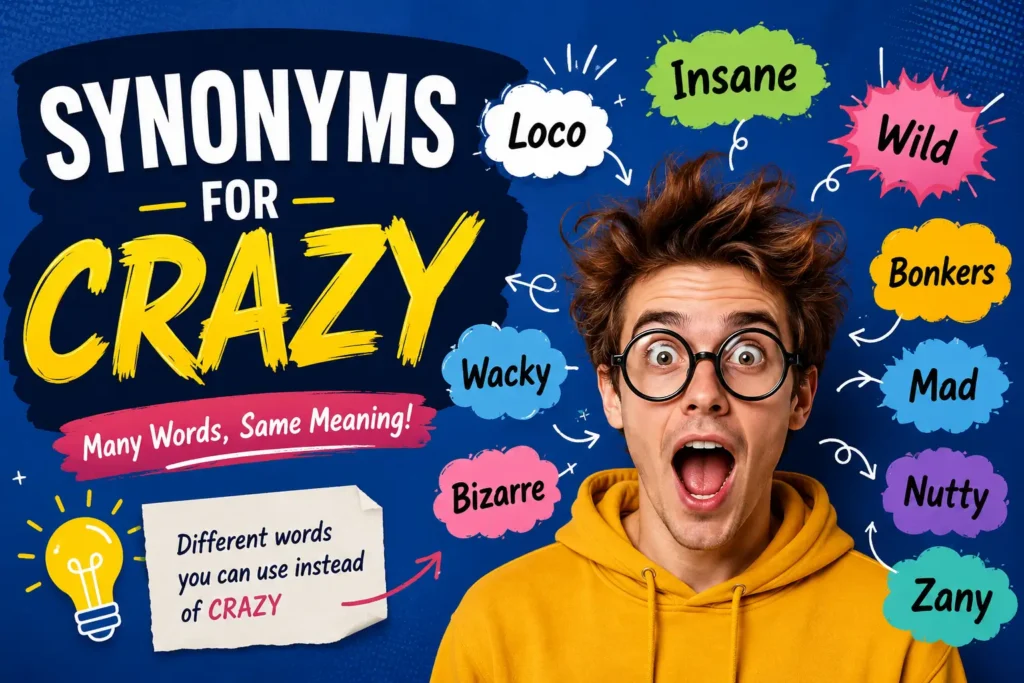

Mad, wild, foolish, bizarre, strange, irrational, frantic, absurd, and unreasonable are useful alternatives to crazy, depending on the context.
Crazy is a common English word with several meanings. Imagine a football fan watching the final seconds of a close match. The crowd is shouting, jumping, and celebrating wildly. Someone might say, “The fans went crazy!” In another situation, a person may call an unusual idea “crazy” because it seems strange or unreasonable. The word is popular in everyday English because it can describe strong excitement, unusual behavior, surprising situations, or something that seems unreasonable.
However, crazy can also sound informal or insensitive when used to describe mental health. Learning its synonyms helps English learners choose more accurate words for each situation. It also helps students and content writers avoid repetition and improve their vocabulary. This article explains the meaning, history, pronunciation, grammar, and 26 useful synonyms of crazy with simple examples.
Meaning of Crazy
Definition
Crazy (Adjective):
Crazy can mean extremely excited, very unusual, unreasonable, wild, or mentally disturbed, depending on the context.
Examples
- The fans went crazy when their team scored.
- That sounds like a crazy idea.
Connotative Meaning
Connotation: The feeling or idea that a word suggests beyond its basic meaning.
- Positive tone: In informal speech, crazy can suggest exciting, impressive, or unusually fun.
- Negative tone: It can suggest foolishness, disorder, or unreasonable behavior.
- Neutral tone: In phrases such as crazy amount or crazy busy, it can simply emphasize something extreme.
Etymology
The word crazy developed from the idea of being damaged, weakened, or mentally disturbed.
- Old English (450–1100): The modern word crazy was not used. Ideas about madness or unusual behavior were expressed through other words.
- Middle English (1100–1500): The related verb craze developed from an older word meaning to break, crack, or shatter.
- Modern English (1500–Present): Crazy developed as an adjective meaning mentally unsound and later gained broader informal meanings such as wild, foolish, extreme, or very enthusiastic.
Pronunciation (IPA)
- IPA: /ˈkreɪzi/
- Syllables: cra-zy — 2 syllables
Affixation Pattern of Crazy
- Root: craze
- Prefix: None
- Suffix: -y
- Word formations:
- craze — verb/noun
- crazy — adjective
- crazily — adverb
- craziness — noun
- crazier — comparative adjective
- craziest — superlative adjective
- crazed — adjective/past participle
- uncrazy — adjective, informal
26 Synonyms for Crazy With Meaning & Examples
1. Mad (Adjective)
Meaning: Informally, very foolish, strange, angry, or mentally disturbed.
Examples:
- That sounds like a mad idea.
- He was mad with excitement.
2. Insane (Adjective)
Meaning: Extremely unreasonable, foolish, or mentally disturbed.
Examples:
- The price of the house is insane.
- It would be insane to ignore the warning.
3. Wild (Adjective)
Meaning: Uncontrolled, extreme, or very energetic.
Examples:
- The party became wild after midnight.
- She had a wild idea for the project.
4. Foolish (Adjective)
Meaning: Lacking good judgment or common sense.
Examples:
- It was foolish to drive so fast.
- He made a foolish decision.
5. Silly (Adjective)
Meaning: Showing poor judgment or lacking seriousness.
Examples:
- That was a silly mistake.
- She had a silly idea.
6. Absurd (Adjective)
Meaning: Completely unreasonable or ridiculous.
Examples:
- The claim sounds absurd.
- It is absurd to blame him for everything.
7. Ridiculous (Adjective)
Meaning: Extremely unreasonable or deserving laughter.
Examples:
- That is a ridiculous excuse.
- The price seems ridiculous.
8. Bizarre (Adjective)
Meaning: Very strange or unusual.
Examples:
- We saw a bizarre scene.
- He told us a bizarre story.
9. Strange (Adjective)
Meaning: Unusual or unfamiliar.
Examples:
- That is a strange question.
- We heard a strange noise outside.
10. Unusual (Adjective)
Meaning: Different from what is normal or expected.
Examples:
- She has an unusual hobby.
- It was an unusual situation.
11. Irrational (Adjective)
Meaning: Not based on reason or sensible thinking.
Examples:
- His fear was irrational.
- It is irrational to panic over a small problem.
12. Unreasonable (Adjective)
Meaning: Not fair, sensible, or based on good judgment.
Examples:
- His demand was unreasonable.
- It is unreasonable to expect perfection.
13. Frantic (Adjective)
Meaning: Extremely worried, excited, or uncontrolled.
Examples:
- She made a frantic search for her keys.
- The crowd became frantic after the announcement.
14. Hysterical (Adjective)
Meaning: Extremely emotional, excited, or difficult to control.
Examples:
- The audience became hysterical with laughter.
- She was hysterical after hearing the news.
15. Feral (Adjective)
Meaning: Wild and uncontrolled, especially like an untamed animal.
Examples:
- The animal became feral when frightened.
- The movie showed a feral character living alone.
16. Deranged (Adjective)
Meaning: Behaving in a severely disturbed or irrational way.
Examples:
- The story featured a deranged villain.
- His actions seemed completely deranged.
17. Unhinged (Adjective)
Meaning: Extremely irrational or emotionally uncontrolled.
Examples:
- His reaction seemed unhinged.
- The character becomes increasingly unhinged.
18. Erratic (Adjective)
Meaning: Unpredictable and inconsistent.
Examples:
- His behavior became erratic.
- The machine has been acting erratically.
19. Frenzied (Adjective)
Meaning: Extremely excited, active, or uncontrolled.
Examples:
- The crowd was frenzied after the goal.
- There was a frenzied rush for tickets.
20. Chaotic (Adjective)
Meaning: Completely disorganized or difficult to control.
Examples:
- The morning was chaotic.
- Traffic became chaotic after the accident.
21. Manic (Adjective)
Meaning: Extremely energetic, excited, or hurried.
Examples:
- The office had a manic atmosphere.
- It was a manic race to finish the project.
22. Nutty (Adjective)
Meaning: Very strange or foolish; an informal word.
Examples:
- He came up with a nutty plan.
- That sounds like a nutty idea.
23. Crackpot (Adjective/Noun)
Meaning: A person or idea considered foolish or eccentric.
Examples:
- He dismissed the theory as crackpot.
- The crackpot inventor had unusual ideas.
24. Eccentric (Adjective)
Meaning: Unusually different in behavior, style, or ideas.
Examples:
- The artist was known for his eccentric style.
- She has an eccentric sense of humor.
25. Outrageous (Adjective)
Meaning: Extremely unusual, shocking, or unreasonable.
Examples:
- The restaurant charged an outrageous price.
- His behavior was completely outrageous.
26. Bonkers (Adjective)
Meaning: Very silly, strange, or unreasonable; mainly informal.
Examples:
- That idea sounds bonkers.
- The traffic was absolutely bonkers today.
Important note: These synonyms are not interchangeable in every situation. Crazy is a broad and informal word. For precise writing, choose a word such as bizarre for something strange, irrational for something unreasonable, chaotic for disorder, or frantic for uncontrolled activity. Terms such as insane, deranged, and unhinged can be sensitive when referring to people, so use them carefully.
Prototype Meaning
The most common everyday meaning of crazy is very unusual, extreme, wild, or unreasonable. When people hear this word in casual conversation, they may imagine something surprising, exciting, or difficult to believe. For example, That was a crazy game! usually means the game was unusually exciting or dramatic. The exact meaning depends strongly on context.
Prototype Categorization
The 26 synonyms can be grouped according to the specific idea they express.
- Strange or unusual: bizarre, strange, unusual, eccentric, bonkers — useful when something is different from what is normal.
- Foolish or unreasonable: foolish, silly, absurd, ridiculous, irrational, unreasonable, crackpot — useful for ideas or actions that lack good sense.
- Wild or uncontrolled: wild, frantic, hysterical, feral, frenzied, manic — useful when behavior or activity is highly energetic or difficult to control.
- Disordered or unpredictable: erratic, chaotic, unhinged — useful when behavior or situations are unstable or difficult to predict.
- Extreme or shocking: insane, outrageous — useful in informal contexts to emphasize something unusually extreme.
- Strongly negative descriptions of behavior: deranged — best reserved for contexts where severely disturbed behavior is genuinely relevant.
This categorization helps writers select a word based on the exact meaning they want instead of using crazy for every situation.
Antonyms of Crazy
1. Sane (Adjective)
Meaning: Having a sound and reasonable mind or judgment.
2. Sensible (Adjective)
Meaning: Showing good judgment and practical thinking.
3. Rational (Adjective)
Meaning: Based on reason and logical thinking.
4. Calm (Adjective)
Meaning: Peaceful and not emotionally excited or upset.
5. Reasonable (Adjective)
Meaning: Fair, sensible, and based on good judgment.
6. Normal (Adjective)
Meaning: Typical or expected rather than unusual.
Short Questions and Answers
What does crazy mean?
Crazy can mean very strange, unreasonable, wild, extreme, or highly excited. Its meaning depends on context.
When should crazy be used?
Use crazy mainly in informal English when describing something unusual, extreme, exciting, or unreasonable. In formal writing, a more precise word is often better.
Is crazy positive or negative?
It can be either. That concert was crazy! may be positive, while That was a crazy decision may be negative.
How is it different from similar words?
Crazy is broad and informal. Bizarre focuses on strangeness, irrational focuses on poor reasoning, frantic focuses on uncontrolled activity, and chaotic focuses on disorder.
Conclusion
Learning synonyms for crazy can make your English more accurate and expressive. Although crazy is common and useful in casual conversation, it has many possible meanings. Words such as bizarre, foolish, irrational, frantic, chaotic, eccentric, and outrageous allow you to describe the exact quality you mean. Choosing a precise synonym also helps avoid repetition in essays, stories, blogs, and everyday speech.
It is important to remember that some words connected with mental illness can sound insensitive when used casually about people. When possible, describe the specific behavior or situation instead. Practice learning a few alternatives each day and use them in your own sentences. This habit will expand your vocabulary, strengthen your writing, and help you communicate with greater confidence and care.
read more : Pretty Synonyms: 25 Beautiful Alternatives to Use