
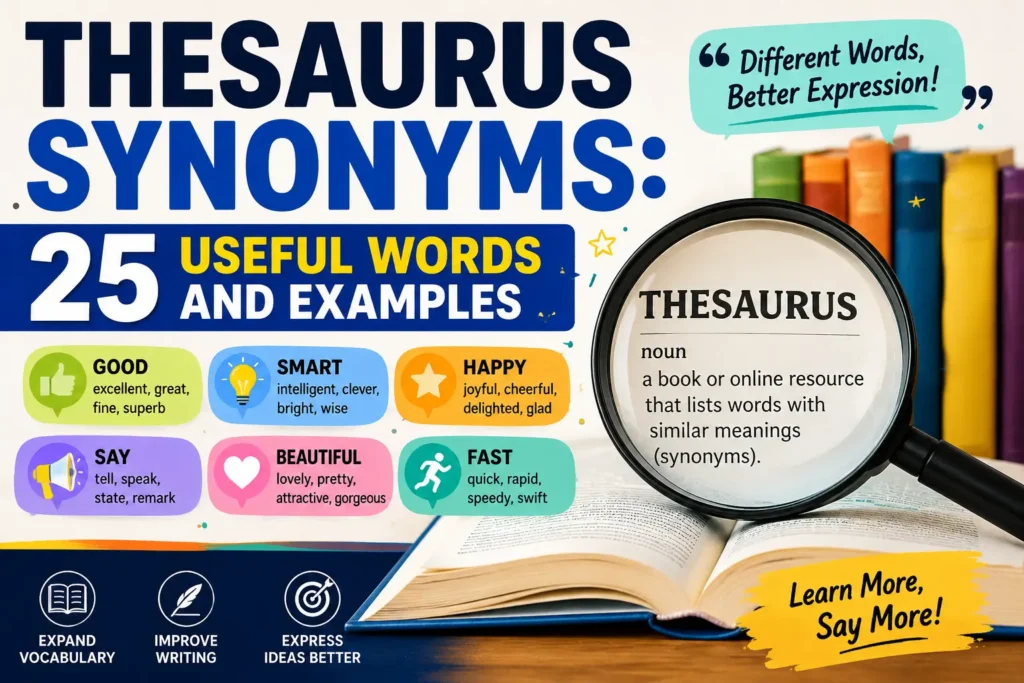

Word alternatives, equivalent words, related terms, substitutes, replacements, similar words, and near-synonyms can help you expand your vocabulary and write with greater variety.
Introduction
A thesaurus is a useful language tool that helps people find words with similar or related meanings. Imagine a student writing an essay and noticing that the word important appears several times on the same page. Instead of repeating it, the student can use a thesaurus to find alternatives such as significant, valuable, or essential. This makes the writing more varied and precise. A thesaurus is helpful for students, writers, editors, teachers, and English learners who want to build a stronger vocabulary.
However, words listed together are not always exact synonyms, so it is important to understand their differences before using them. In this article, you will learn what thesaurus synonyms means, explore 25 related terms with examples, and discover their pronunciation, etymology, grammar, and semantic categories. These words can help you make better choices in both writing and speaking.
Meaning of Thesaurus Synonyms
Definition
Thesaurus Synonyms (Noun Phrase):
Thesaurus synonyms are words or expressions with the same or similar meanings that can be found or suggested by a thesaurus.
Examples
- I used a thesaurus to find synonyms for “beautiful.”
- The writer checked the thesaurus for alternative words.
Connotative Meaning
Connotation: The feeling or idea that a word suggests beyond its basic meaning.
- Positive tone: The phrase can suggest vocabulary growth, better writing, and language learning.
- Negative tone: It may suggest forced word replacement if synonyms are chosen without considering context.
- Neutral tone: It usually refers simply to words with similar meanings found through a thesaurus.
Etymology
The phrase thesaurus synonyms combines two words with different histories.
- Old English (450–1100): English had words related to ideas such as sameness, likeness, and meaning, but the modern term thesaurus was not yet used in English.
- Middle English (1100–1500): Synonym entered English through French and Latin from Greek, while thesaurus came through Latin from Greek.
- Modern English (1500–Present): Thesaurus became established as a term for a collection or dictionary of words, especially words grouped by meaning. Synonym refers to a word with the same or nearly the same meaning as another word.
Pronunciation (IPA)
- Thesaurus: /θɪˈsɔːrəs/
- Synonyms: /ˈsɪnənɪmz/
- Syllables: the-sau-rus syn-o-nyms
Affixation Pattern of Thesaurus Synonyms
- Root: thesaurus comes from Greek thēsauros, meaning “treasure” or “storehouse.” Synonym comes from Greek roots meaning “same” and “name.”
- Prefix: syn- appears in synonym, meaning “together” or “same.”
- Suffix: -ous appears in thesaurus as part of its borrowed historical form; -nym in synonym relates to “name.”
- Word formations:
- thesaurus — noun
- thesauri — plural noun
- synonym — noun
- synonyms — plural noun
- synonymous — adjective
- synonymously — adverb
- synonymy — noun
- antonym — noun
- antonymous — adjective
25 Thesaurus Synonyms With Meaning & Examples
1. Synonym (Noun)
Meaning: A word that has the same or nearly the same meaning as another word.
Examples:
- Happy is a synonym of glad.
- The thesaurus gives several synonyms for the word.
2. Alternative (Noun/Adjective)
Meaning: Another word or choice that can be used instead.
Examples:
- We need an alternative to the word good.
- The writer found an alternative expression.
3. Equivalent (Noun/Adjective)
Meaning: Something that has the same or nearly the same meaning, value, or function.
Examples:
- Begin is an equivalent of start in many contexts.
- The two expressions have similar equivalent meanings.
4. Substitute (Noun/Verb)
Meaning: A word or expression used instead of another.
Examples:
- Purchase can be a formal substitute for buy.
- The writer used a substitute for the repeated word.
5. Replacement (Noun)
Meaning: Something used instead of another word or expression.
Examples:
- She found a suitable replacement for the repeated term.
- The editor suggested a replacement word.
6. Alternative Word (Noun Phrase)
Meaning: A different word that can express a similar idea.
Examples:
- The thesaurus suggested an alternative word.
- Choose an alternative word that fits the sentence.
7. Similar Word (Noun Phrase)
Meaning: A word that has a meaning close to another word.
Examples:
- Large and big are similar words.
- The teacher asked us to find a similar word.
8. Related Term (Noun Phrase)
Meaning: A word connected to another word through meaning or subject.
Examples:
- The thesaurus includes several related terms.
- Look for a related term if no exact synonym works.
9. Near-Synonym (Noun)
Meaning: A word with a meaning very close to another word but not exactly the same.
Examples:
- Slim and thin can be near-synonyms.
- A near-synonym may have a different emotional tone.
10. Analogue (Noun)
Meaning: Something similar to another thing in function or meaning.
Examples:
- The editor found an analogue for the technical term.
- This word has an English analogue with a similar meaning.
11. Paraphrase (Noun/Verb)
Meaning: A different way of expressing the same or nearly the same idea.
Examples:
- The student wrote a paraphrase of the sentence.
- You can paraphrase the original statement.
12. Rewording (Noun)
Meaning: A new way of expressing the same idea using different words.
Examples:
- The sentence needs some rewording.
- Her rewording made the meaning clearer.
13. Restatement (Noun)
Meaning: A statement that expresses an idea again in a different way.
Examples:
- The final paragraph is a restatement of the main idea.
- His restatement made the point easier to understand.
14. Expression (Noun)
Meaning: A word, phrase, or way of communicating an idea.
Examples:
- That is a common English expression.
- The writer chose a formal expression.
15. Term (Noun)
Meaning: A particular word or phrase used to express a specific idea.
Examples:
- Climate change is a common scientific term.
- The thesaurus helped me find a better term.
16. Phrase (Noun)
Meaning: A group of words that expresses an idea.
Examples:
- This phrase has a similar meaning.
- The writer used a different phrase to avoid repetition.
17. Wording (Noun)
Meaning: The particular choice and arrangement of words.
Examples:
- The wording of the sentence is simple.
- Better wording can make the message clearer.
18. Vocabulary (Noun)
Meaning: The words used in a language or by a person.
Examples:
- Reading can improve your vocabulary.
- A thesaurus can help expand your vocabulary.
19. Lexeme (Noun)
Meaning: A basic unit of meaning in a language.
Examples:
- A dictionary entry can represent a lexeme.
- Linguists study how a lexeme functions in different contexts.
20. Word Choice (Noun Phrase)
Meaning: The selection of particular words for speaking or writing.
Examples:
- Good word choice makes writing stronger.
- Careful word choice can change the tone of a sentence.
21. Diction (Noun)
Meaning: A person’s choice and use of words, especially in writing or formal speech.
Examples:
- The author’s diction is clear and formal.
- Strong diction can improve an essay.
22. Terminology (Noun)
Meaning: The special words used in a particular subject or field.
Examples:
- Medical terminology can be difficult for beginners.
- The article explains basic technical terminology.
23. Vocabulary Item (Noun Phrase)
Meaning: A particular word or expression that forms part of a person’s vocabulary.
Examples:
- Generous is a useful vocabulary item.
- Students learned five new vocabulary items.
24. Word Form (Noun)
Meaning: A particular written or spoken version of a word.
Examples:
- The dictionary shows each word form.
- Choose the correct word form for the sentence.
25. Lexical Alternative (Noun Phrase)
Meaning: Another word or expression that can be used to convey a similar meaning.
Examples:
- The writer chose a lexical alternative to avoid repetition.
- A thesaurus can provide useful lexical alternatives.
Note: Not all of these terms are exact synonyms of synonym. Some, such as paraphrase, wording, and diction, are related language concepts. A thesaurus often groups related words together, but context determines whether one word can truly replace another.
Prototype Meaning
The most typical meaning of thesaurus synonyms is words with similar meanings that can be found through a thesaurus. When people hear this phrase, they usually think of looking up a word and finding several alternatives that can make writing more varied. The main goal is to help users select a word that fits their meaning and context.
Prototype Categorization
The 25 terms can be grouped into useful semantic categories.
- Direct meaning relationships: synonym, equivalent, near-synonym, analogue — useful when discussing words with similar meanings.
- Replacement and alternatives: alternative, substitute, replacement, alternative word, lexical alternative — useful when one word is being replaced with another.
- Rephrasing: paraphrase, rewording, restatement, expression, phrase — useful when an entire idea or phrase is expressed differently.
- Language and vocabulary: vocabulary, lexeme, vocabulary item, word form — useful in language learning and linguistics.
- Writing and style: wording, word choice, diction — useful when discussing how writers select and use words.
- Specialized language: term, related term, terminology — useful for words connected to a particular subject or field.
This categorization helps writers understand that a thesaurus is not only a list of interchangeable words. It can also show related ideas, expressions, and language choices.
Antonyms of Thesaurus Synonyms
Because thesaurus synonyms refers to words with similar meanings, its closest opposites are terms related to difference or contrast.
1. Antonym (Noun)
Meaning: A word with an opposite or contrasting meaning.
2. Opposite (Noun/Adjective)
Meaning: A word or idea that has a contrasting meaning.
3. Contrasting Term (Noun Phrase)
Meaning: A word that expresses an idea different from or opposed to another term.
4. Unrelated Word (Noun Phrase)
Meaning: A word that has no meaningful connection to the word being discussed.
5. Distinct Term (Noun Phrase)
Meaning: A separate word with a different meaning.
Short Questions and Answers
What are thesaurus synonyms?
They are words with the same or similar meanings that can be found or suggested by a thesaurus.
When should a thesaurus be used?
Use a thesaurus when you want to expand your vocabulary, avoid unnecessary repetition, or find a word that better matches your intended meaning.
Are all thesaurus synonyms exact synonyms?
No. Many words have slightly different meanings, tones, or uses. Always check the context before replacing one word with another.
How is a thesaurus different from a dictionary?
A dictionary mainly explains a word’s meaning, pronunciation, grammar, and usage. A thesaurus mainly helps you find synonyms, related words, and sometimes antonyms.
Conclusion
Understanding thesaurus synonyms can help English learners and writers develop a richer vocabulary. A thesaurus provides useful alternatives, but choosing the right word requires more than simply selecting the first synonym on a list. Words can differ in tone, strength, formality, and context. Learning terms such as synonym, alternative, equivalent, substitute, near-synonym, paraphrase, wording, and diction can also improve your understanding of how English works.
When writing an essay, article, story, or professional message, use a thesaurus to explore your options and then check whether the chosen word fits the sentence naturally. Regular reading and vocabulary practice will make this process easier. With careful word choice, your writing can become clearer, more varied, precise, and confident.
Read more Synonyms for Crazy: 26 Words to Know.