Categories are groups of things that share something in common. Walk into a grocery store. Fruit is in one aisle, bread in another, and milk in the cold section. Those aisles are categories. They help you find things fast. We use this word in shopping, school, science, games, and websites.
| Section | What You Will Learn |
|---|---|
| Meaning | What categories means, plus tone and examples |
| Background | History, IPA pronunciation, and word parts |
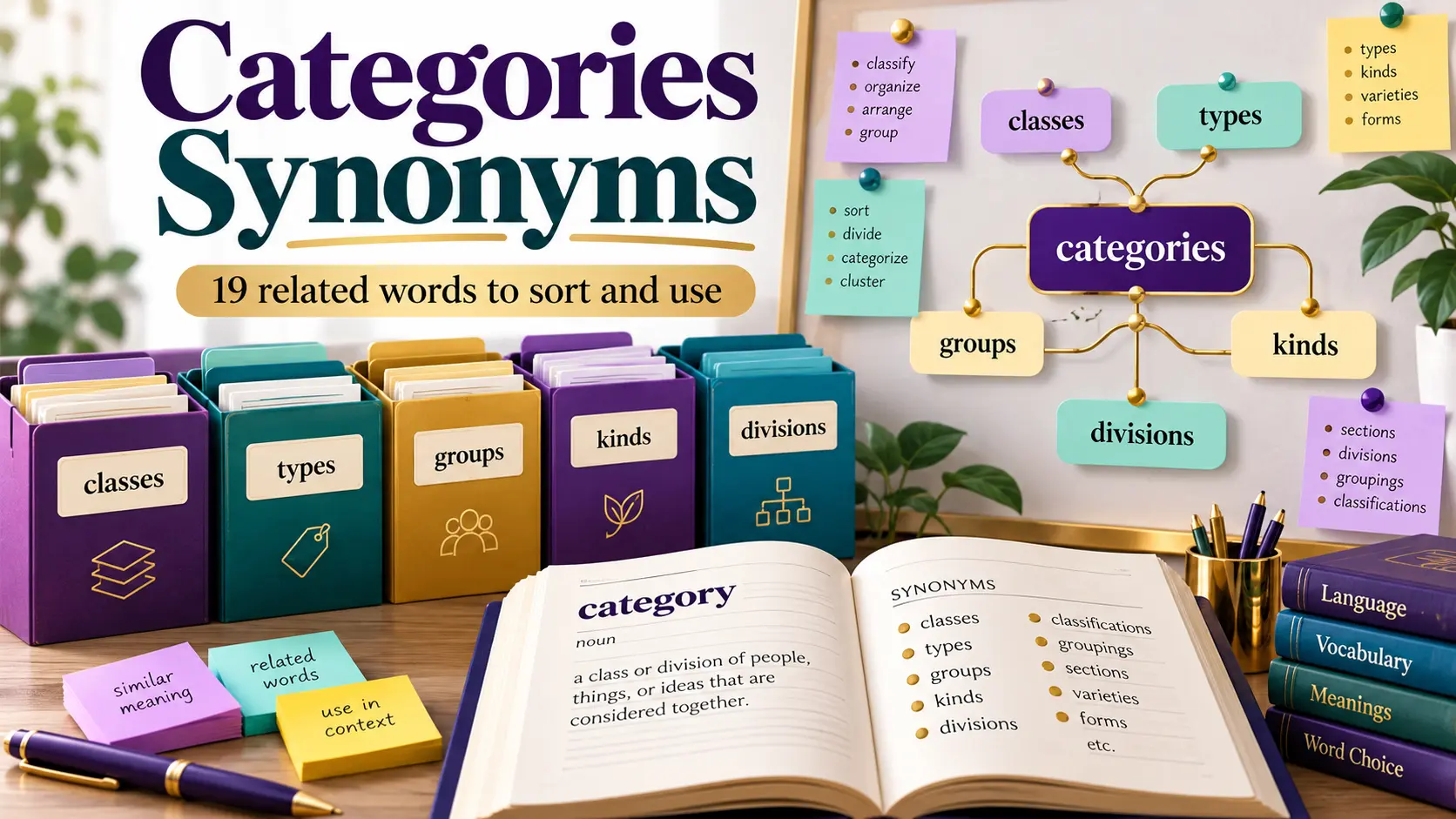
| 26 Synonyms | Each with a meaning and two examples |
| Word Groups | How the synonyms fit into meaning groups |
Synonyms matter because writers use categories again and again in lists, menus, and reports. English learners and content writers need fresh words to stay clear and avoid repetition.
Meaning of Categories
Definition
Categories (Noun, plural): Groups of people or things that share the same features or type.
Examples
- The library sorts books into categories like history and science.
- The contest has three age categories.
Connotative Meaning
The feeling of categories changes with context.
- Positive tone: Organized and helpful. “Clear categories make the site easy to use.”
- Negative tone: It can suggest unfair labels. “Don’t put people into narrow categories.”
- Neutral tone: Mostly plain and factual. “Pick one of the five categories.”
(Connotation: the feeling or emotion a word carries beyond its dictionary meaning.)
Etymology
Category comes from the Greek katēgoria, meaning “accusation” or “statement.” It grew from katēgorein, “to speak against” or “to state.” The Greek thinker Aristotle used it for the main classes of things we can say about the world.
- Old English (450–1100): The word did not exist yet in English.
- Middle English (1100–1500): Scholars knew the Latin form categoria from Aristotle’s books, but it was not an everyday English word.
- Modern English (1500–Present): In the 1580s, category entered English through French catégorie. Its plural, categories, now means any set of groups.
Pronunciation (IPA)
- IPA: /ˈkætəɡəriz/ (UK), /ˈkætəˌɡɔːriz/ (US)
- Syllables: cat·e·go·ries (four syllables, stress on the first)
Affixation Pattern of Categories
- Root: category, from Greek katēgoria
- Prefix: Greek kata- (down, against) is hidden inside the root; sub- can be added (subcategories)
- Suffix: -ies (plural, replacing -y)
- Word formations:
- category (noun, singular)
- subcategory / subcategories (noun)
- categorize (verb)
- categorized (adjective; verb, past tense)
- categorization (noun)
- categorical (adjective)
- categorically (adverb)
26 Categories Synonyms With Meaning & Examples
1. Classes (Noun)
Meaning: Groups sorted by type or level.
Examples:
- Animals are sorted into classes.
- Tickets come in three classes.
2. Groups (Noun)
Meaning: Sets of things or people placed together.
Examples:
- Split the words into groups.
- The kids worked in groups.
3. Types (Noun)
Meaning: Kinds of something with shared features.
Examples:
- There are many types of bread.
- Blood types differ.
4. Kinds (Noun)
Meaning: Sorts or types.
Examples:
- We sell all kinds of toys.
- What kinds of music do you like?
5. Sorts (Noun)
Meaning: Types or kinds (common in speech).
Examples:
- He meets all sorts of people.
- They sell different sorts of tea.
6. Varieties (Noun)
Meaning: Different forms of the same thing.
Examples:
- The farm grows ten varieties of apples.
- Roses come in many varieties.
7. Classifications (Noun)
Meaning: Official groupings in a system.
Examples:
- The film has age classifications.
- Job classifications affect pay.
8. Divisions (Noun)
Meaning: Separate parts of a whole.
Examples:
- The league has two divisions.
- The company has four divisions.
9. Sections (Noun)
Meaning: Parts of something.
Examples:
- The store has a baby section.
- Read the first two sections.
10. Departments (Noun)
Meaning: Parts of a store or company.
Examples:
- Visit the shoe department.
- Each department has a manager.
11. Branches (Noun)
Meaning: Parts that grow from a main subject.
Examples:
- Biology is a branch of science.
- Math has many branches.
12. Genres (Noun)
Meaning: Types of art, music, or writing.
Examples:
- Mystery is my favorite genre.
- Pop and jazz are genres.
13. Brackets (Noun)
Meaning: Groups within a range, like age or income.
Examples:
- Players are in age brackets.
- Taxes depend on income brackets.
14. Tiers (Noun)
Meaning: Levels ranked one above another.
Examples:
- The plan has three price tiers.
- The cake has four tiers.
15. Ranks (Noun)
Meaning: Positions in a system or order.
Examples:
- She rose through the ranks.
- Army ranks show who leads.
16. Grades (Noun)
Meaning: Levels of quality or school years.
Examples:
- Eggs come in different grades.
- He skipped two grades.
17. Levels (Noun)
Meaning: Steps on a scale.
Examples:
- The game has ten levels.
- Choose your skill level.
18. Orders (Noun)
Meaning: Large groups in science or rank.
Examples:
- Bats belong to their own order.
- Monks live in religious orders.
19. Families (Noun)
Meaning: Groups of related things.
Examples:
- Cats and lions are in the same family.
- Words form families too.
20. Species (Noun)
Meaning: Groups of living things that can breed together.
Examples:
- The zoo has 200 species.
- This species is rare.
21. Breeds (Noun)
Meaning: Types of an animal made by people.
Examples:
- Poodles are a dog breed.
- The farm has many cattle breeds.
22. Brands (Noun)
Meaning: Product types made by one company.
Examples:
- Compare brands before you buy.
- The store sells local brands.
23. Labels (Noun)
Meaning: Names given to groups or people.
Examples:
- Food labels list ingredients.
- She dislikes simple labels.
24. Headings (Noun)
Meaning: Titles that group information.
Examples:
- Use clear headings in your essay.
- List items under each heading.
25. Pigeonholes (Noun)
Meaning: Fixed, narrow groups (often negative).
Examples:
- Don’t force people into pigeonholes.
- Each idea had its pigeonhole.
26. Taxonomies (Noun)
Meaning: Formal systems for sorting things.
Examples:
- Scientists use taxonomies for plants.
- The website has a clear taxonomy.
Prototype Meaning
When people hear categories, they usually picture labeled boxes or store aisles, where each item has a clear home. The typical image is sorting: this goes here, that goes there. The core idea is order through grouping.
Prototype Categorization
The 26 synonyms fall into five groups:
- Everyday grouping words (groups, types, kinds, sorts, varieties, classes): Simple words for any set of similar things.
- Parts of a whole (divisions, sections, departments, branches, headings): Words for parts of stores, companies, subjects, and documents.
- Ranked levels (tiers, ranks, grades, levels, brackets): Words for groups placed higher or lower on a scale.
- Science and nature (species, breeds, families, orders, taxonomies, classifications): Words for formal systems in biology and research.
- Culture, products, and labels (genres, brands, labels, pigeonholes): Words for art, shopping, and how we name people or things.
This grouping helps writers use the right term in the right field. Say genres for books, tiers for pricing, and species for animals. Using pigeonholes shows you think a label is too narrow.
Antonyms of Categories
Individuals (Noun)
- Single things or people, not groups.
Mixture (Noun)
- Things mixed together without sorting.
Jumble (Noun)
- A messy, unsorted pile.
Disorder (Noun)
- A lack of order or system.
Whole (Noun)
- The complete thing, not divided.
Chaos (Noun)
- Total confusion with no structure.
Short Questions and Answers
What does categories mean?
It means groups of things or people that share the same features.
When should categories be used?
Use it when sorting items in lists, stores, websites, contests, or science. It fits both casual and formal writing.
Is categories positive or negative?
It is mostly neutral and helpful. It turns negative when people are labeled unfairly.
How is it different from similar words?
Types and kinds are more casual. Tiers and ranks show order. Genres are for art. Categories is a general, flexible word for any sorting system.
Conclusion
Sorting ideas is a skill, and so is sorting words. Learning categories and its synonyms improves your vocabulary and helps you name groups with care.
You can write genres in a book review, tiers on a price page, and species in a science report. This makes your writing and speaking stronger. It also keeps you from repeating one word in every list. The more exact you are, the more confident you will feel in English.
To go further, read synonyms of understanding to see how grouping helps the mind, synonyms for explained to describe each group clearly, and synonyms for additional to talk about extra subcategories.
Practice every day. Pick a room in your home, sort what you see into groups, and name each group with a different synonym.

Dshaikh
Founder & Editorial Director
I’m the founder and editorial director of this vocabulary series. I’ve spent over 35 years in pharmaceutical and healthcare marketing across Pakistan, the UAE, and the USA, where I launched 200+ brands and earned two Guinness World Records. That work taught me one lesson again and again: the right word builds trust, and the wrong one loses it. I set the plain-English standard for every guide here, so you can use new words the same day you learn them.