| At a GlanceWord: additionalSimple meaning: extra; added to what is already thereWhere you see it: receipts, emails, forms, and school rulesIn this guide: 28 synonyms, examples, grammar, history, and pronunciation |
Imagine you order a pizza. The clerk asks, “Any additional toppings?” You say, “Yes, extra cheese, please!” That is additional in real life. It means something more on top of what you have.
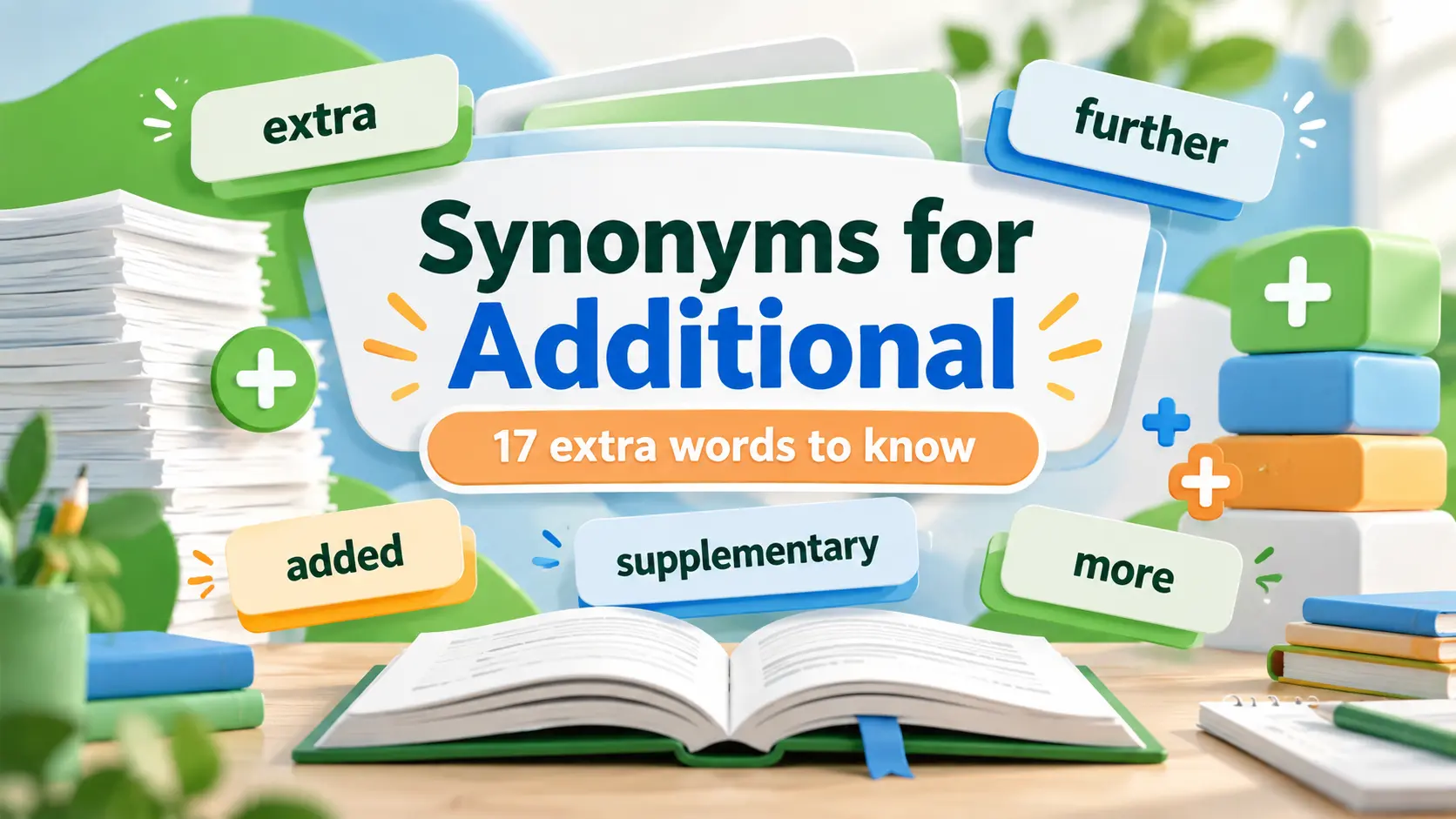
This word is common in business, forms, and polite requests. Because it appears so often, it can feel stiff and repetitive. English learners and content writers need other words like extra, more, or further. This article explains what additional means and shares 28 synonyms with examples, grammar, history, pronunciation, and meaning groups.
Meaning of Additional
Definition
Additional (Adjective): Added to what already exists; extra or more.
Examples
- There is an additional fee for late returns.
- We need additional chairs for the guests.
Connotative Meaning
The feeling of additional changes with context.
- Positive tone: Generous and helpful. “We added an additional bonus for you.”
- Negative tone: Annoying when it means more cost or work. “There are additional charges.”
- Neutral tone: Plain and factual in most uses. “See the additional notes below.”
(Connotation: the feeling or emotion a word carries beyond its dictionary meaning.)
Etymology
Additional grows from the Latin addere, “to add.” It joins ad- (to) and dare (to give). So adding once meant “giving to.”
- Old English (450–1100): The word did not exist yet. Old English used ēaca for “an addition.”
- Middle English (1100–1500): In the late 1300s, adden (to add) and addicioun (addition) came into English through Latin and French.
- Modern English (1500–Present): In the 1640s, -al was added to addition to form the adjective additional. It became common in business and legal writing.
Pronunciation (IPA)
- IPA: /əˈdɪʃənəl/
- Syllables: ad·di·tion·al (four syllables, stress on the second)
Affixation Pattern of Additional
- Root: add, from Latin addere (to add)
- Prefix: The Latin ad- (to) is hidden inside the root; no modern English prefix
- Suffix: -tion (makes a noun) + -al (makes an adjective)
- Word formations:
- add (verb)
- addition (noun)
- additionally (adverb)
- additive (noun and adjective)
- added (adjective)
- add-on (noun)
28 Synonyms for Additional With Meaning & Examples
1. Extra (Adjective)
Meaning: More than usual or needed.
Examples:
- Bring an extra coat.
- He worked extra hours.
2. More (Adjective)
Meaning: A greater amount or number.
Examples:
- We need more paper.
- Can I have more rice?
3. Further (Adjective)
Meaning: Additional or more (often in formal use).
Examples:
- Call us for further help.
- We need further proof.
4. Added (Adjective)
Meaning: Put in to increase something.
Examples:
- The soup has added salt.
- Enjoy the added comfort.
5. Supplementary (Adjective)
Meaning: Added to complete or improve something.
Examples:
- Read the supplementary notes.
- She takes supplementary classes.
6. Supplemental (Adjective)
Meaning: Given as an extra support.
Examples:
- They got supplemental funding.
- Use the supplemental guide.
7. Auxiliary (Adjective)
Meaning: Giving extra help or support.
Examples:
- The ship has an auxiliary engine.
- Auxiliary staff help nurses.
8. Accessory (Adjective)
Meaning: Extra but not main or necessary.
Examples:
- The car has accessory lights.
- These are accessory parts.
9. Ancillary (Adjective)
Meaning: Supporting the main thing (formal).
Examples:
- The hospital has ancillary services.
- There are ancillary costs.
10. Complementary (Adjective)
Meaning: Adding something that completes another.
Examples:
- The colors are complementary.
- They have complementary skills.
11. Fresh (Adjective)
Meaning: New and added.
Examples:
- We need fresh ideas.
- She started a fresh page.
12. New (Adjective)
Meaning: Not there before; recently added.
Examples:
- The school hired new teachers.
- They added new rules.
13. Other (Adjective)
Meaning: Different or additional.
Examples:
- Do you have other options?
- Ask the other students.
14. Another (Adjective)
Meaning: One more of the same kind.
Examples:
- May I have another cookie?
- Take another look.
15. Spare (Adjective)
Meaning: Extra and kept for later use.
Examples:
- Keep a spare key.
- Do you have a spare pen?
16. Surplus (Adjective)
Meaning: More than what is needed.
Examples:
- They gave surplus food away.
- The surplus stock was sold.
17. Excess (Adjective)
Meaning: Over the normal or allowed amount.
Examples:
- Wipe off the excess oil.
- We paid for excess baggage.
18. Leftover (Adjective)
Meaning: Remaining after use.
Examples:
- We ate leftover pasta.
- Use the leftover paint.
19. Increased (Adjective)
Meaning: Made larger in amount.
Examples:
- There is increased traffic today.
- They saw increased sales.
20. Expanded (Adjective)
Meaning: Made bigger or wider.
Examples:
- The store has an expanded menu.
- Read the expanded version.
21. Bonus (Adjective)
Meaning: Extra and pleasant, as a gift.
Examples:
- Enjoy a bonus track.
- We got a bonus day off.
22. Complimentary (Adjective)
Meaning: Given for free as an extra.
Examples:
- The hotel offers complimentary tea.
- Get a complimentary gift.
23. Add-on (Adjective)
Meaning: Added as an optional extra.
Examples:
- Buy the add-on pack.
- It is an add-on service.
24. Appended (Adjective)
Meaning: Attached at the end of something.
Examples:
- Read the appended list.
- The appended note explains the price.
25. Top-up (Adjective)
Meaning: Added to fill something to the full amount.
Examples:
- He made a top-up payment.
- She bought top-up credit.
26. Incremental (Adjective)
Meaning: Added in small steps over time.
Examples:
- We saw incremental growth.
- Make incremental changes.
27. Secondary (Adjective)
Meaning: Coming after the main thing.
Examples:
- That is a secondary issue.
- They used a secondary exit.
28. Adjunct (Adjective)
Meaning: Added as a helper but not the main part.
Examples:
- She is an adjunct teacher.
- The clinic has adjunct services.
Prototype Meaning
When people hear additional, they usually picture something placed on top of what is already there. An extra item on a bill, one more chair at the table, or a second page of notes are typical images. The core idea is “plus one more.”
Prototype Categorization
The 28 synonyms fall into five groups:
- Simple “more” (extra, more, further, added, another, other): Everyday words for adding more.
- Support and completion (supplementary, supplemental, auxiliary, accessory, ancillary, complementary, secondary, adjunct): Formal words for extras that support the main thing.
- New additions (fresh, new, add-on, appended, top-up): Words for things added later or on request.
- Beyond what is needed (spare, surplus, excess, leftover): Words for amounts that are more than enough.
- Growth and gifts (increased, expanded, incremental, bonus, complimentary): Words for growth over time or pleasant free extras.
Grouping helps writers fit the setting. Use extra in chat, supplementary in a report, and complimentary in hotel copy. Watch out: complementary (completes) and complimentary (free) are different words.
Antonyms of Additional
Fewer (Adjective)
- A smaller number of things.
Less (Adjective)
- A smaller amount.
Reduced (Adjective)
- Made smaller.
Basic (Adjective)
- Only the main or simple parts.
Essential (Adjective)
- Needed and central, not extra.
Primary (Adjective)
- First and most important.
Removed (Adjective)
- Taken away.
Short Questions and Answers
What does additional mean?
It means extra or added to what already exists.
When should additional be used?
Use it in forms, emails, business writing, and polite requests. In casual talk, extra or more sounds more natural.
Is additional positive or negative?
It is neutral. Additional help is good news. Additional fees are bad news.
How is it different from similar words?
Extra is more casual. Supplementary is more formal. Surplus means more than needed. Additional sits in the middle and fits most settings.
Conclusion
Learning additional and its synonyms gives you tools for every setting. Your vocabulary grows as you learn when to say extra, further, or supplementary.
This strengthens both writing and speaking. Your emails sound polished, and your chats sound natural. You will also avoid using the same word in every line, which keeps readers interested. Each correct choice builds your English confidence.
Want a few more useful word lists? Read synonyms for cheap to talk about prices, synonyms for result to describe what extra effort brings, and categories synonyms to sort your new words into groups. Here is an easy daily habit: look at one receipt, form, or email each day. Find where additional appears, and swap in a synonym that fits better. A little extra practice goes a long way.

Dshaikh
Founder & Editorial Director
I’m the founder and editorial director of this vocabulary series. I’ve spent over 35 years in pharmaceutical and healthcare marketing across Pakistan, the UAE, and the USA, where I launched 200+ brands and earned two Guinness World Records. That work taught me one lesson again and again: the right word builds trust, and the wrong one loses it. I set the plain-English standard for every guide here, so you can use new words the same day you learn them.