
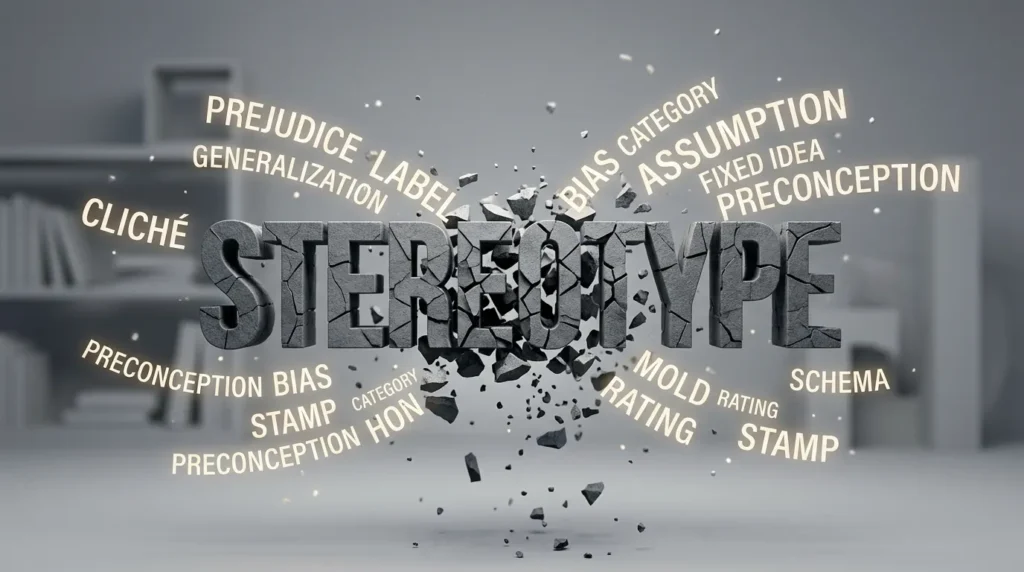
Synonyms of stereotype include generalization, cliché, assumption, misconception, label, bias, preconception, oversimplification, image, belief, and perception.
| Word | Simple Meaning |
|---|---|
| Stereotype | A fixed and oversimplified idea about a group |
| Generalization | A broad idea based on limited information |
| Cliché | An overused idea or expression |
| Assumption | Something accepted as true without proof |
| Label | A simplified description given to a person or group |
| Preconception | An opinion formed before knowing the facts |
Imagine meeting someone for the first time. Before they say much, you may already have an idea about their personality, job, background, or interests. Sometimes that idea comes from previous experiences. Other times, it comes from things you have heard about a particular group.
This kind of fixed idea can become a stereotype.
A stereotype is a simplified belief about a person or group. It may sometimes contain a small element of truth, but it treats a large group as if everyone in it were the same. Stereotypes can be positive, negative, or neutral in tone, although they are often criticized because they ignore individual differences.
There are several words related to stereotype, but they are not perfect replacements in every sentence. Generalization focuses on making a broad claim. Label focuses on assigning an identity or category. Preconception describes an opinion formed before enough information is available.
Knowing these differences helps you choose the most accurate word.
Meaning of Stereotype
Definition
A stereotype is a fixed and simplified belief or image about a particular type of person or group.
Examples:
- The movie relies on stereotypes about wealthy families.
- We should avoid judging people based on stereotypes.
- That stereotype does not describe everyone in the group.
Connotative Meaning
The word stereotype usually has a negative or critical connotation because it can reduce complex people to simple assumptions.
Positive: Rarely positive, although a stereotype can sometimes be used in a neutral descriptive discussion.
Negative: A fixed belief that unfairly describes a group.
Neutral: A commonly held image or idea discussed as a social pattern.
Etymology of Stereotype
The word stereotype has an interesting history.
French Origin
The term comes from French stéréotype, which was formed from Greek roots meaning something like “solid” or “fixed” and “type.”
Printing
Originally, stereotype referred to a printing process that created a solid plate from which copies could be made.
Modern English
The word later developed a figurative meaning. It came to describe a fixed or repeated idea about a person or group.
Today, stereotype is commonly used in discussions about society, culture, media, education, and human behavior.
Pronunciation of Stereotype
Stereotype: /ˈster.i.ə.taɪp/
Syllables: ster-e-o-type
The main stress falls on the first syllable.
Affixation Pattern
Stereotype is mainly used as a noun and verb.
Common forms include:
- Stereotype: noun
- Stereotypes: plural noun or third-person verb
- Stereotyped: past tense or adjective
- Stereotyping: present participle or gerund
- Stereotypical: adjective
- Stereotypically: adverb
Examples:
- The article challenges common stereotypes.
- The character was stereotyped by the media.
- The film contains stereotypical characters.
25 Synonyms of Stereotype With Meanings and Examples
1. Generalization
Part of speech: Noun
Meaning: A broad statement or belief about a group based on limited examples.
- Saying that all teenagers are irresponsible is a generalization.
- His comment was an unfair generalization about young people.
2. Cliché
Part of speech: Noun
Meaning: An overused idea, statement, or way of representing something.
- The movie uses the cliché of the strict teacher.
- That description sounds like a tired cliché.
3. Assumption
Part of speech: Noun
Meaning: Something believed to be true without sufficient evidence.
- The idea that older people cannot use technology is an assumption.
- Her assumption about his personality was incorrect.
4. Preconception
Part of speech: Noun
Meaning: An opinion formed before having enough information.
- He arrived with a preconception about the community.
- Meeting the residents changed her preconceptions.
5. Label
Part of speech: Noun / Verb
Meaning: A simplified category or description assigned to a person or group.
- The label “lazy” does not explain someone’s situation.
- We should not label people based on one mistake.
6. Misconception
Part of speech: Noun
Meaning: An idea or belief that is incorrect.
- The belief that all artists are poor is a misconception.
- The teacher corrected several misconceptions about the profession.
7. Bias
Part of speech: Noun
Meaning: An unfair preference or tendency that affects judgment.
- Cultural bias can influence how people view others.
- The report was criticized for showing bias.
8. Prejudice
Part of speech: Noun
Meaning: An unfair opinion about a person or group formed without proper knowledge.
- Prejudice can develop from repeated negative stereotypes.
- Education can help challenge prejudice.
9. Oversimplification
Part of speech: Noun
Meaning: A description that makes something more simple than it really is.
- Calling every business owner greedy is an oversimplification.
- The issue is more complex than that oversimplification suggests.
10. Fixed Idea
Part of speech: Noun phrase
Meaning: A firmly held idea that is difficult to change.
- He had a fixed idea about what successful people should look like.
- Her fixed idea prevented her from considering other possibilities.
11. Fixed Image
Part of speech: Noun phrase
Meaning: A settled mental picture of a person, group, or thing.
- The media can create a fixed image of certain professions.
- That fixed image does not reflect modern reality.
12. Notion
Part of speech: Noun
Meaning: An idea or belief about something.
- He rejected the notion that intelligence depends on age.
- The notion is common but not always accurate.
13. Belief
Part of speech: Noun
Meaning: An idea that someone accepts as true.
- The belief that success comes easily can be misleading.
- Her belief about the group changed after she met them.
14. Perception
Part of speech: Noun
Meaning: The way someone understands or views a person, group, or situation.
- Media coverage can influence public perception.
- His perception of the profession changed over time.
15. Image
Part of speech: Noun
Meaning: A mental or public idea about someone or something.
- The company wants to change its public image.
- The film creates a particular image of city life.
16. Characterization
Part of speech: Noun
Meaning: The way a person or group is described or presented.
- The novel uses exaggerated characterization.
- Her characterization of the group was too simple.
17. Typecast
Part of speech: Verb
Meaning: To repeatedly place someone in a particular role or category.
- The actor was typecast as a villain.
- She disliked being typecast because she wanted different roles.
18. Archetype
Part of speech: Noun
Meaning: A typical or widely recognized example of a particular kind of person or thing.
- The wise mentor is a common literary archetype.
- The character follows the archetype of the reluctant hero.
19. Formula
Part of speech: Noun
Meaning: A repeated pattern used to create something in a familiar way.
- The show follows a familiar formula.
- The writer avoided the usual romantic comedy formula.
20. Pattern
Part of speech: Noun
Meaning: A repeated way in which something happens or is presented.
- Researchers noticed a pattern in the way groups were represented.
- The same pattern appears in several films.
21. Generalized View
Part of speech: Noun phrase
Meaning: A broad view that does not consider individual differences.
- A generalized view of a culture can be misleading.
- His generalized view ignored many important details.
22. Prejudgment
Part of speech: Noun
Meaning: A judgment made before all the facts are known.
- Prejudgment can prevent people from understanding one another.
- The interview helped challenge his prejudgment.
23. Common Perception
Part of speech: Noun phrase
Meaning: An idea or view widely shared by people.
- The common perception of the profession has changed.
- That common perception does not always match reality.
24. Social Label
Part of speech: Noun phrase
Meaning: A category or description society gives to a person or group.
- Social labels can influence how people treat one another.
- She refused to be defined by a social label.
25. Simplification
Part of speech: Noun
Meaning: A reduction of a complex subject into a simpler form.
- The statement is a simplification of a much larger issue.
- Such simplification can hide important differences between people.
Prototype Meaning of Stereotype
The central idea of stereotype is a fixed and simplified belief about a group.
For example:
All teenagers are addicted to their phones.
This is a stereotype because it treats a diverse group as though everyone has the same behavior.
A more careful statement would recognize individual differences:
Some teenagers spend a lot of time on their phones.
The second sentence does not make a claim about everyone in the group.
Prototype Categorization of Stereotype
Different related words emphasize different parts of the meaning.
Broad Beliefs
- Generalization
- Generalized view
- Common perception
- Belief
These focus on broad ideas about groups or situations.
Unproven Ideas
- Assumption
- Preconception
- Prejudgment
- Notion
These focus on beliefs formed without enough evidence.
Incorrect Ideas
- Misconception
- Oversimplification
- Simplification
These are useful when the idea is inaccurate or fails to capture complexity.
Social Judgment
- Bias
- Prejudice
- Social label
- Label
These are useful when discussing unfair treatment or social categorization.
Repeated Representations
- Cliché
- Archetype
- Formula
- Characterization
- Typecast
These work especially well when discussing books, movies, television, theater, or other creative works.
Antonyms of Stereotype
1. Individuality
Part of speech: Noun
Meaning: The qualities that make a person different from others.
2. Individualization
Part of speech: Noun
Meaning: Treating someone as a distinct individual rather than as part of a general group.
3. Nuance
Part of speech: Noun
Meaning: A subtle difference or detail that adds depth to an idea.
4. Accuracy
Part of speech: Noun
Meaning: The quality of being correct or precise.
5. Specificity
Part of speech: Noun
Meaning: The quality of being clearly focused on particular details.
6. Open-mindedness
Part of speech: Noun
Meaning: A willingness to consider different ideas and perspectives.
Short Questions and Answers
What does stereotype mean?
A stereotype is a fixed and oversimplified belief about a particular person, group, or category.
What is the closest synonym for stereotype?
Generalization is one of the closest alternatives, especially when referring to a broad belief about a group.
Is generalization the same as stereotype?
Not exactly. A generalization is any broad statement based on multiple examples. A stereotype is usually a fixed and simplified belief about a particular type of person or group.
Is cliché a synonym for stereotype?
Sometimes. A cliché is an overused idea or expression, while a stereotype specifically refers to a fixed idea or representation, often about people or groups.
What is a synonym for stereotype in writing?
Depending on the context, useful alternatives include cliché, characterization, archetype, formula, generalization, and oversimplification.
Is stereotype always negative?
No. The word can be used neutrally when discussing a social pattern. However, stereotypes are often criticized because they can ignore individual differences.
What is the difference between stereotype and prejudice?
A stereotype is a belief or general idea about a group. Prejudice involves an unfair attitude or judgment toward a person or group.
Conclusion
The word stereotype describes a fixed and simplified idea about a person or group. It is closely related to words such as generalization, assumption, preconception, label, bias, misconception, and oversimplification, but each word highlights a different part of the meaning.
Use generalization when you want to describe a broad claim. Choose preconception for an opinion formed before knowing enough facts. Bias and prejudice are better when unfair judgment is the main idea. When discussing books, films, or characters, words such as cliché, archetype, typecast, and characterization may fit better.
Choosing the right alternative depends on what you want to emphasize. Understanding these small differences can make your writing clearer and more precise.
Synonyms for Beautiful: 24 Elegant Words to Know

Author Bio
I am Sajjad Ali, an English language writer specializing in synonyms, word meanings, and practical English usage.
I use my expertise in English vocabulary and word choice to create simple, accurate, and helpful content for learners and readers.