
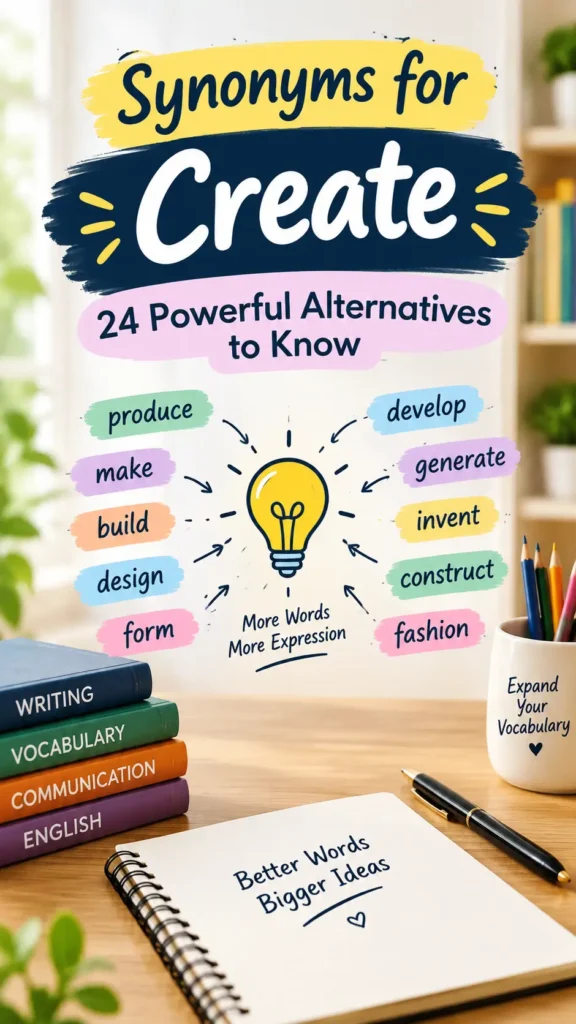

Make, produce, build, design, develop, form, generate, invent, craft, and construct are useful synonyms for create, depending on the context.
Introduction
Create is a common English word that means to make something new or bring something into existence. Imagine a writer sitting at a desk and turning a simple idea into a complete story. We can say that the writer creates a story. The word is useful in everyday English, education, business, art, technology, and content writing. However, using create too often can make your writing sound repetitive.
Learning synonyms helps you choose a word that gives a more exact meaning. For example, an artist may craft a sculpture, an engineer may design a machine, and a company may develop a new product. These differences are useful for English learners, students, bloggers, and professional writers. In this article, you will learn the meaning of create, its synonyms, examples, grammar, etymology, pronunciation, word formation, semantic categories, and antonyms.
Meaning of Create
Definition
Create (Verb):
Create means to make, produce, design, or bring something new into existence.
Examples
- She wants to create a beautiful painting.
- The company plans to create a new product.
Connotative Meaning
Connotation: The feeling or idea that a word suggests beyond its basic meaning.
- Positive tone: Create often suggests imagination, innovation, progress, and originality.
- Negative tone: The word can have a negative tone when what is created is harmful, such as create problems.
- Neutral tone: It can simply describe the act of making or producing something.
Etymology
The word create has Latin roots and entered English through French.
- Old English (450–1100): The modern word create was not commonly used in Old English. Native English words such as macian were used for “make.”
- Middle English (1100–1500): Create entered English through Old French, from Latin creare, meaning “to make, produce, bring forth, or beget.”
- Modern English (1500–Present): Create became widely used for making something new, including ideas, works of art, products, opportunities, and other things.
Pronunciation (IPA)
- IPA: /kriˈeɪt/
- Syllables: cre-ate — 2 syllables
Affixation Pattern of Create
- Root: create
- Prefix: None
- Suffix: None in the basic verb
- Word formations:
- create — verb
- creation — noun
- creator — noun
- creative — adjective
- creatively — adverb
- creativity — noun
- recreate — verb
- recreation — noun
- creational — adjective
- created — past tense/past participle
- creating — present participle
24 Synonyms of Create With Meaning & Examples
1. Make (Verb)
Meaning: To produce or form something.
Examples:
- She wants to make a new dress.
- He made a model for the project.
2. Produce (Verb)
Meaning: To make or manufacture something.
Examples:
- The factory produces electric cars.
- The team produced a short film.
3. Build (Verb)
Meaning: To make something by putting parts together.
Examples:
- They plan to build a new house.
- She built a successful business.
4. Construct (Verb)
Meaning: To build or form something, especially something large or complex.
Examples:
- Workers constructed a new bridge.
- Engineers constructed the building carefully.
5. Design (Verb)
Meaning: To plan and create the form or structure of something.
Examples:
- She designed a beautiful website.
- They designed a new logo.
6. Develop (Verb)
Meaning: To create or improve something over time.
Examples:
- The company developed a new app.
- Scientists are developing a new method.
7. Form (Verb)
Meaning: To make or shape something into a particular form.
Examples:
- The clouds formed interesting shapes.
- They formed a new team.
8. Generate (Verb)
Meaning: To produce or cause something to exist.
Examples:
- The solar panels generate electricity.
- The campaign generated new ideas.
9. Invent (Verb)
Meaning: To create something new that did not exist before.
Examples:
- He invented a useful device.
- Scientists continue to invent new technologies.
10. Craft (Verb)
Meaning: To make something carefully and skillfully.
Examples:
- She crafted a beautiful piece of jewelry.
- The writer crafted a powerful story.
11. Compose (Verb)
Meaning: To create a piece of music or written work.
Examples:
- Mozart composed many famous pieces.
- She composed a short poem.
12. Produce (Verb)
Meaning: To create a work, result, or product.
Examples:
- The director produced a successful movie.
- The study produced interesting results.
13. Establish (Verb)
Meaning: To create or set up an organization, system, or institution.
Examples:
- They established a new school.
- She established a successful company.
14. Found (Verb)
Meaning: To start or create an organization, institution, or company.
Examples:
- They founded the company in 2010.
- She founded a charity for children.
15. Devise (Verb)
Meaning: To create a plan, method, or solution through careful thought.
Examples:
- The team devised a new strategy.
- Engineers devised a solution to the problem.
16. Formulate (Verb)
Meaning: To carefully develop an idea, plan, or system.
Examples:
- Scientists formulated a new theory.
- The committee formulated a detailed plan.
17. Generate (Verb)
Meaning: To produce something such as energy, ideas, interest, or income.
Examples:
- The article generated a lot of interest.
- The panels generate clean energy.
18. Establish (Verb)
Meaning: To bring something into existence in a formal or lasting way.
Examples:
- The organization established new rules.
- They established a research center.
19. Originate (Verb)
Meaning: To begin or come into existence.
Examples:
- The idea originated in a small village.
- The tradition originated centuries ago.
20. Produce (Verb)
Meaning: To make or bring about a particular result.
Examples:
- The new method produced better results.
- The machine produces less waste.
21. Author (Verb)
Meaning: To write or create a book, article, or other written work.
Examples:
- She authored several books.
- He authored an article about education.
22. Fashion (Verb)
Meaning: To make or shape something skillfully.
Examples:
- The artist fashioned a sculpture from clay.
- They fashioned a tool from wood.
23. Assemble (Verb)
Meaning: To create something by putting separate parts together.
Examples:
- Workers assembled the machine.
- We assembled the furniture in an hour.
24. Originate (Verb)
Meaning: To cause an idea, activity, or process to begin.
Examples:
- She originated the idea for the project.
- The program originated at the university.
Note: These synonyms are not exact replacements in every sentence. Make is general, design focuses on planning, invent suggests something completely new, craft emphasizes skill, compose is common for music and writing, and establish is useful for organizations and systems.
Prototype Meaning
The most typical meaning of create is to make something new or bring something into existence. When people hear this word, they often imagine someone producing something through an idea, skill, effort, or imagination. A person can create a painting, story, business, plan, product, opportunity, or even a problem.
Prototype Categorization
The 24 synonyms can be grouped into meaningful semantic categories:
- General making: make, produce, form, assemble — useful when something is simply made or put together.
- Building and physical creation: build, construct, fashion, craft — useful for objects, structures, and handmade items.
- Planning and development: design, develop, devise, formulate — useful for ideas, systems, plans, and solutions.
- New ideas and inventions: invent, originate — useful when something new begins or is introduced.
- Organizations and institutions: establish, found — useful when starting companies, schools, charities, or systems.
- Art and writing: compose, author — useful for music, poems, books, articles, and other creative works.
- Production and results: generate — useful for energy, income, interest, ideas, and results.
This categorization helps writers choose a synonym that describes how something is created rather than using create for every situation.
Antonyms of Create
1. Destroy (Verb)
Meaning: To damage or completely ruin something.
2. Demolish (Verb)
Meaning: To destroy a building or structure completely.
3. Eliminate (Verb)
Meaning: To remove or get rid of something.
4. Erase (Verb)
Meaning: To remove something completely from a record, surface, or memory.
5. Remove (Verb)
Meaning: To take something away from a place or situation.
6. Abolish (Verb)
Meaning: To officially end a law, system, or practice.
Short Questions and Answers
What does create mean?
Create means to make something new or bring something into existence.
When should create be used?
Use create when talking about making something, especially an idea, product, artwork, plan, opportunity, or other new thing.
Is create positive or negative?
Create is usually neutral or positive, but its tone depends on what is being created. Someone can create something helpful or create a problem.
How is it different from similar words?
Create is broad. Invent focuses on something new, design focuses on planning, construct focuses on building, and craft emphasizes careful skill.
Conclusion
Learning synonyms for create can make your English more precise, flexible, and interesting. The word create is useful in many situations, but different alternatives can show exactly how something comes into existence. Make is a general choice, while design focuses on planning, invent suggests originality, craft highlights skill, and establish works well for organizations and systems.
These words are especially useful for English learners, students, bloggers, and content writers who want to avoid repetition and communicate ideas clearly. Remember that synonyms are not always interchangeable. The best word depends on the object, action, and context. Try learning a few new alternatives each day and use them in your own sentences. Regular practice will improve your vocabulary, strengthen your writing, and help you speak English with greater confidence.
Read More: Good Synonyms: 25 Powerful Words for Better English.