
Awful, terrible, poor, harmful, unpleasant, negative, weak, inferior, and unsatisfactory are useful alternatives to bad, depending on the context.
Introduction
Bad is one of the most common words in English. We use it to describe something unpleasant, poor in quality, harmful, wrong, or unsuccessful. Imagine ordering a meal at a restaurant and finding that it is cold, tasteless, and poorly prepared. You might simply say, “The food was bad.” The word is easy and useful, but it can be too general when you want to explain exactly what is wrong.
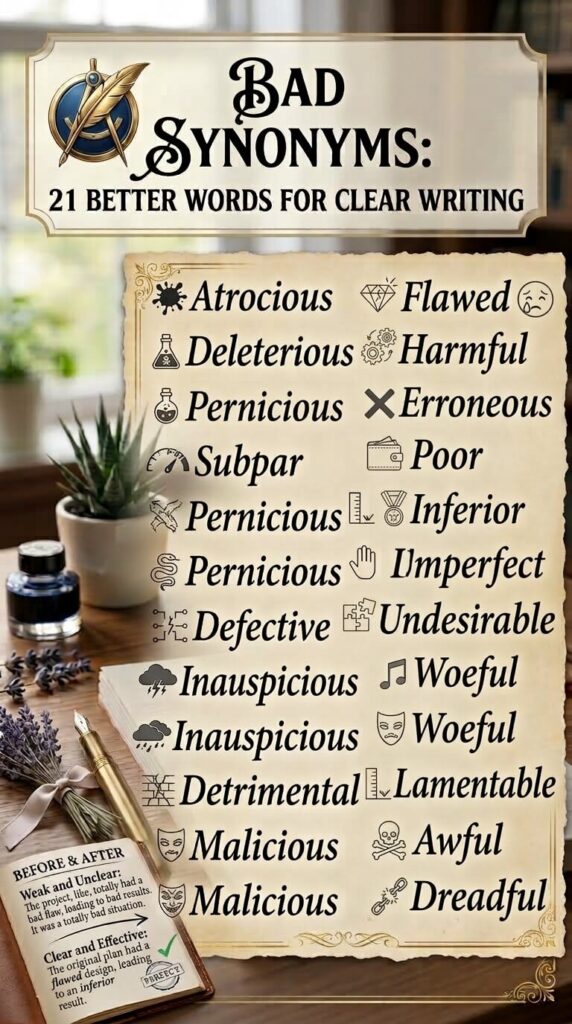
For example, awful shows a very strong negative feeling, poor focuses on low quality, and harmful describes something that causes damage. Learning synonyms for bad helps English learners express negative ideas more clearly and naturally. It also helps students, bloggers, and content writers avoid repetition. In this article, you will learn the meaning of bad, its history, pronunciation, word formation, 21 synonyms, examples, semantic categories, antonyms, and useful tips for choosing the right word.
Meaning of Bad
Definition
Bad (Adjective/Noun/Adverb):
Bad means unpleasant, harmful, incorrect, poor in quality, or not acceptable, depending on the context.
Examples
- The weather was bad yesterday.
- He received a bad result on the test.
Connotative Meaning
Connotation: The feeling or idea that a word suggests beyond its basic meaning.
- Positive tone: Bad can occasionally be used informally in a positive sense, such as “That song is bad!” meaning impressive or excellent.
- Negative tone: Its normal use suggests something unpleasant, harmful, wrong, or poor.
- Neutral tone: In some expressions, bad simply describes an unfavorable condition without strong emotion.
Etymology
The word bad has a somewhat uncertain history, but its meaning has long been connected with something poor or undesirable.
- Old English (450–1100): The exact origin of modern bad is uncertain. Old English used words such as yfel for “evil” and unriht for “wrong.”
- Middle English (1100–1500): Bad began appearing in English around the Middle English period, originally referring to something undesirable, inferior, or wicked.
- Modern English (1500–Present): Bad developed many meanings related to quality, behavior, health, morality, difficulty, and unfavorable situations.
Pronunciation (IPA)
- IPA: /bæd/
- Syllables: bad — 1 syllable
Affixation Pattern of Bad
- Root: bad
- Prefix: None
- Suffix: None
- Word formations:
- bad — adjective/noun/adverb
- badly — adverb
- badness — noun
- worse — comparative form
- worst — superlative form
21 Synonyms of Bad With Meaning & Examples
1. Awful (Adjective)
Meaning: Extremely unpleasant, poor, or bad.
Examples:
- The weather was awful.
- We had an awful experience.
2. Terrible (Adjective)
Meaning: Extremely bad, unpleasant, or serious.
Examples:
- He received terrible news.
- The traffic was terrible this morning.
3. Poor (Adjective)
Meaning: Low in quality, ability, or standard.
Examples:
- The service was poor.
- She received a poor grade.
4. Harmful (Adjective)
Meaning: Causing damage or injury.
Examples:
- Smoking is harmful to health.
- Too much pollution is harmful to the environment.
5. Unpleasant (Adjective)
Meaning: Not enjoyable, comfortable, or pleasant.
Examples:
- It was an unpleasant experience.
- The smell was unpleasant.
6. Negative (Adjective)
Meaning: Unfavorable, harmful, or expressing criticism.
Examples:
- The article received negative comments.
- Stress can have a negative effect.
7. Inferior (Adjective)
Meaning: Lower in quality or value than something else.
Examples:
- This material is inferior to the original.
- The product was of inferior quality.
8. Unsatisfactory (Adjective)
Meaning: Not good enough or not meeting expected standards.
Examples:
- The results were unsatisfactory.
- His performance was unsatisfactory.
9. Defective (Adjective)
Meaning: Not working correctly because of a fault or problem.
Examples:
- The company replaced the defective product.
- The machine was defective.
10. Faulty (Adjective)
Meaning: Not working correctly or containing a mistake.
Examples:
- The equipment was faulty.
- The report contained faulty information.
11. Unsuccessful (Adjective)
Meaning: Failing to achieve the desired result.
Examples:
- The first attempt was unsuccessful.
- Their business became unsuccessful.
12. Unacceptable (Adjective)
Meaning: Not good enough or not allowed according to expected standards.
Examples:
- This behavior is unacceptable.
- The level of service was unacceptable.
13. Disagreeable (Adjective)
Meaning: Unpleasant, uncomfortable, or difficult to enjoy.
Examples:
- He has a disagreeable personality.
- The task became disagreeable after several hours.
14. Nasty (Adjective)
Meaning: Very unpleasant, harmful, or unkind.
Examples:
- He made a nasty comment.
- The wound became nasty and painful.
15. Horrible (Adjective)
Meaning: Extremely unpleasant, frightening, or bad.
Examples:
- It was a horrible accident.
- The food tasted horrible.
16. Dreadful (Adjective)
Meaning: Extremely bad or unpleasant.
Examples:
- The service was dreadful.
- We had dreadful weather.
17. Disastrous (Adjective)
Meaning: Causing serious damage, failure, or harm.
Examples:
- The decision had disastrous results.
- The project was a disastrous failure.
18. Damaging (Adjective)
Meaning: Causing harm or negative effects.
Examples:
- The rumor was damaging to her reputation.
- The storm caused damaging floods.
19. Mediocre (Adjective)
Meaning: Only average and not particularly good.
Examples:
- The movie was mediocre.
- His performance was mediocre.
20. Substandard (Adjective)
Meaning: Below the expected level of quality.
Examples:
- The building was made with substandard materials.
- The company was criticized for substandard service.
21. Dire (Adjective)
Meaning: Extremely serious, urgent, or bad.
Examples:
- The country faced a dire situation.
- The family was in dire need of help.
Note: These words are not exact replacements in every sentence. Poor usually focuses on quality, harmful focuses on damage, defective describes something faulty, mediocre means average rather than terrible, and disastrous suggests very serious consequences.
Prototype Meaning
The most typical meaning of bad is not good, unpleasant, or below an acceptable standard. When people hear this word, they may imagine something that has poor quality, causes problems, or produces an unwanted result. The exact meaning depends on the situation.
Prototype Categorization
The 21 synonyms can be grouped into meaningful semantic categories:
- General negative quality: awful, terrible, horrible, dreadful — useful when something is strongly unpleasant or very bad.
- Low quality: poor, inferior, unsatisfactory, mediocre, substandard — useful for products, services, work, results, and performance.
- Harm and damage: harmful, damaging, disastrous — useful when something causes injury, loss, or serious negative effects.
- Problems and faults: defective, faulty — mainly used for objects, machines, systems, or information containing errors.
- Negative situations: negative, unacceptable, unsuccessful, dire — useful for results, behavior, situations, or outcomes.
- Unpleasant behavior or experiences: unpleasant, disagreeable, nasty — useful for people, comments, experiences, smells, and situations.
This grouping helps writers choose a synonym based on why something is bad, rather than simply replacing the word with another negative adjective.
Antonyms of Bad
1. Good (Adjective)
Meaning: Having positive qualities or being satisfactory.
2. Excellent (Adjective)
Meaning: Extremely good or high in quality.
3. Great (Adjective)
Meaning: Very good, impressive, or enjoyable.
4. Positive (Adjective)
Meaning: Favorable, helpful, or beneficial.
5. Superior (Adjective)
Meaning: Better in quality or ability than something else.
6. Beneficial (Adjective)
Meaning: Producing a helpful or positive result.
Short Questions and Answers
What does bad mean?
Bad generally means unpleasant, poor, harmful, incorrect, or not acceptable.
When should bad be used?
Use bad in everyday English when you want a simple and general way to describe something negative or unsatisfactory.
Is bad positive or negative?
Bad is normally negative, although informal English can sometimes use it positively, such as “bad” meaning impressive or fashionable.
How is it different from similar words?
Bad is a broad word. Poor focuses on quality, harmful focuses on damage, terrible shows stronger negativity, and mediocre means average rather than extremely bad.
Conclusion
Learning synonyms for bad can help you express negative ideas with greater accuracy and variety. The word bad is useful in everyday English, but it is often too general for detailed writing. Alternatives such as awful, terrible, poor, harmful, unpleasant, inferior, defective, unsuccessful, and disastrous can explain exactly what makes something negative. Some words describe poor quality, while others focus on harm, failure, unpleasant experiences, or serious consequences. This distinction is especially useful for English learners, students, bloggers, and content writers. Instead of choosing the strongest synonym every time, think about the exact meaning you want to communicate. Practice these words in complete sentences and pay attention to how native speakers use them. Regular vocabulary practice will help you avoid repetition, improve your writing and speaking, and build confidence when expressing negative ideas in English.
Good Synonyms: 25 Powerful Words for Better English.