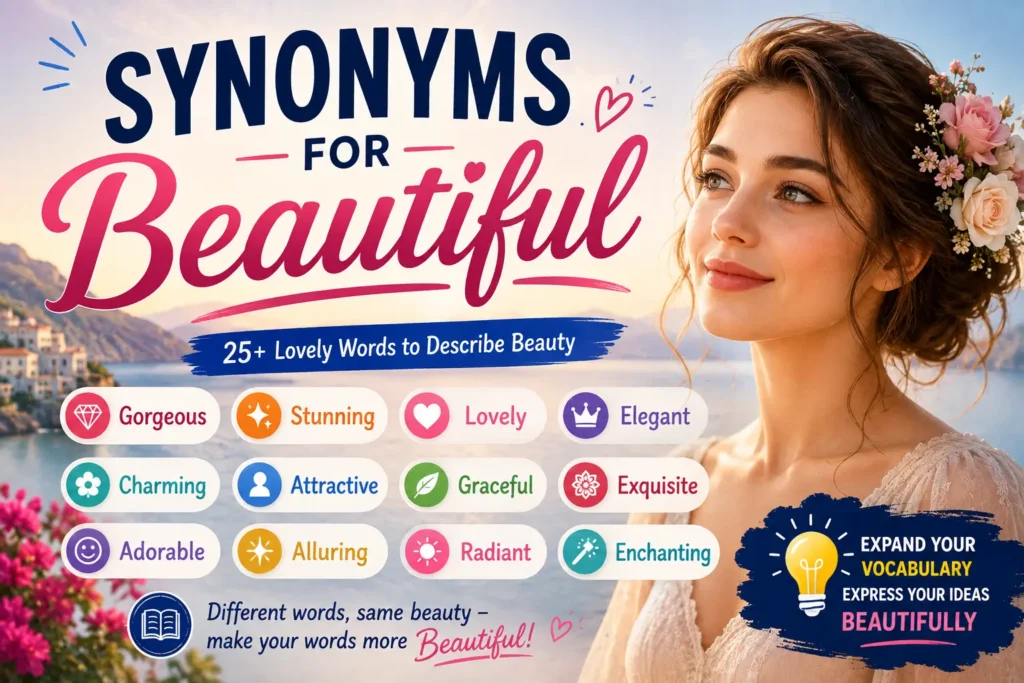
Gorgeous, lovely, stunning, attractive, charming, exquisite, radiant, graceful, breathtaking, and magnificent are useful alternatives to beautiful.
Beautiful is a common English word used to describe something that looks, feels, or sounds pleasing. Imagine opening your window early in the morning and seeing a garden covered with fresh flowers. You may smile and say, “The garden looks beautiful today.” The word is simple and powerful, but using it again and again can make writing less interesting. Learning synonyms gives you more ways to describe beauty with greater detail. For English learners, these words can expand vocabulary and improve everyday communication.
They are also useful for students, bloggers, poets, and content writers who want their descriptions to sound fresh and natural. Some synonyms describe strong beauty, while others focus on elegance, charm, scenery, or a person’s appearance. In this article, you will learn the meaning of beautiful, its history, pronunciation, word formation, 24 useful synonyms, examples, antonyms, and semantic categories.
Meaning of Beautiful
Definition
Beautiful (Adjective):
Beautiful means very pleasing or attractive to the senses, mind, or emotions.
Examples
- The flowers in the garden are beautiful.
- She has a beautiful voice.
Connotative Meaning
Connotation: The feeling or idea that a word suggests beyond its basic meaning.
- Positive tone: It suggests attractiveness, pleasure, admiration, or delight.
- Negative tone: The word itself is positive, but it can sound sarcastic in some contexts.
- Neutral tone: It can simply describe something that is pleasing or attractive.
Etymology
The word beautiful comes from the older word beauty and has roots in French and Latin.
- Old English (450–1100): The modern word beautiful was not used. Old English used other words to describe fairness, attractiveness, and pleasant appearance.
- Middle English (1100–1500): Beauty entered English from Old French beauté, ultimately connected to Latin bellus, meaning “pretty” or “beautiful.”
- Modern English (1500–Present): Beautiful developed from beauty with the suffix -ful, meaning “full of” or “characterized by.”
Pronunciation (IPA)
- IPA: /ˈbjuːtɪfəl/
- Syllables: beau-ti-ful — 3 syllables
Affixation Pattern of Beautiful
- Root: beauty
- Prefix: None
- Suffix: -ful
- Word formations:
- beauty — noun
- beautiful — adjective
- beautifully — adverb
- beautify — verb
- beautification — noun
- beautician — noun
- beautified — adjective/verb form
- beautifying — adjective/verb form
24 Synonyms of Beautiful With Meaning & Examples
1. Gorgeous (Adjective)
Meaning: Extremely attractive or beautiful.
Examples:
- She wore a gorgeous dress.
- The sunset looked gorgeous.
2. Lovely (Adjective)
Meaning: Very attractive, pleasant, or enjoyable.
Examples:
- She has a lovely smile.
- We spent a lovely afternoon together.
3. Stunning (Adjective)
Meaning: Extremely attractive or impressive.
Examples:
- She looked stunning in the blue dress.
- The view was stunning.
4. Attractive (Adjective)
Meaning: Pleasant or appealing to look at.
Examples:
- The house has an attractive design.
- She has an attractive appearance.
5. Exquisite (Adjective)
Meaning: Extremely beautiful and carefully made or detailed.
Examples:
- The necklace has exquisite details.
- She admired the exquisite painting.
6. Charming (Adjective)
Meaning: Pleasant and attractive in a warm and appealing way.
Examples:
- They stayed in a charming village.
- He has a charming personality.
7. Radiant (Adjective)
Meaning: Showing great beauty or happiness that seems to shine.
Examples:
- The bride looked radiant.
- Her radiant smile made everyone happy.
8. Breathtaking (Adjective)
Meaning: Extremely beautiful or impressive.
Examples:
- The mountain view was breathtaking.
- We saw a breathtaking sunset.
9. Magnificent (Adjective)
Meaning: Extremely impressive, grand, or beautiful.
Examples:
- The palace was magnificent.
- We saw a magnificent waterfall.
10. Elegant (Adjective)
Meaning: Attractive because of graceful style and simplicity.
Examples:
- She wore an elegant dress.
- The room has an elegant design.
11. Dazzling (Adjective)
Meaning: Extremely impressive or beautiful.
Examples:
- The actress gave a dazzling performance.
- The lights were dazzling.
12. Alluring (Adjective)
Meaning: Very attractive in a way that draws attention.
Examples:
- The island has an alluring beauty.
- The painting has an alluring quality.
13. Enchanting (Adjective)
Meaning: Very charming and delightful, almost magical.
Examples:
- The forest looked enchanting.
- We enjoyed an enchanting evening.
14. Captivating (Adjective)
Meaning: So attractive or interesting that it holds your attention.
Examples:
- She has a captivating smile.
- The story was captivating.
15. Pretty (Adjective)
Meaning: Pleasant and attractive, often in a delicate or simple way.
Examples:
- She bought a pretty dress.
- There are pretty flowers outside.
16. Handsome (Adjective)
Meaning: Attractive in appearance, especially commonly used for men.
Examples:
- He is a handsome young man.
- The actor looked handsome in the suit.
17. Splendid (Adjective)
Meaning: Excellent, impressive, or very beautiful.
Examples:
- The garden looked splendid.
- We enjoyed a splendid view.
18. Spectacular (Adjective)
Meaning: Very impressive or beautiful to see.
Examples:
- The fireworks were spectacular.
- The waterfall was spectacular.
19. Picturesque (Adjective)
Meaning: Visually attractive like a beautiful picture.
Examples:
- The village is picturesque.
- We walked through a picturesque town.
20. Graceful (Adjective)
Meaning: Attractive because of smooth, elegant movement or form.
Examples:
- The dancer was graceful.
- The swan made a graceful movement.
21. Sublime (Adjective)
Meaning: Extremely beautiful or impressive in a way that inspires deep admiration.
Examples:
- The mountain scenery was sublime.
- The music was truly sublime.
22. Beauteous (Adjective)
Meaning: Very beautiful; mainly used in poetic or literary English.
Examples:
- The poet described a beauteous garden.
- A beauteous moon shone above the lake.
23. Ravishing (Adjective)
Meaning: Extremely beautiful or attractive.
Examples:
- She looked ravishing in the gown.
- The garden had a ravishing display of flowers.
24. Comely (Adjective)
Meaning: Attractive or pleasant in appearance; an old-fashioned word.
Examples:
- The novel describes a comely young woman.
- The character was known for her comely appearance.
Note: These words are not exact replacements in every sentence. Handsome is often used for men, picturesque commonly describes places, graceful focuses on movement or form, and exquisite often suggests fine detail and high quality.
Prototype Meaning
The most typical meaning of beautiful is very pleasing or attractive in appearance. When people hear this word, they often imagine an attractive person, a lovely flower, a scenic landscape, a colorful sunset, or a beautiful work of art. However, beautiful can also describe sounds, ideas, emotions, actions, and personal qualities.
Prototype Categorization
The 24 synonyms can be grouped into useful semantic categories:
- Everyday beauty: lovely, pretty, attractive, gorgeous — common choices for ordinary descriptions.
- Striking beauty: stunning, breathtaking, dazzling, spectacular, ravishing — useful when something is exceptionally impressive.
- Grace and elegance: elegant, graceful, charming — focus on style, movement, manners, or refined beauty.
- Magical or captivating beauty: enchanting, alluring, captivating — useful when something strongly attracts attention.
- Scenic beauty: picturesque, magnificent, sublime, splendid — especially useful for landscapes, buildings, and views.
- Literary beauty: beauteous, comely — mainly suitable for poetry, literature, or old-fashioned writing.
- Physical appearance: handsome — commonly used to describe an attractive man.
This grouping helps writers select a synonym that matches the exact kind of beauty they want to express.
Antonyms of Beautiful
1. Ugly (Adjective)
Meaning: Unpleasant or unattractive in appearance.
2. Unattractive (Adjective)
Meaning: Not pleasing or appealing to look at.
3. Hideous (Adjective)
Meaning: Extremely ugly or unpleasant to look at.
4. Plain (Adjective)
Meaning: Ordinary or simple in appearance.
5. Unpleasant (Adjective)
Meaning: Not pleasing, enjoyable, or attractive.
6. Repulsive (Adjective)
Meaning: Extremely unpleasant or causing strong dislike.
Short Questions and Answers
What does beautiful mean?
Beautiful means very pleasing, attractive, or delightful to the senses, mind, or emotions.
When should beautiful be used?
Use beautiful to describe people, places, objects, sounds, ideas, or qualities that create a strong feeling of pleasure or admiration.
Is beautiful positive or negative?
Beautiful is normally a strongly positive word. It expresses admiration, pleasure, or appreciation.
How is it different from similar words?
Beautiful is a broad term. Gorgeous and stunning suggest stronger visual beauty, elegant suggests refined style, and picturesque is especially useful for attractive scenery.
Conclusion
Learning synonyms for beautiful can make your English richer, clearer, and more expressive. Although beautiful is a useful everyday word, alternatives such as gorgeous, lovely, stunning, exquisite, elegant, radiant, breathtaking, charming, and picturesque allow you to describe beauty in more specific ways. These words can help students improve essays, writers create stronger descriptions, and English learners speak with greater confidence.
It is important to remember that synonyms are not always interchangeable. Each word carries its own shade of meaning and works best in certain contexts. Try learning a few new alternatives each day and use them in your own sentences. With regular reading and practice, you can avoid repetition, expand your vocabulary, and express your ideas more naturally.
Read more Synonyms for Crazy: 26 Words to Know

Hi, I’m Anaya. Words that look almost identical but mean completely different things have always fascinated me, that’s what pulled me toward writing about spelling and usage. I focus on digging into where these mix-ups actually come from, whether it’s a British-American split or just a rule English never bothered to make consistent. My goal with every guide is simple: give you the answer fast, then explain it well enough that you never have to look it up again.