
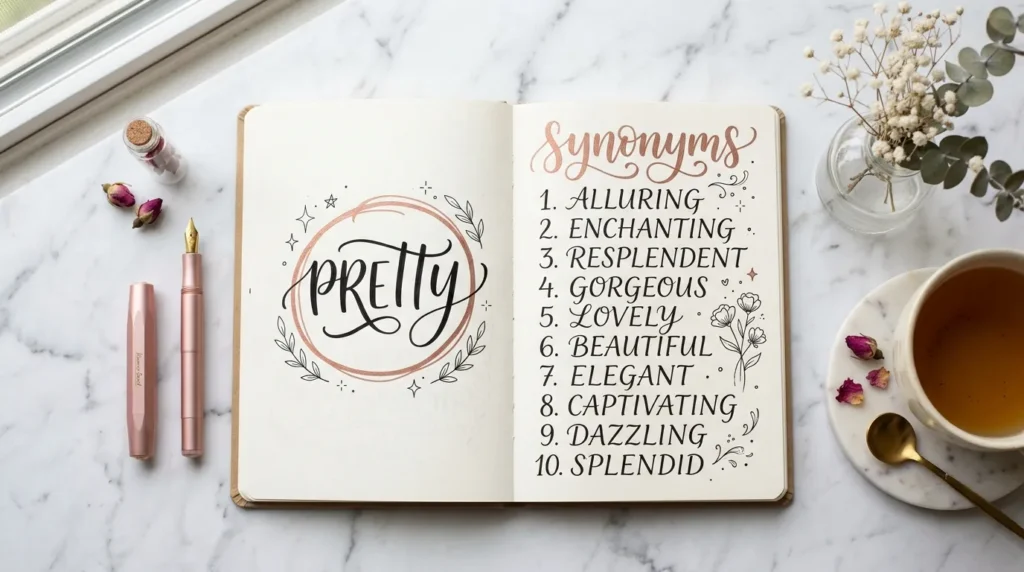
Beautiful, lovely, attractive, charming, cute, gorgeous, elegant, graceful, adorable, stunning and appealing are useful synonyms for pretty, depending on the context.
Pretty is a common English word used to describe someone or something that looks attractive or pleasant. Imagine visiting a small village and seeing colorful flowers, clean streets, and charming little houses. You might say, “What a pretty place!” The word is simple and natural, but using it again and again can make your writing sound repetitive. Learning synonyms gives you more ways to describe beauty, charm, style, and appearance.
For example, cute can suggest sweetness, elegant can suggest refined style, and stunning can describe something extremely impressive. These differences are useful for English learners, students, bloggers, and content writers. In this article, you will learn the meaning of pretty, its history, pronunciation, word formation, and 25 useful synonyms with examples. You will also learn how these words differ, how they can be grouped, and when to use them.
Meaning of Pretty
Definition
Pretty (Adjective/Adverb):
Pretty means attractive, pleasant, or pleasing to look at; as an adverb, it can also mean “fairly” or “quite.”
Examples
- She wore a pretty dress to the wedding.
- The garden looks pretty in spring.
Connotative Meaning
Connotation: The feeling or idea that a word suggests beyond its basic meaning.
- Positive tone: Pretty often suggests pleasant, charming, delicate, or attractive beauty.
- Negative tone: In some contexts, it may suggest that something is attractive but not especially impressive or powerful.
- Neutral tone: It can simply describe something that looks pleasing.
Etymology
The meaning of pretty has changed over many centuries.
- Old English (450–1100): The modern word pretty was not used in its current form.
- Middle English (1100–1500): Forms such as praty were used to describe something clever, skillful, attractive, or pleasing.
- Modern English (1500–Present): Pretty became strongly connected with attractiveness and beauty. It also developed its adverbial meaning, as in “pretty good,” meaning “fairly good” or “quite good.”
Pronunciation (IPA)
- IPA: /ˈprɪti/
- Syllables: pret-ty — 2 syllables
Affixation Pattern of Pretty
- Root: pretty
- Prefix: None
- Suffix: None in the basic modern word
- Word formations:
- pretty — adjective/adverb
- prettier — comparative adjective
- prettiest — superlative adjective
- prettily — adverb
- prettiness — noun
25 Pretty Synonyms With Meaning & Examples
1. Beautiful (Adjective)
Meaning: Very attractive or pleasing to look at.
Examples:
- She has a beautiful smile.
- The beach looks beautiful at sunset.
2. Lovely (Adjective)
Meaning: Very pleasant, attractive, or charming.
Examples:
- She wore a lovely dress.
- We had a lovely afternoon.
3. Attractive (Adjective)
Meaning: Pleasant or appealing in appearance.
Examples:
- She has an attractive smile.
- The house has an attractive design.
4. Charming (Adjective)
Meaning: Pleasant and attractive in a warm or delightful way.
Examples:
- They stayed in a charming village.
- He has a charming personality.
5. Cute (Adjective)
Meaning: Attractive in a sweet, lovable, or endearing way.
Examples:
- That puppy is very cute.
- She bought a cute little bag.
6. Gorgeous (Adjective)
Meaning: Extremely beautiful or attractive.
Examples:
- She looked gorgeous in her new dress.
- The sunset was gorgeous.
7. Elegant (Adjective)
Meaning: Attractive in a graceful, stylish, and refined way.
Examples:
- She wore an elegant gown.
- The room has an elegant design.
8. Graceful (Adjective)
Meaning: Attractive because of smooth and elegant movement or appearance.
Examples:
- The dancer looked graceful.
- The bird made a graceful movement.
9. Adorable (Adjective)
Meaning: Very attractive or lovable in a sweet way.
Examples:
- The baby looks adorable.
- Her kitten is absolutely adorable.
10. Stunning (Adjective)
Meaning: Extremely attractive or impressive.
Examples:
- She looked stunning at the event.
- The mountain view was stunning.
11. Appealing (Adjective)
Meaning: Attractive or interesting enough to make someone like it.
Examples:
- The website has an appealing design.
- The idea sounds appealing.
12. Alluring (Adjective)
Meaning: Very attractive in a way that strongly draws attention.
Examples:
- She has an alluring smile.
- The island has an alluring atmosphere.
13. Enchanting (Adjective)
Meaning: Extremely charming and delightful, almost magical.
Examples:
- The garden looked enchanting at night.
- They visited an enchanting village.
14. Dainty (Adjective)
Meaning: Small, delicate, and attractive.
Examples:
- She wore a dainty necklace.
- The flowers were small and dainty.
15. Refined (Adjective)
Meaning: Elegant, tasteful, and polished.
Examples:
- She has a refined sense of style.
- The restaurant has a refined atmosphere.
16. Fetching (Adjective)
Meaning: Attractive and pleasing in appearance.
Examples:
- She looked fetching in her new coat.
- He wore a fetching jacket.
17. Comely (Adjective)
Meaning: Attractive or pleasant in appearance; mostly literary or old-fashioned.
Examples:
- The poem describes a comely young woman.
- The character had a comely appearance.
18. Fair (Adjective)
Meaning: Beautiful or attractive, especially in literary or traditional English.
Examples:
- The story tells of a fair princess.
- The poet described her as a fair maiden.
19. Winsome (Adjective)
Meaning: Attractive and charming in a sweet or innocent way.
Examples:
- She has a winsome smile.
- His winsome personality attracted everyone.
20. Picturesque (Adjective)
Meaning: Visually attractive like a beautiful picture.
Examples:
- They visited a picturesque village.
- The town has a picturesque landscape.
21. Beauteous (Adjective)
Meaning: Very beautiful; mainly used in poetic or literary writing.
Examples:
- The poet described a beauteous garden.
- A beauteous moon shone above the hills.
22. Splendid (Adjective)
Meaning: Very impressive, beautiful, or excellent.
Examples:
- The palace has a splendid interior.
- She looked splendid in her new outfit.
23. Exquisite (Adjective)
Meaning: Extremely beautiful, delicate, and carefully made.
Examples:
- She wore an exquisite necklace.
- The artist created an exquisite painting.
24. Radiant (Adjective)
Meaning: Extremely attractive or joyful in appearance, often suggesting a glowing quality.
Examples:
- She looked radiant on her wedding day.
- Her radiant smile brightened the room.
25. Delightful (Adjective)
Meaning: Very pleasant, charming, or enjoyable.
Examples:
- The little cottage was delightful.
- She has a delightful personality.
Note: These words are not exact replacements in every sentence. Cute suggests sweetness, gorgeous and stunning suggest strong beauty, elegant focuses on refined style, dainty suggests delicacy, and picturesque is mainly used for attractive scenery.
Prototype Meaning
The most typical meaning of pretty is attractive or pleasing to look at. When people hear this word, they often imagine a person, dress, flower, room, or place with a pleasant appearance. Pretty usually suggests a softer and more delicate kind of beauty than stronger words such as gorgeous or stunning.
Prototype Categorization
The 25 synonyms can be grouped into meaningful semantic categories:
- General beauty: beautiful, lovely, attractive — useful for people, objects, places, and appearances.
- Sweet and charming beauty: cute, adorable, charming, winsome — useful when beauty also suggests warmth, sweetness, or innocence.
- Strong and impressive beauty: gorgeous, stunning, splendid, exquisite — useful when something is exceptionally attractive or impressive.
- Elegant beauty: elegant, graceful, refined — useful for clothing, movement, design, and personal style.
- Delicate beauty: dainty, comely, fair, beauteous — useful for delicate, traditional, poetic, or literary descriptions.
- Attractive scenery: picturesque, enchanting — useful for landscapes, villages, gardens, and beautiful places.
- Visual appeal: appealing, alluring, fetching, delightful — useful when something attracts attention or creates a pleasant feeling.
- Glowing beauty: radiant — useful when someone’s appearance suggests happiness, energy, or a natural glow.
This grouping helps writers select the most accurate synonym instead of using pretty repeatedly.
Antonyms of Pretty
1. Ugly (Adjective)
Meaning: Unpleasant or unattractive in appearance.
2. Unattractive (Adjective)
Meaning: Not pleasing or appealing to look at.
3. Plain (Adjective)
Meaning: Ordinary in appearance and not especially attractive.
4. Unsightly (Adjective)
Meaning: Unpleasant or unattractive to look at.
5. Unappealing (Adjective)
Meaning: Not attractive, interesting, or pleasing.
6. Hideous (Adjective)
Meaning: Extremely ugly or unpleasant in appearance.
Short Questions and Answers
What does pretty mean?
Pretty usually means attractive, pleasant, or charming in appearance.
When should pretty be used?
Use pretty in everyday English when describing someone or something that looks attractive or pleasant. It can also mean “fairly” or “quite” when used as an adverb.
Is pretty positive or negative?
Pretty is normally positive when it describes appearance. Its exact tone depends on the context.
How is it different from similar words?
Pretty usually suggests pleasant or delicate beauty. Gorgeous and stunning are stronger, cute suggests sweetness, and elegant suggests refined style.
Conclusion
Learning synonyms for pretty gives you more ways to describe beauty and appearance with accuracy and variety. While pretty is a simple and useful everyday word, alternatives such as beautiful, lovely, charming, cute, gorgeous, elegant, graceful, adorable, stunning, and exquisite can make your writing more expressive. Each synonym carries a slightly different meaning or feeling. Cute can suggest sweetness, dainty suggests delicacy, elegant suggests refined style, and stunning suggests powerful visual beauty.
This vocabulary is especially helpful for English learners, students, bloggers, and content writers who want to avoid repetition. Instead of choosing a synonym only because it appears in a thesaurus, consider the exact context and tone of your sentence. Practice a few new words every day, read them in real examples, and use them in your own writing. Regular practice will strengthen your vocabulary and improve your English confidence.
Synonyms for Said:Better Ways to Say It

Hi, I’m Anaya. Words that look almost identical but mean completely different things have always fascinated me, that’s what pulled me toward writing about spelling and usage. I focus on digging into where these mix-ups actually come from, whether it’s a British-American split or just a rule English never bothered to make consistent. My goal with every guide is simple: give you the answer fast, then explain it well enough that you never have to look it up again.