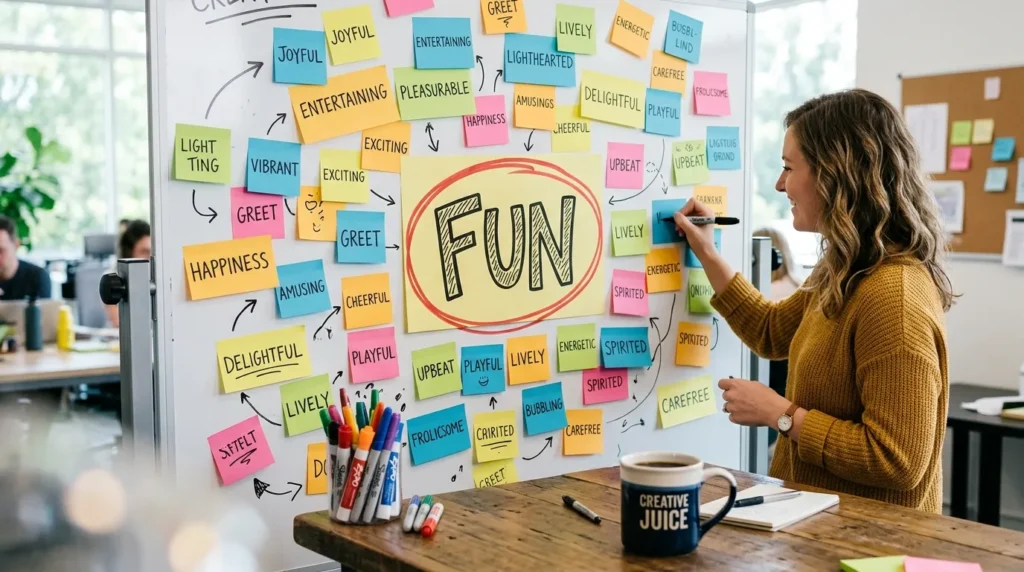
Enjoyment, pleasure, amusement, delight, entertainment, excitement, recreation, and joy are useful synonyms for fun, each fitting a slightly different situation.
Fun is a common English word for something that gives us pleasure, enjoyment, or amusement. Imagine a family spending an evening at a park. The children play games, the parents laugh together, and everyone enjoys the time. Someone might simply say, “We had so much fun!” The word is popular because it is short, friendly, and easy to use in daily conversations.
However, using the same word again and again can make your English less varied. Learning synonyms for fun helps English learners express different kinds of enjoyment more clearly. It also helps students, bloggers, and content writers choose words that fit their exact meaning and tone. In this article, you will learn the meaning of fun, its synonyms, examples, grammar, history, pronunciation, word formation, and semantic categories.
Meaning of Fun
Definition
Fun (Noun/Adjective):
Fun means enjoyment, pleasure, or an activity that makes people feel happy and entertained.
Examples
- We had a lot of fun at the party.
- The children had fun playing outside.
Connotative Meaning
Connotation: The feeling or idea that a word suggests beyond its basic meaning.
- Positive tone: Fun usually suggests happiness, enjoyment, laughter, and pleasant experiences.
- Negative tone: In some contexts, fun can be negative when someone uses it to describe something unpleasant in a mocking way.
- Neutral tone: It can simply describe an enjoyable activity without a strong emotional message.
Etymology
The modern word fun developed from an older English word meaning amusement or enjoyment.
- Old English (450–1100): The modern noun fun did not exist in its present form. Related ideas were expressed through words connected with joy, pleasure, play, and amusement.
- Middle English (1100–1500): The word fun is believed to have developed from Middle English fon, meaning “to make a fool of” or “to be foolish.”
- Modern English (1500–Present): By the 18th century, fun was used for amusement, entertainment, and enjoyment. It later became common in expressions such as have fun and fun activity.
Pronunciation (IPA)
- IPA: /fʌn/
- Syllables: fun — 1 syllable
Affixation Pattern of Fun
- Root: fun
- Prefix: None
- Suffix: None
- Word formations:
- fun — noun/adjective
- funny — adjective
- funnier — adjective
- funniest — adjective
- funnily — adverb
- fun-filled — adjective
- fun-loving — adjective
- unfun — adjective, informal
22 Synonyms for Fun With Meaning & Examples
1. Enjoyment (Noun)
Meaning: The feeling of pleasure you get from something you like.
Examples:
- Reading gives me great enjoyment.
- The children found enjoyment in the simple game.
2. Pleasure (Noun)
Meaning: A feeling of happiness or satisfaction.
Examples:
- She gets great pleasure from gardening.
- It was a pleasure to spend the day with friends.
3. Amusement (Noun)
Meaning: Something that makes you laugh or feel entertained.
Examples:
- The show provided hours of amusement.
- The children watched the clown with amusement.
4. Entertainment (Noun)
Meaning: An activity or performance that gives people enjoyment.
Examples:
- The concert provided excellent entertainment.
- We watched a movie for entertainment.
5. Delight (Noun)
Meaning: A strong feeling of happiness and pleasure.
Examples:
- The children screamed with delight.
- The surprise brought her great delight.
6. Joy (Noun)
Meaning: A strong feeling of happiness.
Examples:
- The festival filled the town with joy.
- Spending time with family brings me joy.
7. Excitement (Noun)
Meaning: A strong feeling of happiness and energy about something.
Examples:
- The children could hardly hide their excitement.
- There was great excitement before the game.
8. Recreation (Noun)
Meaning: An activity done for enjoyment during free time.
Examples:
- Swimming is her favorite form of recreation.
- The park offers many recreation options.
9. Merriment (Noun)
Meaning: Lively happiness, laughter, and enjoyment.
Examples:
- The wedding was filled with merriment.
- Music and laughter added to the merriment.
10. Cheer (Noun)
Meaning: A feeling of happiness, hope, or positive energy.
Examples:
- The decorations brought cheer to the room.
- Her smile spread cheer among her friends.
11. Festivity (Noun)
Meaning: Enjoyment and celebration connected with a special event.
Examples:
- The streets were full of festivity.
- Music added to the holiday festivity.
12. Frolic (Noun/Verb)
Meaning: Playful and energetic activity, often involving movement.
Examples:
- The puppies enjoyed a playful frolic in the garden.
- The children frolicked on the beach.
13. Playfulness (Noun)
Meaning: A cheerful and lighthearted way of behaving.
Examples:
- Her playfulness made everyone smile.
- The child’s playfulness was infectious.
14. Laughter (Noun)
Meaning: The sound or act of laughing, often caused by something funny or enjoyable.
Examples:
- The room was filled with laughter.
- Their conversation ended in laughter.
15. Recreation (Noun)
Meaning: An enjoyable activity done during free time.
Examples:
- Hiking is a healthy form of recreation.
- The center provides recreation for young people.
16. Diversion (Noun)
Meaning: An activity that takes your attention away from work or worry.
Examples:
- The game was a welcome diversion.
- A short walk can be a pleasant diversion.
17. Good time (Noun Phrase)
Meaning: An enjoyable experience or period.
Examples:
- We had a good time at the picnic.
- Everyone had a good time at the party.
18. Enjoyable activity (Noun Phrase)
Meaning: Something pleasant that people do for enjoyment.
Examples:
- Painting can be an enjoyable activity.
- We planned an enjoyable activity for the children.
19. Pleasure (Noun)
Meaning: Something that gives happiness or satisfaction.
Examples:
- Music is a great pleasure for him.
- She takes pleasure in helping others.
20. Lightheartedness (Noun)
Meaning: A cheerful attitude without serious worry.
Examples:
- Her lightheartedness made the meeting more relaxed.
- The movie brought some lightheartedness to the evening.
21. Good humor (Noun Phrase)
Meaning: A cheerful and friendly mood.
Examples:
- He accepted the joke with good humor.
- Her good humor made everyone comfortable.
22. Recreation time (Noun Phrase)
Meaning: Free time used for relaxing and enjoyable activities.
Examples:
- Children need enough recreation time each day.
- We use the afternoon as recreation time.
Note: Not every synonym is an exact replacement for fun. Words such as joy describe a feeling, while recreation usually refers to an activity. Choose the word that matches your intended meaning.
Prototype Meaning
The most typical meaning of fun is an enjoyable experience or activity that makes people feel happy, relaxed, or entertained. When people hear the word fun, they often imagine laughing with friends, playing games, enjoying a trip, watching something entertaining, or taking part in a pleasant activity. The word usually has a positive and informal tone.
Prototype Categorization
The 22 alternatives can be grouped according to the type of enjoyment they express.
- General enjoyment: enjoyment, pleasure, good time, enjoyable activity — useful for ordinary situations where something feels pleasant.
- Happiness and emotion: delight, joy, cheer, excitement — useful when focusing on a person’s emotional response.
- Entertainment: amusement, entertainment, diversion — useful for shows, games, activities, or things that keep people interested.
- Free-time activities: recreation, recreation time — useful for hobbies, sports, and activities done during free time.
- Lively celebration: merriment, festivity, frolic — useful for parties, celebrations, playful activity, and energetic situations.
- Positive social mood: playfulness, laughter, lightheartedness, good humor — useful when describing a cheerful atmosphere or behavior.
This grouping helps writers select a word that gives the sentence the right meaning instead of using fun in every situation.
Antonyms of Fun
There is no single perfect antonym for fun, but these words can express the opposite idea.
1. Boredom (Noun)
Meaning: A feeling of having nothing interesting or enjoyable to do.
2. Sadness (Noun)
Meaning: A feeling of unhappiness.
3. Misery (Noun)
Meaning: Great unhappiness or suffering.
4. Seriousness (Noun)
Meaning: A state without playfulness or lighthearted behavior.
5. Tedium (Noun)
Meaning: The state of being boring because something is repetitive or dull.
Short Questions and Answers
What does fun mean?
Fun means enjoyment, pleasure, or an activity that makes people happy and entertained.
When should fun be used?
Use fun in casual and everyday English when talking about enjoyable experiences, activities, or situations.
Is fun positive or negative?
Fun is normally positive because it suggests enjoyment and happiness. Its meaning can change slightly depending on context.
How is it different from similar words?
Fun is a broad and informal word. Joy describes a strong feeling of happiness, amusement often involves entertainment or laughter, and recreation usually means an activity done during free time.
Conclusion
Learning synonyms for fun gives English learners more ways to express enjoyment and happiness. Although fun is simple and useful, words such as enjoyment, pleasure, amusement, delight, joy, excitement, recreation, and merriment can add more detail to your writing and speech. The best synonym depends on the situation. For example, joy works well for a strong feeling, while recreation is better for a free-time activity.
Using the right word can also prevent repetition and make your writing sound more natural. Students, bloggers, and content writers can improve their vocabulary by learning a few synonyms each day and creating their own sentences. With regular practice, these small vocabulary choices can build stronger English skills and greater confidence.
Read More:Pretty Synonyms: 25 Beautiful Alternatives to Use

Author Bio
I am Sajjad Ali, an English language writer specializing in synonyms, word meanings, and practical English usage.
I use my expertise in English vocabulary and word choice to create simple, accurate, and helpful content for learners and readers.