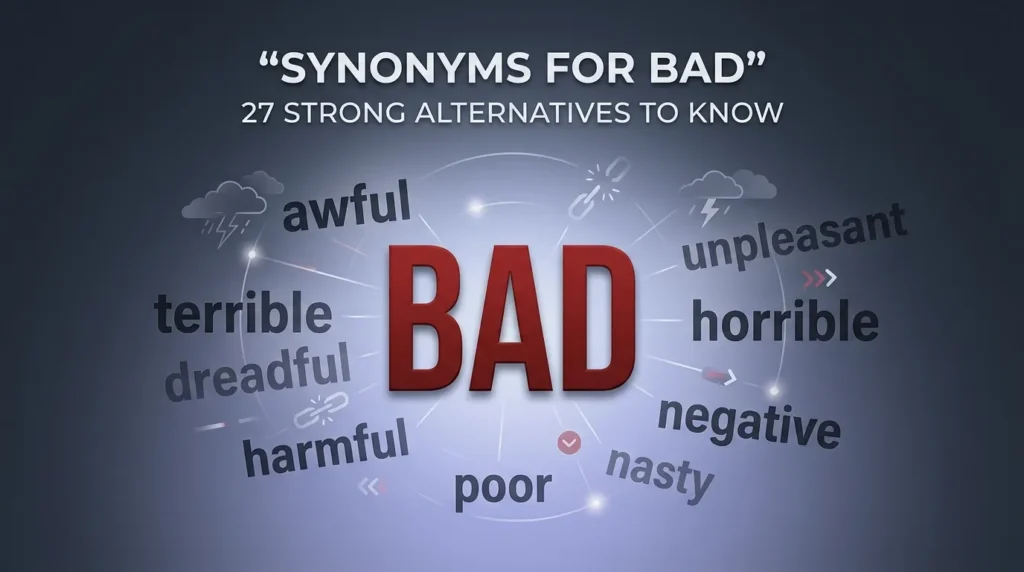
Alternatives to bad include awful, poor, terrible, harmful, unpleasant, negative, wicked, evil, nasty, dreadful, horrible, inferior, faulty, defective, damaging, and undesirable.
Imagine ordering your favorite meal at a restaurant and taking the first bite. The food is cold, tasteless, and nothing like you expected. You might quickly say, “This food is bad.” The word bad is simple, common, and useful, but it can describe many different situations. A bad meal can mean poor quality, while a bad decision can mean unwise, and a bad person can suggest harmful or immoral behavior.
This wide range of meanings makes bad an important English word to understand. Learning its synonyms helps English learners choose more exact words for different situations. It also helps writers avoid repetition and make their descriptions stronger. In this article, we will explore the meaning, history, pronunciation, word formation, 27 synonyms, examples, semantic categories, antonyms, and common uses of bad.
Meaning of Bad
Definition
Bad (Adjective):
Bad means unpleasant, harmful, poor in quality, unsuccessful, or morally wrong.
Examples
- The weather was bad yesterday.
- He made a bad decision.
Connotative Meaning
Connotation: the feelings or ideas that a word suggests beyond its basic meaning.
- Positive tone: Bad normally does not carry a positive tone, although it can be used humorously or playfully in some expressions.
- Negative tone: It commonly suggests poor quality, harm, failure, danger, or wrongdoing.
- Neutral tone: In some contexts, it simply describes something that does not meet an expected standard.
Etymology
The history of bad is unusual because its exact origin is not completely certain.
- Old English (450 to 1100): The modern form bad was not common in Old English. Other words such as yfel were used to express the idea of something evil or wrong.
- Middle English (1100 to 1500): Forms such as badde and bad began appearing in English. The word gradually became associated with something poor, defective, or undesirable.
- Modern English (1500 to Present): Bad developed into one of the most flexible negative words in English. It can describe quality, behavior, health, weather, situations, decisions, and results.
The exact origin of the Middle English word remains uncertain, although several possible Germanic connections have been suggested.
Pronunciation (IPA)
- IPA: /bæd/
- Syllables: bad
Affixation Pattern of Bad
- Root: bad
- Prefix: None
- Suffix: None
- Word formations:
- bad: adjective
- badly: adverb
- badness: noun
- worse: comparative form
- worst: superlative form
- bad-tempered: adjective
- badly behaved: adjective phrase
The basic word bad does not contain a productive prefix or suffix. However, related forms can be created through inflection and derivation.
27 Synonyms of Bad With Meaning & Examples
1. Awful (Adjective)
Meaning: Extremely unpleasant, poor, or bad.
Examples:
- The weather was awful yesterday.
- We had an awful experience at the hotel.
2. Poor (Adjective)
Meaning: Low in quality, ability, or standard.
Examples:
- The report received a poor grade.
- The road is in poor condition.
3. Terrible (Adjective)
Meaning: Extremely bad, unpleasant, or serious.
Examples:
- We heard some terrible news.
- The traffic was terrible this morning.
4. Harmful (Adjective)
Meaning: Causing damage, injury, or negative effects.
Examples:
- Too much sugar can be harmful.
- Smoking is harmful to health.
5. Unpleasant (Adjective)
Meaning: Not enjoyable, comfortable, or agreeable.
Examples:
- We had an unpleasant conversation.
- There was an unpleasant smell in the room.
6. Negative (Adjective)
Meaning: Showing an unfavorable, harmful, or pessimistic quality.
Examples:
- His negative attitude affected the team.
- The decision had negative effects.
7. Wicked (Adjective)
Meaning: Morally very bad or deliberately harmful.
Examples:
- The story features a wicked king.
- The villain had a wicked plan.
8. Evil (Adjective)
Meaning: Extremely immoral or harmful.
Examples:
- The story describes an evil character.
- The villain was known for his evil actions.
9. Nasty (Adjective)
Meaning: Very unpleasant, unkind, or offensive.
Examples:
- He made a nasty comment.
- There was a nasty smell in the kitchen.
10. Dreadful (Adjective)
Meaning: Extremely bad or unpleasant.
Examples:
- The service at the restaurant was dreadful.
- We had dreadful weather all weekend.
11. Horrible (Adjective)
Meaning: Extremely unpleasant, frightening, or bad.
Examples:
- It was a horrible experience.
- The accident caused horrible injuries.
12. Inferior (Adjective)
Meaning: Lower in quality or value than something else.
Examples:
- This material is inferior to the original.
- The cheaper product was clearly inferior.
13. Faulty (Adjective)
Meaning: Not working correctly because of a defect or mistake.
Examples:
- The mechanic found a faulty wire.
- The machine stopped because of a faulty part.
14. Defective (Adjective)
Meaning: Having a fault that prevents something from working properly.
Examples:
- The company replaced the defective product.
- The device was defective when we received it.
15. Damaging (Adjective)
Meaning: Causing harm or negative effects.
Examples:
- The rumor was damaging to her reputation.
- The storm had a damaging effect on crops.
16. Undesirable (Adjective)
Meaning: Not wanted, suitable, or acceptable.
Examples:
- The policy may have undesirable results.
- Loud noise is an undesirable problem in the area.
17. Atrocious (Adjective)
Meaning: Extremely bad or unacceptable.
Examples:
- The service was atrocious.
- The team made an atrocious mistake.
18. Deplorable (Adjective)
Meaning: Shockingly bad or deserving strong criticism.
Examples:
- The living conditions were deplorable.
- His behavior was deplorable.
19. Disastrous (Adjective)
Meaning: Causing serious damage, failure, or harm.
Examples:
- The decision had disastrous consequences.
- The business suffered a disastrous loss.
20. Dire (Adjective)
Meaning: Extremely serious, urgent, or bad.
Examples:
- The country faces a dire situation.
- The company is in dire need of help.
21. Substandard (Adjective)
Meaning: Below the expected level of quality.
Examples:
- The building was made with substandard materials.
- Customers complained about substandard service.
22. Unacceptable (Adjective)
Meaning: Not good enough or not allowed according to a standard.
Examples:
- This behavior is unacceptable.
- The quality of the work was unacceptable.
23. Unsatisfactory (Adjective)
Meaning: Not good enough to meet expectations.
Examples:
- His performance was unsatisfactory.
- The final result was unsatisfactory.
24. Rotten (Adjective)
Meaning: Very bad, spoiled, or morally unpleasant.
Examples:
- The fruit was rotten.
- The story described a rotten system.
25. Vile (Adjective)
Meaning: Extremely unpleasant, offensive, or morally bad.
Examples:
- The criminal committed a vile act.
- The article contained vile language.
26. Corrupt (Adjective)
Meaning: Dishonest or morally wrong, especially when power or money is involved.
Examples:
- The official was accused of corrupt behavior.
- The investigation uncovered a corrupt system.
27. Pernicious (Adjective)
Meaning: Having a harmful effect that may develop gradually.
Examples:
- The habit can have pernicious effects.
- The misinformation had a pernicious influence on the community.
Prototype Meaning
The most typical meaning of bad is something that is not good, desirable, acceptable, or satisfactory. When people hear bad, they often imagine something unpleasant or below an expected standard. However, the exact meaning depends on context. A bad meal may be poor in quality, a bad person may behave immorally, a bad decision may be unwise, and bad weather may simply mean unpleasant weather. This flexibility makes bad one of the most frequently used negative words in English.
Prototype Categorization
The 27 synonyms of bad can be divided into semantic groups. This helps writers choose the word that best matches the exact type of problem.
- General negative quality: awful, terrible, horrible, dreadful, poor describe something that is simply very bad or unpleasant.
- Harm and damage: harmful, damaging, pernicious, disastrous focus on negative effects or serious consequences.
- Moral wrongdoing: wicked, evil, vile, corrupt, deplorable describe immoral, dishonest, or deeply wrong behavior.
- Low quality: inferior, faulty, defective, substandard, unsatisfactory are useful for products, services, work, or performance.
- Unpleasant experiences: unpleasant, nasty, dreadful, horrible describe experiences, feelings, smells, behavior, or situations that are difficult to enjoy.
- Serious or urgent problems: dire, disastrous, unacceptable emphasize serious conditions, consequences, or failures.
- Unwanted results: undesirable, negative, damaging describe outcomes or effects that people do not want.
Understanding these groups helps you replace bad with a more exact word instead of choosing a synonym that does not fit the situation.
Antonyms of Bad
Good (Adjective)
Meaning: Having positive quality, value, or moral character.
Excellent (Adjective)
Meaning: Extremely good or of very high quality.
Beneficial (Adjective)
Meaning: Producing a helpful or positive result.
Pleasant (Adjective)
Meaning: Enjoyable, comfortable, or agreeable.
Favorable (Adjective)
Meaning: Positive or likely to produce a good result.
Virtuous (Adjective)
Meaning: Morally good and guided by strong principles.
Effective (Adjective)
Meaning: Successful in producing the desired result.
Short Questions and Answers
What does bad mean?
Bad means unpleasant, harmful, poor in quality, unsuccessful, or morally wrong.
When should bad be used?
Use bad when describing something negative, poor, harmful, unpleasant, or below an expected standard.
Is bad positive or negative?
Bad is normally a negative word. It describes something that is undesirable, harmful, poor, or wrong.
How is it different from similar words?
Bad is a broad word. Poor focuses on low quality, harmful focuses on damage, evil focuses on serious moral wrongdoing, and faulty usually describes something that does not work correctly.
Conclusion
Learning synonyms for bad helps you describe negative situations with greater accuracy. Instead of using bad for every problem, you can choose poor for low quality, harmful for something that causes damage, faulty for a product that does not work correctly, or wicked for serious moral wrongdoing. Stronger words such as atrocious, disastrous, and deplorable can express a much more serious level of negativity.
The key is to understand the small difference between each word before using it. Start by learning a few common alternatives and practice them in your daily conversations and writing. Over time, these words will become easier to remember and use naturally. A wider vocabulary helps you communicate clearly, avoid repetition, and express exactly what you mean.

Hi, I’m Anaya. Words that look almost identical but mean completely different things have always fascinated me, that’s what pulled me toward writing about spelling and usage. I focus on digging into where these mix-ups actually come from, whether it’s a British-American split or just a rule English never bothered to make consistent. My goal with every guide is simple: give you the answer fast, then explain it well enough that you never have to look it up again.