
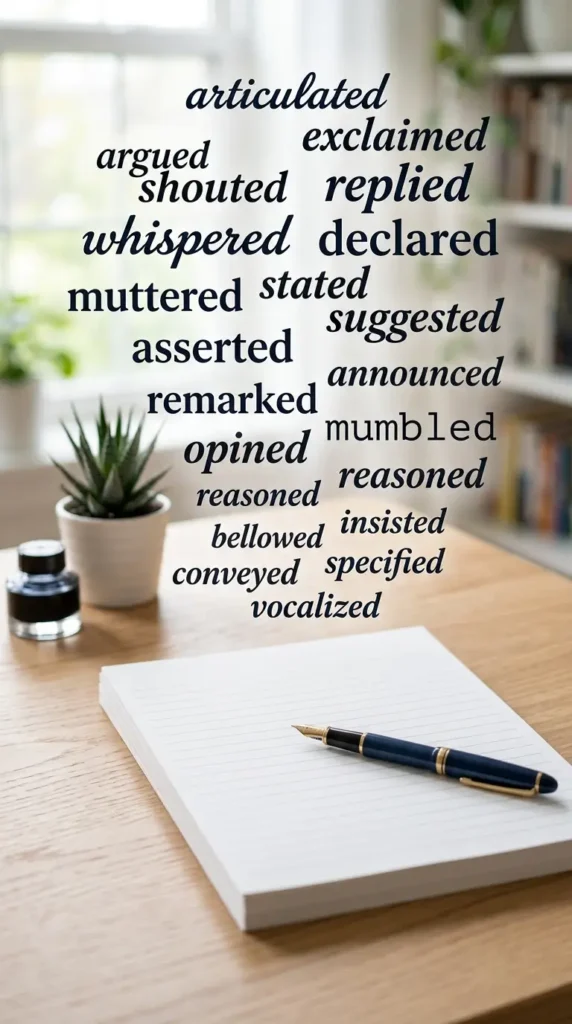

States, tells, mentions, explains, remarks, comments, declares, claims, notes, and announces are useful alternatives to says, depending on the context.
Introduction
Says is the third-person singular form of say, one of the most common verbs in English. We use it whenever we report someone’s words, opinion, or message. Imagine a teacher explaining a new lesson to her students. After giving an example, she says, “Practice makes progress.” The word is simple and natural, but repeating it many times can make a story, essay, or article feel dull.
Learning synonyms for says helps writers show exactly how a person communicates. For example, a speaker may whisper something quietly, declare an idea strongly, or explain something clearly. These alternatives are useful for English learners, students, journalists, bloggers, and content writers. In this article, you will learn the meaning of says, its history, pronunciation, word formation, 26 useful synonyms, examples, semantic categories, antonyms, and practical usage tips.
Meaning of Says
Definition
Says (Verb):
Says means expresses words, thoughts, information, or opinions through speaking or writing.
Examples
- She says that she will arrive tomorrow.
- The teacher says the answer is correct.
Connotative Meaning
Connotation: The feeling or idea that a word suggests beyond its basic meaning.
- Positive tone: Says can sound clear, calm, and neutral.
- Negative tone: In some contexts, it may sound doubtful or dismissive, especially in phrases such as “He says so.”
- Neutral tone: It usually simply reports what someone communicates without showing how they feel.
Etymology
The word says comes from the very old English verb say.
- Old English (450–1100): Secgan meant “to say, tell, or relate.”
- Middle English (1100–1500): The verb developed into forms such as seien, seyn, and sayen.
- Modern English (1500–Present): Say became the standard form, while says developed as its third-person singular present-tense form.
Pronunciation (IPA)
- IPA: /sez/
- Syllables: says — 1 syllable
Pronunciation note: Although says is spelled with an ay, it is pronounced /sez/, like “sez.”
Affixation Pattern of Says
- Root: say
- Prefix: None
- Suffix: -s — marks third-person singular present tense
- Word formations:
- say — verb
- says — verb
- said — past tense/past participle
- saying — present participle/gerund
- sayable — adjective
- unsay — verb
- saying — noun/adjective in some contexts
26 Synonyms of Says With Meaning & Examples
1. States (Verb)
Meaning: Expresses information, an opinion, or a fact clearly.
Examples:
- The report states that sales have increased.
- She states her opinion clearly.
2. Tells (Verb)
Meaning: Gives information to someone through speech or writing.
Examples:
- He tells me everything.
- She tells her children a story.
3. Mentions (Verb)
Meaning: Refers to something briefly without giving many details.
Examples:
- She mentions your name in the article.
- He mentions that the meeting starts at nine.
4. Explains (Verb)
Meaning: Makes an idea or situation clear by giving details.
Examples:
- The teacher explains the lesson.
- She explains why she was late.
5. Remarks (Verb)
Meaning: Makes a comment or short observation.
Examples:
- He remarks that the weather is unusually cold.
- She remarks on the beautiful view.
6. Comments (Verb)
Meaning: Gives an opinion or observation about something.
Examples:
- The writer comments on the current situation.
- She comments that the plan needs more work.
7. Declares (Verb)
Meaning: Says something clearly and firmly, often in public.
Examples:
- The leader declares that the project is complete.
- She declares her support for the proposal.
8. Announces (Verb)
Meaning: Gives information publicly or officially.
Examples:
- The company announces a new product.
- The school announces the exam results.
9. Claims (Verb)
Meaning: Says that something is true, especially when it may not be proven.
Examples:
- He claims that he saw the accident.
- The company claims that its product is safer.
10. Notes (Verb)
Meaning: Points out or mentions something important.
Examples:
- The report notes several important changes.
- She notes that prices have increased.
11. Observes (Verb)
Meaning: Makes a thoughtful comment based on what has been noticed.
Examples:
- The professor observes that the results are unusual.
- She observes that everyone looks tired.
12. Argues (Verb)
Meaning: Gives reasons to support an opinion or position.
Examples:
- The writer argues that education should be free.
- He argues that the plan will save money.
13. Asserts (Verb)
Meaning: States something confidently and strongly.
Examples:
- She asserts that the decision was correct.
- The lawyer asserts that his client is innocent.
14. Suggests (Verb)
Meaning: Gives an idea or indicates something without stating it directly.
Examples:
- The evidence suggests that the plan worked.
- She suggests taking a different route.
15. Indicates (Verb)
Meaning: Shows or communicates information about something.
Examples:
- The report indicates a rise in demand.
- His expression indicates that he is worried.
16. Expresses (Verb)
Meaning: Communicates a thought, feeling, or opinion.
Examples:
- She expresses her concern about the problem.
- He expresses strong support for the idea.
17. Reports (Verb)
Meaning: Gives information about something that happened or was discovered.
Examples:
- The newspaper reports that the event was successful.
- She reports the results to her manager.
18. Reveals (Verb)
Meaning: Gives information that was previously unknown or hidden.
Examples:
- The study reveals an important fact.
- He reveals the truth in the final chapter.
19. Adds (Verb)
Meaning: Gives additional information after something has already been said.
Examples:
- She adds that the meeting has been postponed.
- He adds a few more details.
20. Replies (Verb)
Meaning: Gives an answer after someone has spoken or asked a question.
Examples:
- She replies that she is ready.
- He replies with a smile.
21. Responds (Verb)
Meaning: Answers or reacts to something that another person has said or done.
Examples:
- She responds that she understands.
- He responds politely to the question.
22. Answers (Verb)
Meaning: Gives a response to a question.
Examples:
- She answers that she does not know.
- He answers the question confidently.
23. Whispers (Verb)
Meaning: Speaks very quietly.
Examples:
- She whispers that someone is outside.
- He whispers the answer to his friend.
24. Shouts (Verb)
Meaning: Speaks very loudly, often because of anger, excitement, or distance.
Examples:
- He shouts that the door is open.
- She shouts for help.
25. Exclaims (Verb)
Meaning: Says something suddenly and with strong emotion.
Examples:
- She exclaims that the view is amazing.
- He exclaims in surprise when he sees the gift.
26. Admits (Verb)
Meaning: Says that something is true, especially something that may be difficult to accept.
Examples:
- He admits that he made a mistake.
- She admits that the task was difficult.
Note: These synonyms are not interchangeable in every sentence. States is formal and neutral, whispers describes a quiet voice, shouts describes a loud voice, claims can suggest doubt, and admits often introduces something the speaker was reluctant to accept.
Prototype Meaning
The most typical meaning of says is expresses something through words. When people hear says, they usually imagine a person communicating an idea, fact, opinion, or message. It is a neutral reporting verb, which makes it useful in everyday conversations, stories, news reports, essays, and articles.
Prototype Categorization
The 26 synonyms can be grouped into meaningful semantic categories:
- General communication: states, tells, mentions, comments, remarks, notes — useful for ordinary speech and writing.
- Explanation and information: explains, reports, reveals, indicates, expresses — useful when someone provides information or makes something clear.
- Strong statements: declares, asserts, claims, argues — useful when a speaker presents an opinion or position with confidence.
- Suggestions and observations: suggests, observes — useful when someone gives an idea or makes an observation.
- Responses: replies, responds, answers — useful when someone reacts to a question or previous statement.
- Voice and emotion: whispers, shouts, exclaims — useful when you want to show how something was spoken.
- Personal admission: admits — useful when someone accepts that something is true, often reluctantly.
- Additional information: adds — useful when a speaker gives another detail after making a statement.
This categorization helps writers choose a verb that shows what was communicated and how it was communicated, rather than repeatedly using says.
Antonyms of Says
There is no single exact antonym for says, because the opposite depends on the context. However, these verbs can express a lack of communication:
1. Hides (Verb)
Meaning: Keeps information secret instead of communicating it.
2. Conceals (Verb)
Meaning: Deliberately keeps something from being known.
3. Withholds (Verb)
Meaning: Refuses to give information or reveal something.
4. Silences (Verb)
Meaning: Prevents someone from speaking.
5. Denies (Verb)
Meaning: Says that something is not true.
6. Suppresses (Verb)
Meaning: Prevents information or expression from being communicated or made public.
Short Questions and Answers
What does says mean?
Says means communicates or expresses something through spoken or written words.
When should says be used?
Use says as a neutral reporting verb when describing what a person communicates. It is suitable for both everyday and formal English.
Is says positive or negative?
Says is usually neutral. Its emotional meaning comes from the words being spoken and the surrounding context.
How is it different from similar words?
Says is neutral and general. Claims may suggest doubt, states sounds more formal, explains gives details, whispers shows a quiet voice, and declares suggests a strong public statement.
Conclusion
Learning synonyms for says can make your English writing more natural, precise, and interesting. Although says is a simple and useful reporting verb, using different alternatives can show the speaker’s purpose, emotion, confidence, and manner of speaking. Words such as states, explains, mentions, remarks, declares, claims, suggests, reports, replies, whispers, shouts, and admits each add a different shade of meaning.
This is especially helpful for English learners, students, storytellers, journalists, bloggers, and content writers. However, choosing a synonym should depend on the context. Do not replace says simply to avoid repetition if the alternative changes the meaning. Read English regularly, notice how reporting verbs are used, and practice putting new words into your own sentences. A few minutes of daily vocabulary practice can gradually improve your writing, speaking, and confidence.
Synonyms for Explorer: 24 Words and Alternatives.