
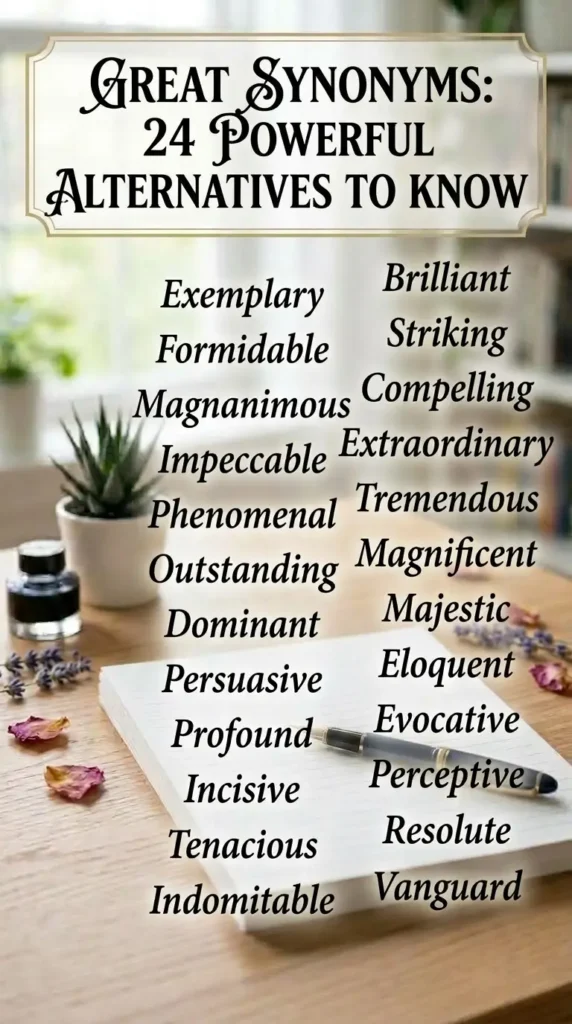

Excellent, amazing, wonderful, fantastic, superb, outstanding, remarkable, impressive, magnificent, and exceptional are useful synonyms for great, depending on the context.
Introduction
Great is one of the most useful and common words in English. We use it to describe something excellent, impressive, important, large, or enjoyable. Imagine a student receiving a high score after working hard for weeks. Her teacher might say, “You did a great job!” The same word can describe a movie, meal, achievement, person, idea, or experience. Because great has so many meanings, choosing the right synonym depends on what you want to express.
For example, excellent focuses on quality, magnificent suggests impressive beauty, and remarkable highlights something unusual or worthy of attention. Learning these alternatives helps English learners build stronger vocabulary and helps writers avoid repeating the same word. This article explores the meaning, history, pronunciation, grammar, 24 synonyms, examples, semantic categories, antonyms, and common uses of great.
Meaning of Great
Definition
Great (Adjective/Noun/Adverb):
Great means very good, excellent, impressive, important, large, or remarkable, depending on the context.
Examples
- She did a great job on the project.
- We had a great time at the party.
Connotative Meaning
Connotation: The feeling or idea that a word suggests beyond its basic meaning.
- Positive tone: Great often suggests excellence, success, admiration, or enjoyment.
- Negative tone: It can sometimes be used sarcastically, such as “Great, another problem.”
- Neutral tone: It can describe something large or important without expressing strong emotion.
Etymology
The word great has ancient Germanic roots.
- Old English (450–1100): Grēat meant “big, thick, coarse, or large.”
- Middle English (1100–1500): Great continued to mean large in size and gradually developed meanings connected with importance, power, and high status.
- Modern English (1500–Present): The word expanded further and came to describe excellence, achievement, importance, intensity, and admiration.
Pronunciation (IPA)
- IPA: /ɡreɪt/
- Syllables: great — 1 syllable
Affixation Pattern of Great
- Root: great
- Prefix: None
- Suffix: None in the basic word
- Word formations:
- great — adjective/noun/adverb
- greater — comparative adjective
- greatest — superlative adjective
- greatness — noun
- greatly — adverb
24 Synonyms of Great With Meaning & Examples
1. Excellent (Adjective)
Meaning: Extremely good in quality or performance.
Examples:
- She did an excellent job.
- The restaurant offers excellent food.
2. Amazing (Adjective)
Meaning: Extremely impressive or surprising.
Examples:
- The view was amazing.
- She gave an amazing performance.
3. Wonderful (Adjective)
Meaning: Very pleasant, enjoyable, or excellent.
Examples:
- We had a wonderful evening.
- She is a wonderful teacher.
4. Fantastic (Adjective)
Meaning: Extremely good, impressive, or enjoyable.
Examples:
- The concert was fantastic.
- You did a fantastic job.
5. Superb (Adjective)
Meaning: Extremely excellent or high in quality.
Examples:
- The hotel provides superb service.
- His performance was superb.
6. Outstanding (Adjective)
Meaning: Exceptionally good and better than others.
Examples:
- She received an award for her outstanding work.
- He is an outstanding athlete.
7. Remarkable (Adjective)
Meaning: Unusual or impressive enough to deserve attention.
Examples:
- She made remarkable progress.
- His memory is remarkable.
8. Impressive (Adjective)
Meaning: Causing admiration because of quality, skill, or achievement.
Examples:
- The building is impressive.
- She gave an impressive presentation.
9. Magnificent (Adjective)
Meaning: Extremely beautiful, impressive, or grand.
Examples:
- The palace was magnificent.
- We enjoyed a magnificent view.
10. Exceptional (Adjective)
Meaning: Much better than usual or ordinary.
Examples:
- She is an exceptional student.
- The restaurant offers exceptional service.
11. Superb (Adjective)
Meaning: Of very high quality or excellence.
Examples:
- The meal was superb.
- He delivered a superb performance.
12. Terrific (Adjective)
Meaning: Extremely good or enjoyable.
Examples:
- We had a terrific time.
- That is a terrific idea.
13. Brilliant (Adjective)
Meaning: Extremely clever, impressive, or excellent.
Examples:
- That was a brilliant idea.
- She gave a brilliant performance.
14. Marvelous (Adjective)
Meaning: Extremely good, enjoyable, or impressive.
Examples:
- We had a marvelous holiday.
- The food was marvelous.
15. Phenomenal (Adjective)
Meaning: Extremely impressive or extraordinary.
Examples:
- The athlete had a phenomenal season.
- Her progress has been phenomenal.
16. Extraordinary (Adjective)
Meaning: Very unusual, special, or impressive.
Examples:
- He showed extraordinary courage.
- The results were extraordinary.
17. Notable (Adjective)
Meaning: Worth noticing because of importance or quality.
Examples:
- The project achieved notable success.
- She made a notable contribution.
18. Glorious (Adjective)
Meaning: Wonderful, beautiful, or deserving admiration.
Examples:
- It was a glorious summer morning.
- They celebrated a glorious victory.
19. Splendid (Adjective)
Meaning: Very good, beautiful, or impressive.
Examples:
- She looked splendid in her new dress.
- We had a splendid meal.
20. First-rate (Adjective)
Meaning: Of the highest quality.
Examples:
- The hotel provides first-rate service.
- They hired a first-rate designer.
21. Top-notch (Adjective)
Meaning: Excellent and of very high quality.
Examples:
- The company provides top-notch support.
- We received top-notch service.
22. Superior (Adjective)
Meaning: Better in quality, ability, or value than something else.
Examples:
- This product has superior quality.
- The new system offers superior performance.
23. Prime (Adjective)
Meaning: Of the best or most important quality or condition.
Examples:
- This is a prime location.
- They used prime materials.
24. First-class (Adjective)
Meaning: Extremely good or of the highest quality.
Examples:
- The hotel offers first-class facilities.
- She received first-class training.
Note: These synonyms do not have exactly the same meaning in every situation. Excellent focuses on quality, remarkable highlights something unusual, magnificent suggests grandeur, superior involves comparison, and first-rate describes very high quality.
Prototype Meaning
The most typical meaning of great is very good, impressive, or excellent. When people hear the word in everyday conversation, they often think of something that deserves praise or admiration. For example, a great movie is highly enjoyable, a great teacher is highly effective, and a great achievement is something impressive or important.
Prototype Categorization
The 24 synonyms can be grouped into useful semantic categories:
- General excellence: excellent, wonderful, fantastic, terrific, marvelous, splendid — useful for describing something very good or enjoyable.
- Exceptional quality: superb, outstanding, exceptional, first-rate, top-notch, first-class — useful when something is far above average.
- Impressive or unusual: amazing, remarkable, impressive, phenomenal, extraordinary — useful when something attracts attention or admiration.
- Beauty and grandeur: magnificent, glorious — useful for impressive places, events, achievements, and visual experiences.
- Intelligence and skill: brilliant — useful when describing clever ideas, performances, or people.
- Comparison and importance: superior, prime, notable — useful when emphasizing higher quality, importance, or status.
This grouping helps writers choose a synonym based on the exact meaning of great instead of replacing it randomly.
Antonyms of Great
1. Poor (Adjective)
Meaning: Low in quality or not good.
2. Terrible (Adjective)
Meaning: Extremely bad or unpleasant.
3. Awful (Adjective)
Meaning: Very bad or unpleasant.
4. Inferior (Adjective)
Meaning: Lower in quality or ability than something else.
5. Ordinary (Adjective)
Meaning: Normal and not especially impressive or unusual.
6. Mediocre (Adjective)
Meaning: Average or not very good.
Short Questions and Answers
What does great mean?
Great can mean very good, excellent, impressive, important, or large, depending on the context.
When should great be used?
Use great when you want to praise something, describe excellence, or express that something is important, impressive, or large.
Is great positive or negative?
Great is usually positive. However, it can be negative or sarcastic depending on the speaker’s tone and context.
How is it different from similar words?
Great is broad and flexible. Excellent focuses on quality, amazing suggests surprise, magnificent suggests grandeur, and superior usually compares one thing with another.
Conclusion
Learning synonyms for great can make your English more expressive and precise. Although great is an easy and useful word, alternatives such as excellent, amazing, wonderful, superb, outstanding, remarkable, impressive, magnificent, exceptional, and phenomenal allow you to express different shades of praise and importance. Some words are best for quality, while others describe beauty, achievement, skill, or something unusual. Understanding these differences is especially helpful for English learners, students, bloggers, and content writers.
It also helps you avoid unnecessary repetition and choose vocabulary that fits your exact meaning. Do not simply replace great with the most complicated word you can find. Choose the synonym that sounds natural and matches your context. Practice a few new words each day, use them in sentences, and notice how they appear in real English. Regular vocabulary practice will strengthen your writing and speaking skills.
Good Synonyms: 25 Powerful Words for Better English.